Eico HF-50: The Pioneer of DIY Stereo Amplification
In the early 1950s, when high-fidelity audio was still in its infancy and stereo reproduction was little more than a laboratory curiosity, Eico—a name synonymous with accessible electronics—introduced the HF-50, one of the first commercially available stereo vacuum tube amplifier kits designed for the do-it-yourself (DIY) enthusiast. While not as widely recognized as later integrated receivers or commercial stereo amplifiers, the Eico HF-50 holds a unique and important place in the history of home audio as a trailblazer in both stereo sound and the DIY electronics movement.
Manufactured by Electronic Instrument Corporation (Eico) of Long Island City, New York, the HF-50 was introduced in 1952—a time when most home audio systems were monophonic, and stereo broadcasting and recording were still years away. The HF-50 wasn’t just an amplifier; it was a bold statement about the future of sound reproduction. It offered two complete, matched stereo amplifier channels in a single chassis, allowing audiophiles and tinkerers alike to experiment with true stereo playback long before it became mainstream.
Technical Specifications
The Eico HF-50 was designed as a high-fidelity stereo amplifier kit, meaning buyers received all components, chassis, tubes, and detailed assembly instructions, but had to build it themselves. This was standard for Eico, which built its reputation on high-quality, affordable kits for hobbyists and technicians.
| Specification | Detail |
| Manufacturer | Eico (Electronic Instrument Corp.) |
| Model | HF-50 |
| Year Introduced | 1952 |
| Type | Stereo vacuum tube amplifier (kit) |
| Channels | 2 (dual mono, fully independent) |
| Output Power | 12 watts per channel (RMS) |
| Output Impedance | 4Ω, 8Ω, 16Ω taps |
| Frequency Response | 20 Hz – 20 kHz (±1 dB) |
| Total Harmonic Distortion | Less than 0.5% at full power |
| Input Sensitivity | 0.3 volts for full output |
| Input Impedance | 1 megohm |
| Tubes (per channel) | 2 x 6SC7 (preamp), 1 x 6SN7 (phase inverter), 2 x 6L6GC (output) |
| Power Supply | Full-wave rectifier with choke input filter (5Y3GT tube) |
| Dimensions | Approx. 19" W × 7" H × 10" D |
| Weight | ~25 lbs (without tubes) |
| Assembly Time | Estimated 25–30 hours |
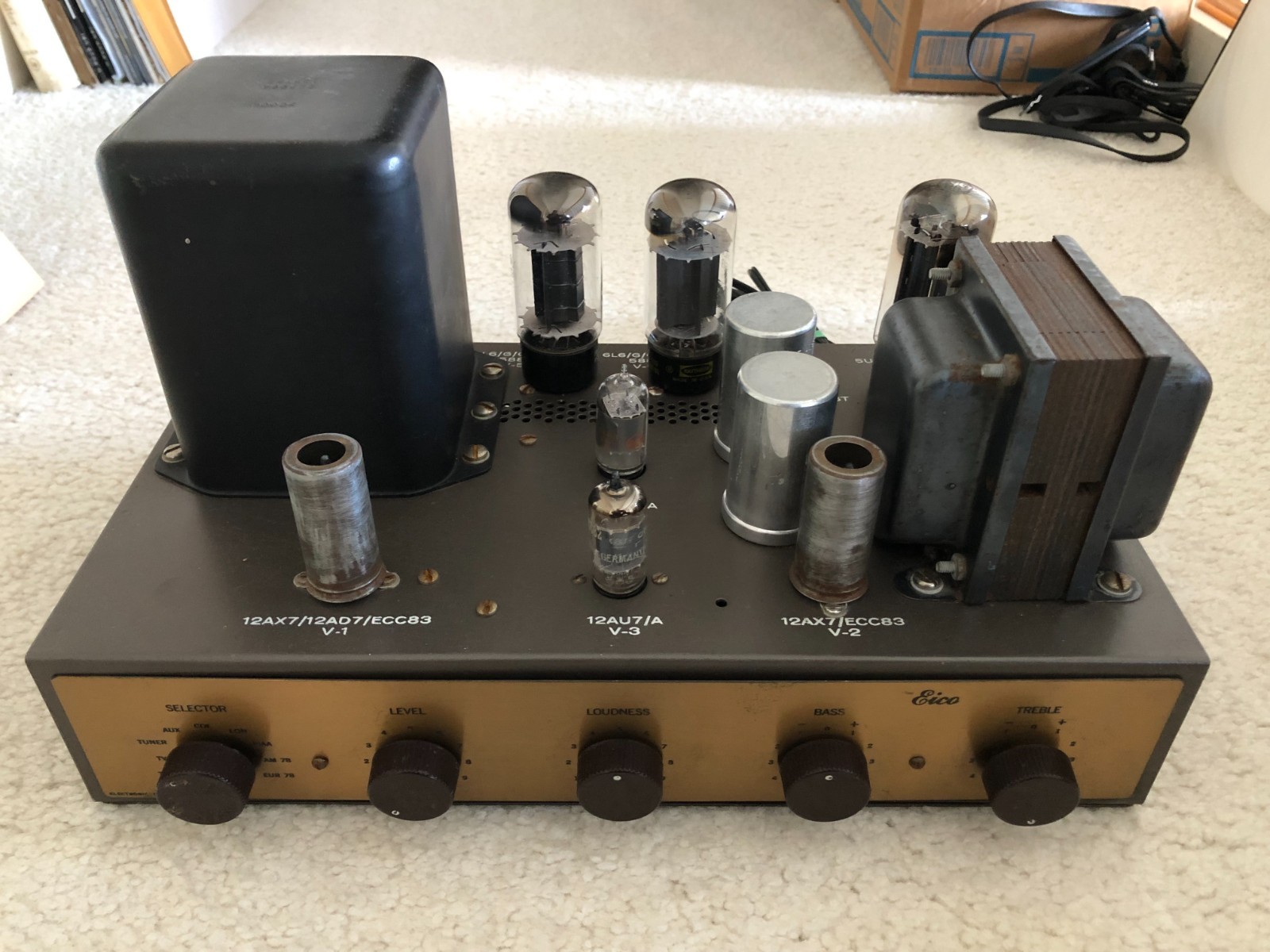
The HF-50 used a push-pull Class AB design with dual 6L6GC output tubes per stereo channel, delivering a clean 12 watts per channel—impressive for its time and sufficient to drive the high-efficiency speakers of the era. Its wide frequency response and low distortion were marketed as "true high fidelity," a term Eico helped popularize.
Sound Characteristics and Performance
Despite its age, the Eico HF-50 delivers a sound that many vintage audio enthusiasts still admire today. The dual 6L6GC output tubes produce a warm, rich midrange with a smooth high-frequency roll-off—typical of well-designed tube amplifiers of the era. Bass response is tight and controlled, thanks to the robust power supply and careful transformer design.
Because the HF-50 features fully independent stereo channels—each with its own preamp, phase inverter, and output stage—channel separation is excellent for its time, contributing to a spacious and immersive soundstage. This was revolutionary in 1952, when most "stereo" systems were merely dual mono setups with minimal isolation.
When paired with vintage high-efficiency speakers like Altec Lansing, JBL, or Klipsch models, the HF-50 can produce a surprisingly dynamic and engaging listening experience. Its low feedback design and point-to-point wiring contribute to a natural, organic sound that many modern solid-state amplifiers struggle to replicate.
Notable Features and Innovations
The Eico HF-50 was packed with features that were advanced for a kit amplifier:
- True Stereo Design: Unlike many "stereo" amplifiers of the late 1950s that simply duplicated circuits, the HF-50 was engineered from the ground up for stereo, with matched components and symmetrical layout.
- High-Fidelity Engineering: Eico emphasized low distortion, wide frequency response, and excellent transient response—hallmarks of the emerging hi-fi movement.
- Comprehensive Manual: The HF-50 came with a detailed instruction manual that not only guided assembly but also taught electronics theory, troubleshooting, and alignment techniques. This educational aspect helped train a generation of technicians and audiophiles.
- Modular Construction: The chassis was designed for easy access, with terminal strips and clearly labeled sections, making both assembly and future servicing straightforward.
- Upgrade-Friendly Design: Many owners later upgraded tubes (e.g., using 5881s instead of 6L6GCs) or improved capacitors and resistors to enhance performance.
Common Issues and Maintenance
As with any 70-year-old electronic equipment, the Eico HF-50 requires careful restoration before safe and reliable operation. Common issues include:
- Aging Capacitors: Electrolytic and paper capacitors degrade over time and should be replaced to prevent shorts or tube damage.
- Resistor Drift: Carbon composition resistors may have drifted in value, affecting bias and performance.
- Tube Wear: Original tubes are long past their lifespan; replacements (6SC7, 6SN7, 6L6GC, 5Y3GT) are readily available but should be tested for matching.
- Chassis Grounding: Poor grounding can cause hum; checking and cleaning ground points is essential.
- Power Transformer Health: While generally robust, old transformers should be tested for shorts or overheating.
Restoration is often part of the fun for HF-50 owners, as the kit nature of the amplifier makes it highly serviceable. Many vintage audio forums and Eico enthusiast groups offer schematics, restoration guides, and support.
Current Market Value and Collectibility
The Eico HF-50 is a rare and sought-after piece among vintage audio collectors, particularly those interested in the history of stereo sound and DIY electronics. Complete, unrestored kits in good condition can fetch $300–$600, while fully restored and functioning units—especially those with original manuals and packaging—can command $800–$1,200 or more.
Its value lies not just in performance, but in historical significance. The HF-50 represents a moment when stereo audio transitioned from theory to practice, and when average consumers could build cutting-edge technology at home. It's a favorite among museum curators, audio historians, and tube amplifier enthusiasts.
Conclusion and Legacy
The Eico HF-50 may not have achieved the fame of later stereo receivers or high-powered amplifiers, but its role in audio history is undeniable. As one of the first stereo amplifier kits available to the public, it empowered a generation of hobbyists to explore the future of sound. It combined affordability, educational value, and genuine high-fidelity performance in a way that few kits could match.
Today, the HF-50 stands as a testament to the ingenuity and optimism of early audio engineering. For collectors and restorers, it offers a rewarding project. For listeners, it delivers a warm, engaging sound that connects modern ears to the golden age of vacuum tubes. Whether admired as a historical artifact or enjoyed as a living piece of audio history, the Eico HF-50 remains a true pioneer of stereo sound—and a proud emblem of the DIY spirit that shaped the world of high-fidelity audio.
eBay Listings


As an eBay Partner, we earn from qualifying purchases. This helps support our independent vintage technology research.
Related Models
- Eico HF-61 (1956)
- Eico 2536 (1970)
- Eico 3150 (1967)
- Eico HF-12A (1957)
- Eico HF-14 (1952)
- Luxman L-530 (1975)
- Luxman R-404 (1975)
- Luxman RV-371 (1975)
- Luxman SQ-38U (1975)
- Luxman T-14 (1972)