Eico HF-22 High-Fidelity Amplifier: A Vintage Tube Classic
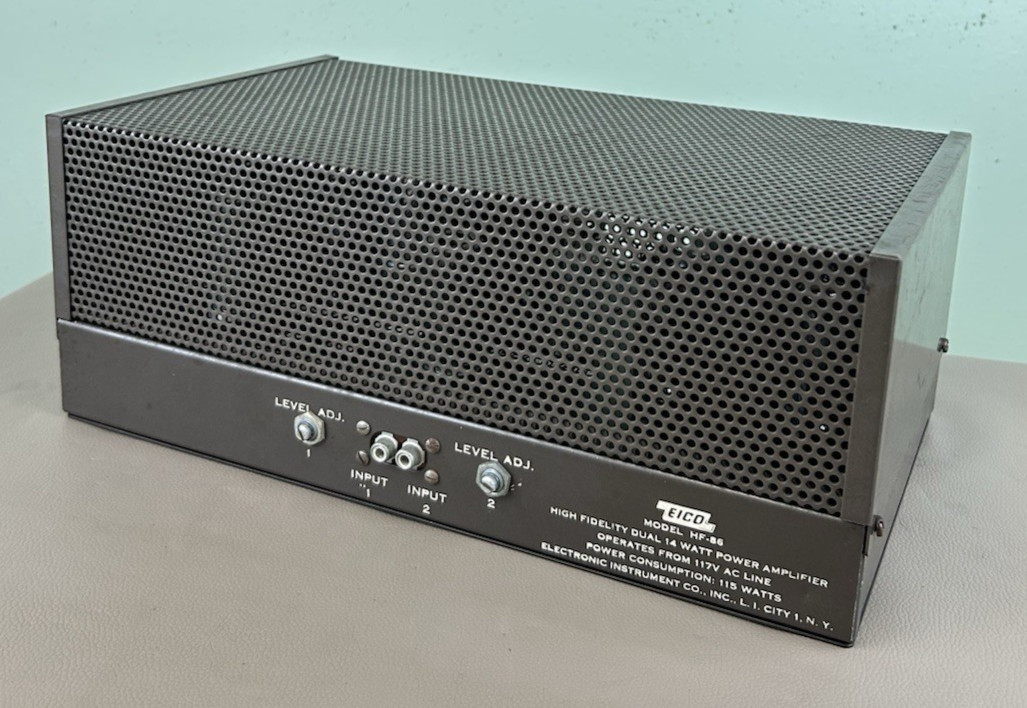
The Eico HF-22 stands as a notable milestone in the evolution of American high-fidelity audio equipment. Introduced in 1955 by Eico (Electronic Instrument Company), the HF-22 was one of the earliest stereo vacuum tube amplifiers available to the public—offered both as a kit for home assembly and in factory-assembled form. At a time when stereo broadcasting and recording were just beginning to emerge, the HF-22 gave serious audio enthusiasts an affordable and technically sound entry point into true stereo reproduction.
Eico, based in Long Island City, New York, was renowned throughout the 1950s and 1960s for producing high-quality electronic kits aimed at hobbyists, technicians, and audiophiles. The HF-22 was part of their push into the burgeoning hi-fi market, following the success of earlier test equipment and AM/FM tuners. Unlike mass-produced consoles of the era, the HF-22 represented a serious commitment to fidelity, transparency, and user engagement—especially for those who chose to build it themselves.
Technical Specifications
The Eico HF-22 was designed as a push-pull, class AB stereo amplifier using vacuum tube technology. It delivered 22 watts per channel, a respectable output for the time, especially when driving efficient speakers of the mid-century era. The amplifier was engineered with a focus on low distortion, wide frequency response, and excellent channel separation, all key metrics for high-fidelity reproduction.
| Specification | Detail |
| Manufacturer | Eico (Electronic Instrument Company) |
| Model | HF-22 |
| Year Introduced | 1955 |
| Configuration | Stereo (dual mono) |
| Power Output | 22 watts per channel (RMS) |
| Frequency Response | 20 Hz – 20 kHz ±1 dB |
| Total Harmonic Distortion | Less than 0.5% at rated output |
| Input Sensitivity | 0.3 volts for full output |
| Input Impedance | 1 MΩ (high impedance) |
| Output Impedance | 8Ω (matching standard speakers) |
| Damping Factor | Approximately 10 |
| Channel Separation | Better than 40 dB |
| Tubes Used | 2x 6SN7GT (dual triode), 2x 6V6GT (output), 1x 5Y3GT (rectifier) |
| Power Requirements | 117 VAC, 60 Hz, 250 watts |
| Dimensions | 17" W × 7" H × 10" D |
| Weight | Approx. 28 lbs |
| Construction Options | Kit or factory-assembled |
The HF-22 used a dual-mono design, meaning each channel had its own independent amplification path, minimizing crosstalk and ensuring clean stereo imaging. The circuit was based on proven tube topology: the 6SN7GT tubes served as voltage amplifiers and phase inverters, while the 6V6GT beam power tetrodes handled the output stage. The 5Y3GT rectifier tube provided full-wave rectification for stable DC voltage.
One of the HF-22’s strengths was its high input sensitivity, allowing it to pair well with early preamplifiers and tuners that had limited output. Its 1 MΩ input impedance also made it compatible with a wide range of sources without loading them down.
Sound Characteristics and Performance
The Eico HF-22 delivers the warm, smooth, and organic sound typical of well-designed tube amplifiers from the 1950s. Its 22 watts per channel may seem modest by modern standards, but when paired with high-efficiency speakers (such as Altec Lansing, JBL, or Klipsch models of the era), it could produce dynamic, room-filling sound with excellent clarity.
Listeners often describe the HF-22’s sonic signature as musical and engaging, with a slightly rich midrange and smooth high frequencies. Bass response is tight and controlled for a tube amp of its class, aided by a decent damping factor and well-regulated power supply. The wide frequency response and low distortion ensure that recordings retain their original tonal balance, making the HF-22 a favorite among vintage audio purists.
Stereo imaging is impressive for its time. The excellent channel separation (over 40 dB) creates a stable and spacious soundstage, allowing instruments and voices to be clearly localized. This made the HF-22 particularly well-suited for early stereo LPs, which were just becoming popular in the mid-1950s.
Notable Features and Innovations
While not flashy by today’s standards, the HF-22 introduced several thoughtful design elements:
- Kit-Based Accessibility: Eico’s kit model empowered hobbyists to build their own high-quality amplifiers at a fraction of the cost of commercial units. The HF-22 came with detailed manuals, wiring diagrams, and alignment instructions—making it a popular educational tool.
- Dual-Mono Architecture: Unlike some early stereo amps that shared power supplies or preamp stages, the HF-22 treated each channel independently, reducing interference and improving stereo fidelity.
- User-Serviceable Design: With all tubes and components mounted on accessible sockets and terminal strips, the HF-22 was easy to troubleshoot and repair—a hallmark of Eico’s philosophy.
- Front-Panel Metering: Some versions included a front-panel VU meter to monitor output levels, a rare feature in kits of the era.
Common Issues and Maintenance
Like all vintage tube gear, the Eico HF-22 requires careful attention before being powered up after years of storage. Common issues include:
- Aging Capacitors: The paper and electrolytic capacitors from the 1950s are likely dried out or shorted. A full capacitor replacement (recapping) is essential before operation to prevent damage or fire risk.
- Resistor Drift: Carbon composition resistors can drift in value over time, affecting bias and performance. Checking and replacing out-of-tolerance resistors is recommended.
- Tube Wear: While tubes can often be replaced with NOS (New Old Stock) or modern equivalents, weak or gassy tubes should be tested and replaced.
- Transformer Health: The power and output transformers are generally robust, but should be inspected for signs of overheating or insulation breakdown.
- Dust and Corrosion: Decades of dust accumulation can cause arcing or poor connections. Cleaning tube sockets, switches, and jacks is important.
Due to the availability of schematics and active online communities (such as the Antique Radio Forums and DIY Audio), restoring an HF-22 is a manageable project for intermediate-level technicians.
Current Market Value and Collectibility
The Eico HF-22 is a moderately collectible piece among vintage audio enthusiasts. Factory-assembled units in excellent working condition typically sell for $300–$600, while original kits in un-built condition (with all parts and manuals) can command similar or higher prices due to their historical appeal.
Fully restored HF-22 amplifiers are prized not only for their sound but also as functional artifacts of the early hi-fi era. Their appeal lies in their simplicity, repairability, and authentic mid-century design. While not as rare or powerful as some contemporaries (like the Fisher 500 or Marantz 7), the HF-22 holds a special place as an accessible, well-engineered entry into vintage stereo amplification.
Conclusion and Legacy
The Eico HF-22 represents a pivotal moment in audio history—the dawn of consumer stereo and the rise of the DIY hi-fi movement. More than just an amplifier, it was a gateway for thousands of hobbyists to understand and engage with high-fidelity sound at a fundamental level.
Its combination of solid engineering, warm sonic character, and user-friendly design continues to earn admiration today. For vintage audio collectors, restorers, and tube enthusiasts, the HF-22 is more than a relic—it’s a working testament to an era when audio quality mattered, and listeners weren’t afraid to roll up their sleeves to achieve it.
Whether you're building one from an original kit or enjoying its rich sound in a restored unit, the Eico HF-22 remains a true classic of American audio craftsmanship.
eBay Listings


As an eBay Partner, we earn from qualifying purchases. This helps support our independent vintage technology research.
Related Models
- Eico HF-61 (1956)
- Eico 2536 (1970)
- Eico 3150 (1967)
- Eico HF-12A (1957)
- Eico HF-14 (1952)
- Luxman L-530 (1975)
- Luxman R-404 (1975)
- Luxman RV-371 (1975)
- Luxman SQ-38U (1975)
- Luxman T-14 (1972)