Eico Cortina Model 3570 Solid State FM MPX Stereo Receiver (1967)
You didn’t just turn this receiver on—you resurrected it, one cautious probe at a time, knowing the first puff of smoke could mean a transformer’s last breath.
Overview
The Eico Cortina Model 3570 Solid State FM MPX Stereo Receiver wasn’t something you simply plugged in and forgot about. Built by EICO (Electronic Instrument Company) of New York City, this stereo receiver emerged in 1967 as part of a deliberate shift by the company into solid-state audio gear—a move timed with the broader industry transition from tubes to transistors. Unlike EICO’s earlier reputation for test equipment and vacuum tube kits, the 3570 belonged to the Cortina line, a series of solid-state electronics introduced in the late 1960s aimed squarely at the growing hi-fi market. It combined an FM MPX stereo tuner and amplifier into a single chassis, designed to decode the expanding network of FM stereo broadcasts becoming available across the U.S.
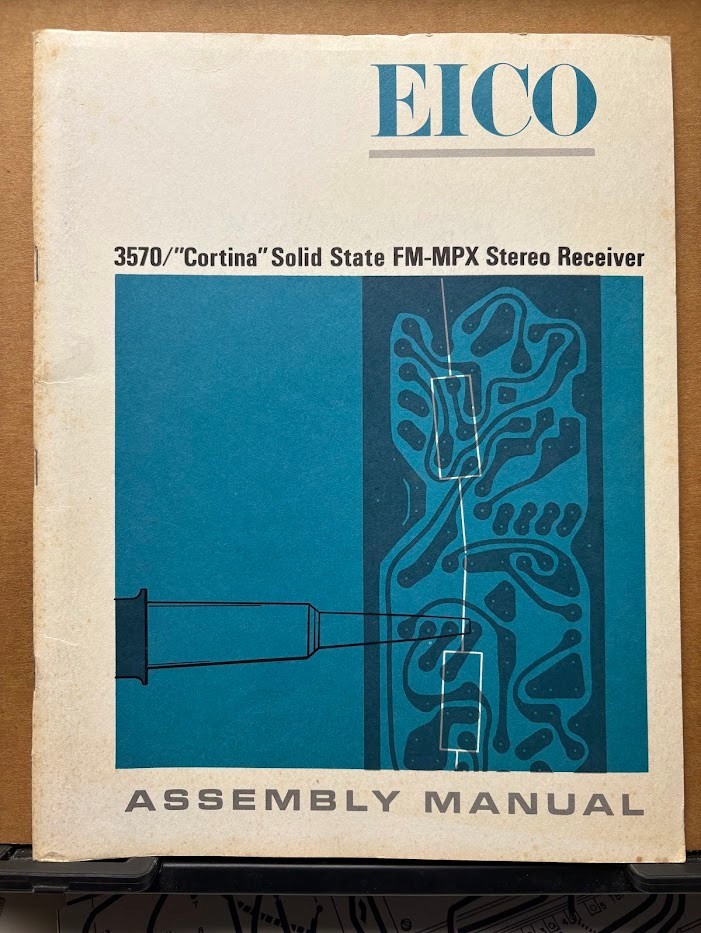
But here’s the catch: you didn’t buy it pre-assembled. The 3570 was sold as a kit, meaning buyers received a box of components, a bare chassis, and a detailed manual, then spent nights at the workbench soldering resistors, mounting transformers, and aligning the tuner circuitry. There was no factory QA, no burn-in period. What you ended up with depended entirely on your skill with a soldering iron and your patience with alignment procedures. That DIY DNA is still visible in every surviving unit today. Even if it powers on, you’re never quite sure if it’s running as designed—or if that one cold joint from 1967 is waiting to fail.
For EICO, the 3570 wasn’t just another product—it was part of a broader pivot. Founded in 1945, the company built its name on test instruments and amateur radio gear, often sold in kit form. By the late 1960s, with consumer demand shifting toward integrated solid-state receivers, EICO launched the Cortina line to stay relevant. The 3570 was one of their focused attempts to capture a slice of the hi-fi market before the company gradually retreated from audio production by the late 1970s. While EICO would later exist only as a property management entity until its 1999 liquidation, the 3570 remains a tangible artifact of their final serious push into home audio.
Specifications
| Manufacturer | EICO (Electronic Instrument Company) |
| Product type | Stereo Receiver |
| Production years | 1967 |
| Amplification type | Solid State |
| Tuner type | FM MPX Stereo |
| Form | Kit built |
| Power output | 70 Watt |
| Speaker load impedance | 4Ω to 16Ω |
| Dimensions | 4-1/8 x 16 x 9 inches |
| Signal-to-noise ratio | 72dB (line) |
| Channel separation | 50dB (line) |
| Original price | $159.96 - kit (1968); $239.96 - wired (1968) |
Historical Context
EICO was established in New York City in 1945 and built its reputation on test instruments and amateur radio gear, much of it sold in kit form. The company produced hi-fi products—including tuners, preamplifiers, and amplifiers—from the early 1950s to the mid-1960s. By the late 1960s, as consumer electronics shifted toward solid-state technology, EICO introduced the Cortina line to remain competitive. The 3570 was part of that effort—a modern, kit-based stereo receiver designed for the DIY audiophile. It represented both a continuation of EICO’s legacy in kit electronics and a strategic move into the evolving hi-fi space. EICO eventually left the audio market in the late 1970s, marking the end of its direct involvement in consumer audio equipment.
Collectibility & Value
The Eico Cortina Model 3570 is not a collectible for casual listeners or display-only collectors. It’s a project—often listed “AS-IS” with the blunt warning that it “will need a general going over by a technician or hobbyist.” Even units that appear intact carry decades of component aging. Surface blemishes are common: one listing notes “some wear around some of the switches on the front control panel,” a “noticeable rub mark on the upper right corner edge of the front panel,” and “two noticeable 1/2 to 3/4” scratches on the top cover.” These are minor compared to what’s underneath.
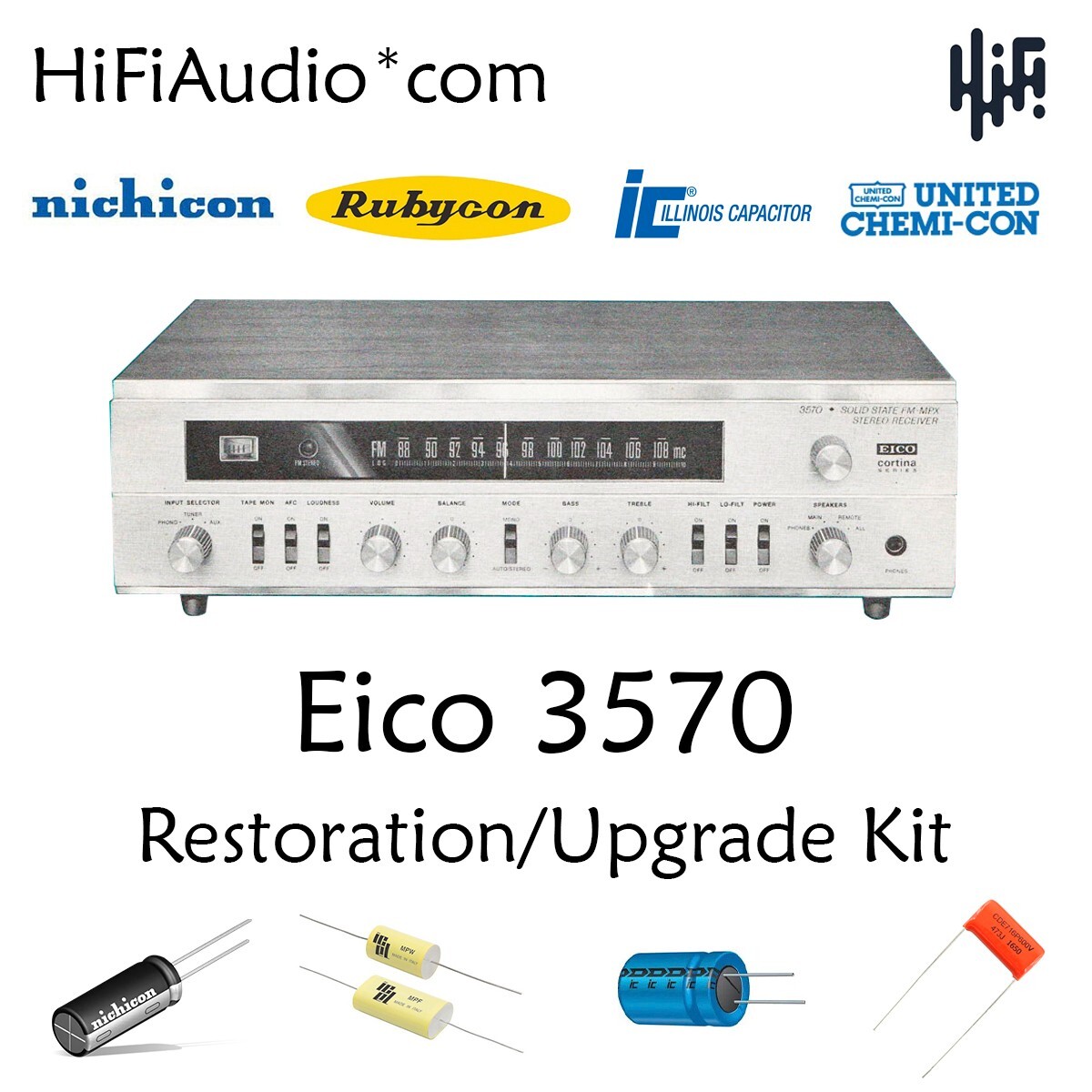
The real risks are internal. Multiple reports cite units that “smoke upon plug-in” or are completely “not powering,” often pointing to failed electrolytic capacitors, cold solder joints, or transformer issues. One detailed account describes “burned up resistors just beyond power transformer” and suspects an “internally shorted power transformer,” along with large electrolytic capacitors needing re-soldering. While a restoration kit for filter capacitor repair is available—priced at $147 as of August 16, 2022—this is just the starting point. There is no verified market pricing data for a fully restored, working 3570. What you’re buying isn’t performance; it’s potential. The original kit cost $159.96 in 1968, but today’s cost is measured in time, tools, and a willingness to troubleshoot blind. Unbuilt kits still surface occasionally, offering a clean slate for the truly committed. And while the operating manual is available through enthusiast archives, success isn’t guaranteed—it’s earned.
eBay Listings


As an eBay Partner, we earn from qualifying purchases. This helps support our independent vintage technology research.
Related Models
- Eico 3200 (1970)
- Eico HF-65A (1958)
- Eico 2716 (1970)
- Eico 3070 (1969)
- Eico 3080 (1972)
- Akai AM-2850 (1975)
- Akai AP-206 (1975)
- Nakamichi BX-1 (1985)
- Acoustic Research research-ar-17 (1978)
- Acoustic Research AR-19 (1994)