Eico 3200 (1967–1968)
Not the tube-powered dream you might expect—this is solid-state Eico, from the quiet end of their hi-fi run.
Overview
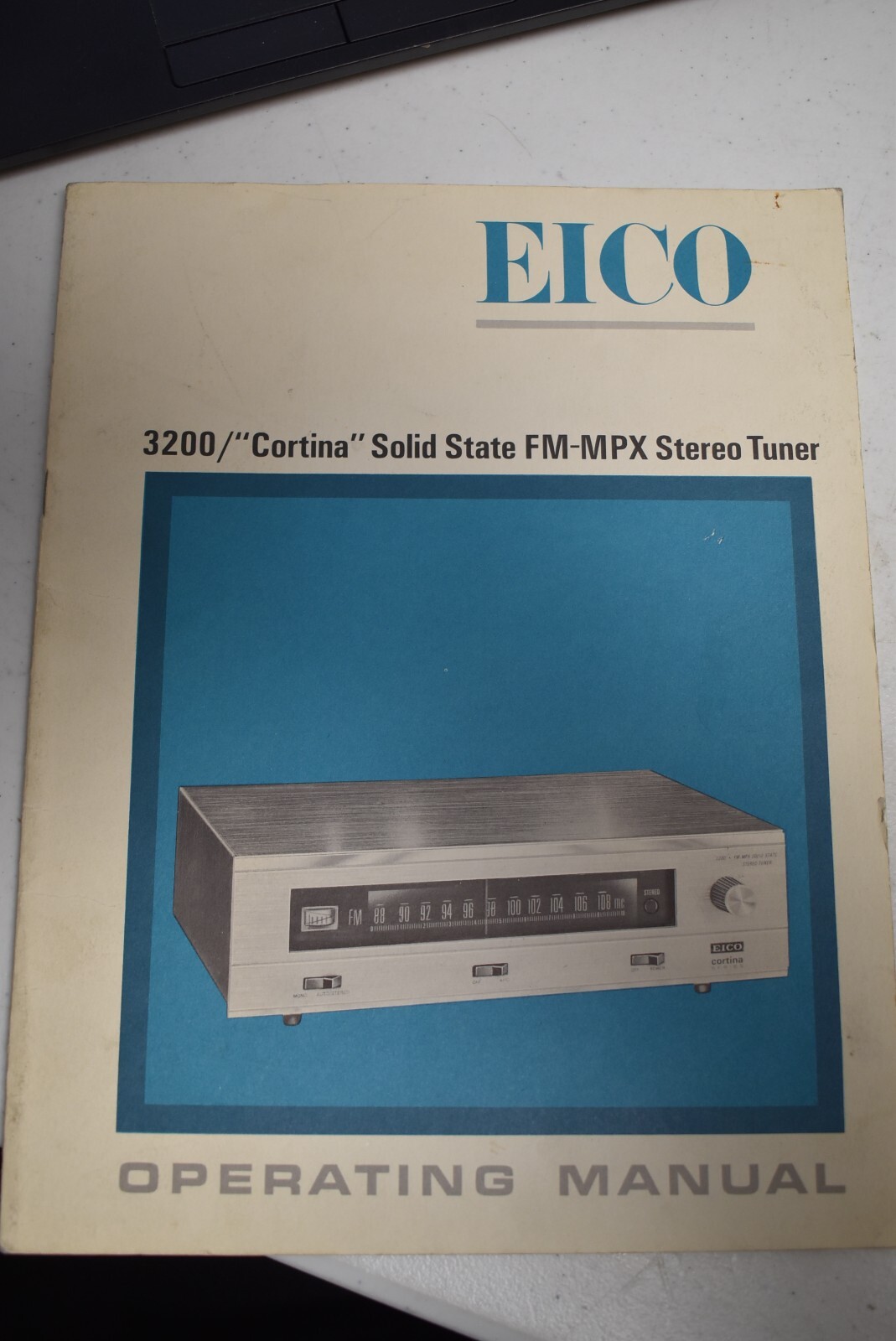
The Eico 3200 isn’t one of the big names you hear at swap meets or see glowing on display shelves. It doesn’t have the cult following of a Marantz or the heft of a Harman Kardon, but it’s a real piece of the late-1960s shift in hi-fi design—when transistors started edging out tubes, and manufacturers like EICO adapted to stay relevant. This is the Eico 3200 Solid-State FM Stereo Tuner, a modest but capable receiver of its moment, built when stereo broadcasting was finally taking hold and FM was becoming something worth tuning into carefully.
Unlike EICO’s earlier tube-based tuners and amplifiers, the 3200 embraced solid-state technology, marking a departure from the warm-glow era that defined much of the company’s reputation. It was part of EICO’s later push into stereo components, produced right around the time the company was winding down its audio equipment line—hi-fi production had peaked for them in the mid-1960s, and by the late '70s they’d left the market entirely. The 3200 landed near that quiet exit, in 1967–1968, a period when EICO was no longer leading the pack but still building functional, accessible gear for the serious listener or do-it-yourselfer.
It was designed as a mono/stereo tuner, meaning it could decode the emerging FM stereo broadcasts of the time while remaining compatible with mono signals. That made it a practical upgrade path for existing systems. And while it didn’t come as a kit like many of EICO’s earlier offerings, it carried the same no-nonsense engineering ethos—clean layout, serviceable design, and an emphasis on reliability over flash.
Specifications
| Manufacturer | EICO (Electronic Instrument Co. Inc.) |
| Model | 3200 |
| Type | Mono/Stereo Tuner |
| Tuning Bands | FM |
| Tuning Scale | Analogue |
| FM Tuning Range | 88 to 108 MHz |
| Dimensions | 3-1/8 x 12 x 7-3/4 inches |
| Weight | 7lbs |
| Technology | Solid-State |
| Contains | transistors, 8 x diodes, 2 x rectifiers, 1 x varactor |
The specs tell a story of transition. The analogue tuning scale was standard for the era—no digital readouts here, just a dial and a needle, requiring a careful hand and a good ear. The 88 to 108 MHz FM range covered the full modern broadcast band, which had been standardized by the FCC in the early 1940s but only became widely used for high-fidelity music in the 1960s. The inclusion of a varactor—a voltage-variable capacitor—hints at more modern tuning circuitry, likely used in the oscillator or filter stages for smoother frequency control.
The internal parts list—transistors, diodes, rectifiers—confirms its solid-state nature, but gives no clue to the circuit topology. Still, the presence of discrete components rather than integrated circuits suggests a design that was advanced for EICO but not cutting-edge compared to contemporaries from Sony or Pioneer, who were already pushing deeper into miniaturization and IC-based signal processing.
Historical Context
EICO built its name in the 1950s and early 1960s on DIY audio kits and test equipment, becoming a staple for hobbyists and technicians. Their hi-fi production ran from the early 1950s to the mid-1960s, after which the company began to fade from the audio spotlight. The 3200 arrived in 1967–1968, after that peak, suggesting it was part of a final wave of audio products before EICO fully retreated from the market in the late 1970s. It wasn’t a flagship—it was a practical component for the time, designed to work within a system. The Eico Cortina 3070 stereo amplifier was its intended companion, forming a complete stereo setup for listeners stepping into the FM stereo era.
eBay Listings
As an eBay Partner, we earn from qualifying purchases. This helps support our independent vintage technology research.
Related Models
- Eico 3570 (1972)
- Eico HF-65A (1958)
- Eico 2716 (1970)
- Eico 3070 (1969)
- Eico 3080 (1972)
- Akai AM-2850 (1975)
- Akai AP-206 (1975)
- Nakamichi BX-1 (1985)
- Acoustic Research research-ar-17 (1978)
- Acoustic Research AR-19 (1994)