Eico 2080 (1964)
That first warm, rich chord through a freshly biased pair of 7591s—this is why people still chase tube magic.
Overview
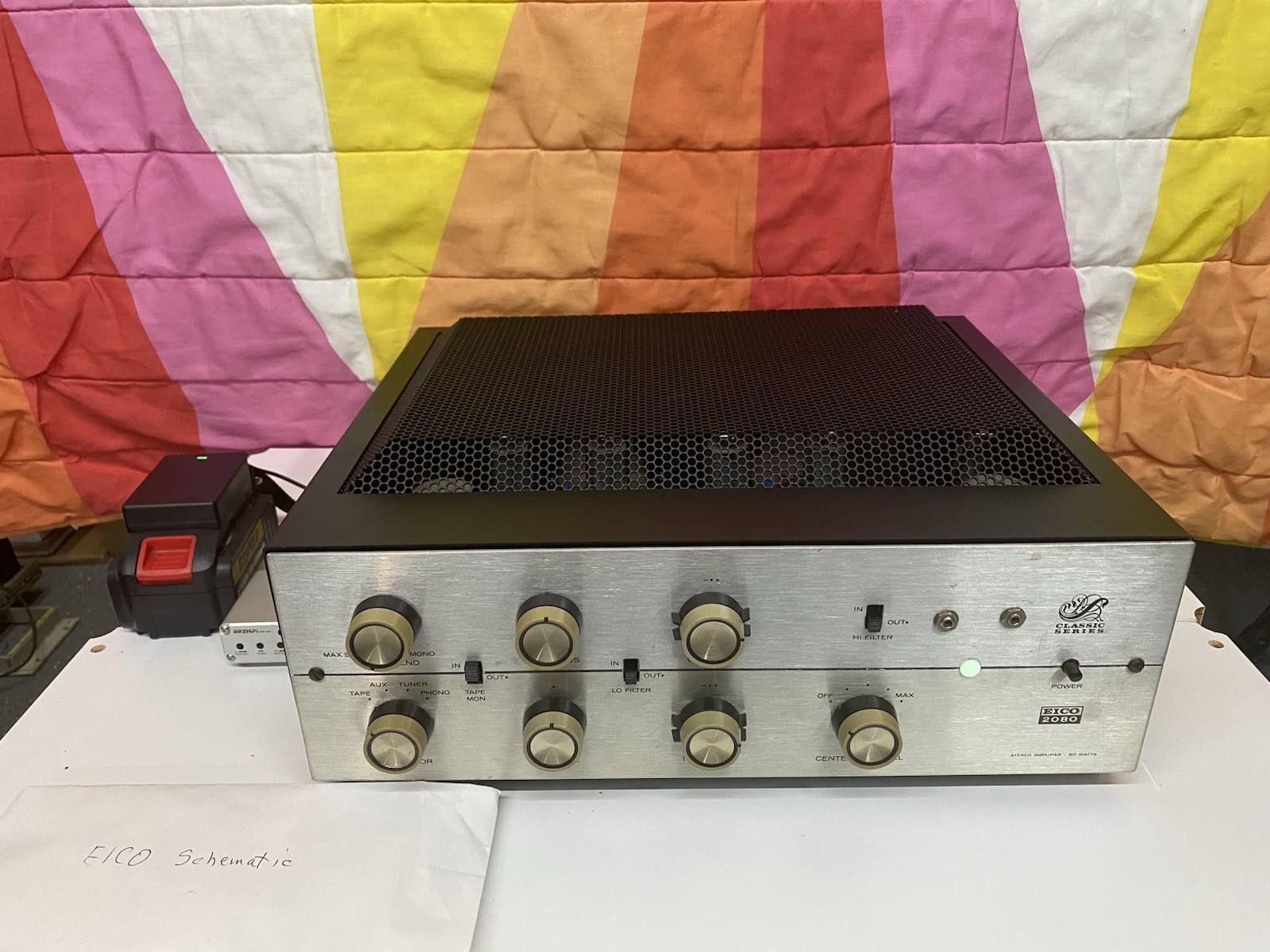
The Eico 2080 isn’t just another vintage tube amp—it’s a love letter to the golden age of DIY hi-fi, built when you could still get your hands dirty and actually understand how your stereo worked. Released in 1964 as part of EICO’s Cortina series, this stereo integrated amplifier was designed for builders and music lovers who wanted serious performance without the boutique price tag. Made by Electronic Instrument Co. Inc. in Brooklyn, NY, the 2080 arrived during the peak of the kit era, when EICO had already cemented its reputation as a leader in accessible, well-engineered electronics. It wasn’t just a box of parts—it was a promise: build it right, and it would deliver sound that could rival far more expensive brands.
And it delivered. The 2080 is essentially a modernized remake of EICO’s legendary ST-70, updated with a sleeker look and an improved line amplifier stage. While the ST-70 relied on 6SN7 tubes, the 2080 swaps in miniature tubes for those positions, streamlining the layout without sacrificing the core DNA. The power transformers and other critical iron components are reportedly identical—right down to the part numbers—giving the 2080 the same robust foundation that made the ST-70 a classic. This continuity means that if you’ve heard a well-restored ST-70, you already have a sense of what the 2080 can do: deep, dynamic bass, clear midrange, and a sense of musical ease that solid-state often struggles to replicate.
Owners report it “works and sounds beautiful,” with a presentation that’s “less compressed than the Fisher” and endowed with “good bass and clear treble.” That’s high praise, especially coming from someone comparing it to Fisher’s respected tube gear. Another notes that after installing Uc153s—likely a typo or forum shorthand for a tube substitution—all the amp’s flaws became glaringly obvious, suggesting the 2080 is transparent enough to reveal both its strengths and weaknesses depending on component choices. It’s not a forgiving amp in a bad setup; it’s an honest one.
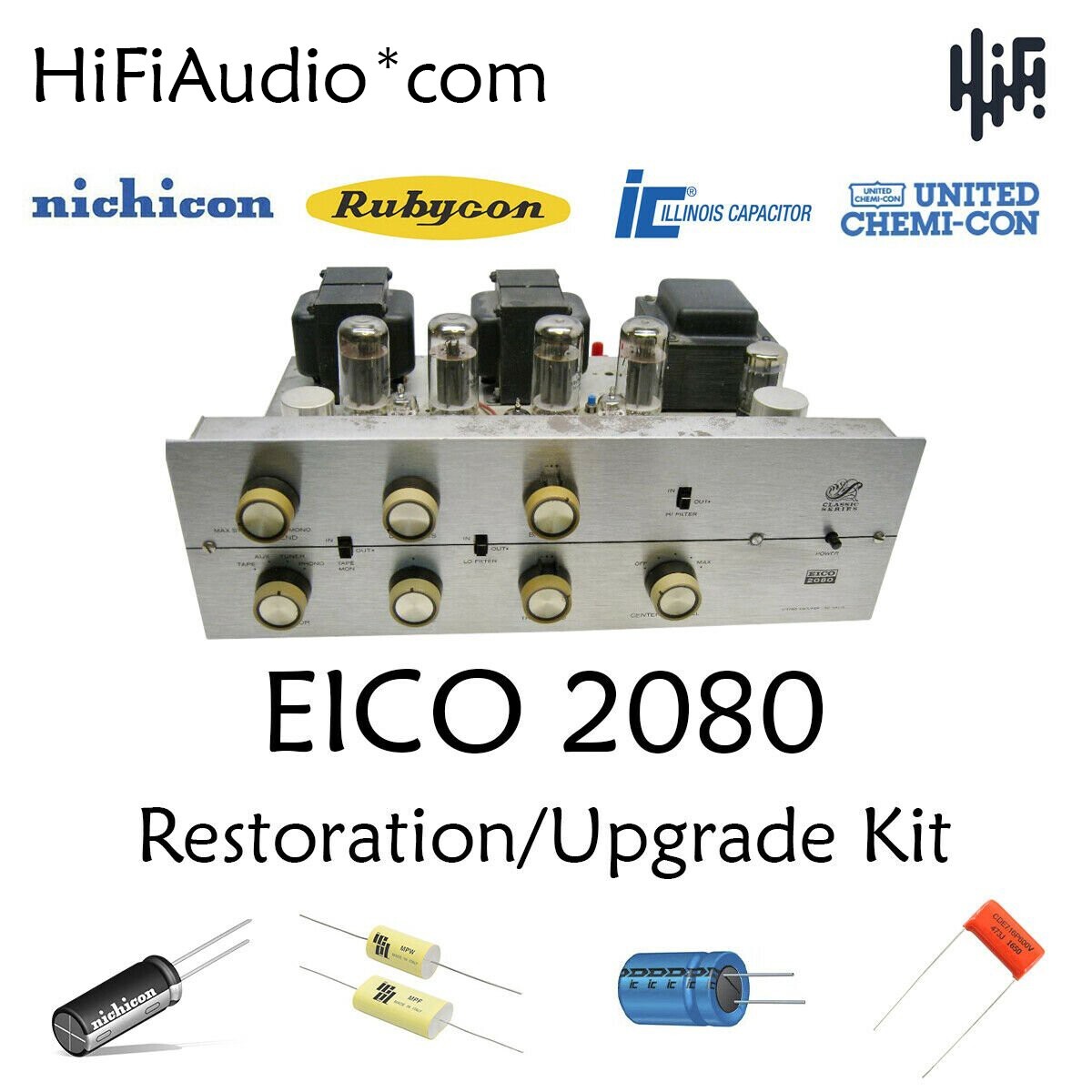
Built with point-to-point chassis construction, the 2080 was meant to be serviced, understood, and upgraded. It came as a kit or pre-assembled, and its design reflects EICO’s roots in test equipment: functional, logical, and repairable. Inside, you’ll find the infamous “Black Beauty” coupling capacitors—components revered for their build quality but notorious for aging poorly—and a full complement of electrolytic caps that, after 60 years, should be assumed to need replacement. There’s a selector switch for inputs, bass and treble controls (which some owners reportedly bypass), and a 500K audio taper volume potentiometer that, when worn, can develop a “nasty cracking sound” with every turn.
Historically, the 2080 had real-world credibility beyond the hobbyist bench: it was used in the original Phantom Studios in Alpine, Texas. That’s not just a cool anecdote—it’s proof this amp could handle professional monitoring duties in its day, a testament to its clarity and reliability when properly maintained.
Specifications
| Manufacturer | EICO (Electronic Instrument Co. Inc.), Brooklyn, NY, USA. |
| Model | 2080 |
| Year Introduced | 1964 |
| Type | Stereo Integrated Amplifier; Tube Amplifier |
| Series | Cortina series |
| Power Output | 35 watts per channel into 8Ω (stereo) |
| Frequency Response | 10Hz to 80kHz |
| Total Harmonic Distortion | 0.5% |
| Input Sensitivity | 2.6mV (MM), 280mV (line) |
| Signal to Noise Ratio | 65dB (MM), 80dB (line) |
| Speaker Load Impedance | 4Ω to 16Ω |
| Dimensions | 5-5/8 x 15-7/8 x 13-5/8 inches |
| Output Tubes | 7591 |
| Output Tube Configuration | PP (push-pull) |
Key Features
Point-to-Point Chassis Construction
There’s no printed circuit board here—just hand-soldered connections on a steel chassis, laid out with a logic that feels almost architectural. This point-to-point wiring isn’t just nostalgic; it makes troubleshooting and servicing far more intuitive than with modern layered boards. Every wire has a purpose, every component is accessible. If something fails, you can see it, test it, and replace it without a magnifying glass or desoldering station. It’s engineering as craftsmanship, and it’s one reason the 2080 remains popular with restorers.
“Black Beauty” Coupling Capacitors and Electrolytics
The “Black Beauty” capacitors—so named for their distinctive black phenolic casings—were considered premium components in their day, known for durability and low microphonics. But time has not been kind. These caps, along with the electrolytic capacitors throughout the power supply and signal path, are almost certainly degraded after 60 years. They should be replaced during any serious restoration. Leaky signal coupling caps can allow DC voltage to pass into the output stage, throwing off tube bias and potentially damaging speakers. It’s not a “maybe”—it’s a must-do.
Input Selector and Tone Controls
The 2080 includes a proper input selector switch, letting you connect a turntable (with its 2.6mV MM sensitivity), a tuner, or other line-level sources. The bass and treble controls are present, but some owners reportedly bypass them, either for sonic purity or because they’ve become noisy with age. Whether you use them or not, their inclusion makes the 2080 more versatile than minimalist amps that force you into external tone management.
Push-Pull 7591 Output Stage
At the heart of the 2080 are four 7591 tubes in a push-pull configuration, delivering 35 watts per channel into 8 ohms. The 7591 was a favorite in mid-tier hi-fi of the 1960s—more powerful than the 6V6, more refined than the 6L6, and capable of excellent linearity. When biased correctly and fed with clean power, they produce a lush, dynamic sound that’s hard to tire of. A rebuilt Eico ST-70 (which shares the same output tube type and transformer DNA) has been described as “spectacular for a 50 year old piece,” and the 2080, being a direct descendant, inherits that potential.
Historical Context
EICO was founded in 1945, starting out in test equipment before expanding into audio kits that empowered a generation of hobbyists. By 1964, when the 2080 was introduced, the company was a recognized leader in kit-based electronics, offering products that balanced performance, clarity, and build accessibility. The 2080 wasn’t just another amplifier—it was part of a culture where building your stereo was as important as listening to it. That ethos is baked into every solder pad and terminal strip. Its use at Phantom Studios in Alpine, Texas, underscores that this wasn’t just a weekend project for amateurs; it was gear trusted in real-world recording environments.
Collectibility & Value
The Eico 2080 isn’t a showstopper at vintage audio auctions, but it holds steady value among restorers and tube enthusiasts who appreciate its lineage and repairability. A recently serviced unit—updated with a 3-prong power cord, recapped, and properly biased—sold for $455, suggesting that a fully functional, safe, and optimized 2080 can command a fair price. Non-working or unrestored units will be cheaper, but factor in $100–$200 in parts and labor for a proper recap and safety upgrade.
The biggest red flags for buyers? The volume control potentiometer, which can develop that “nasty cracking sound” when turned, and the aged capacitors, which should be assumed faulty until proven otherwise. Replacing the “Black Beauty” caps and electrolytics isn’t optional—it’s essential for both performance and safety. The good news? An “excellent manual” with full schematic is available for download, making the 2080 one of the better-documented vintage kits out there. That documentation, combined with its ST-70 heritage, makes it a favorite for first-time tube restorers.
If a unit comes with original Mullard tubes and they test well, that could add significant value—enough that one owner noted you “could make some decent coin off it.” But the real value of the 2080 isn’t in resale—it’s in the experience of bringing it back to life and hearing a piece of hi-fi history sing again.
eBay Listings


As an eBay Partner, we earn from qualifying purchases. This helps support our independent vintage technology research.
Related Models
- Eico HFT-80 (1957)
- Eico ST-3020 (1975)
- Eico ST-4120 (1970)
- Eico ST-96 (1965)
- Eico ST-97 (1968)
- Aiwa CS-250 (1978)
- Denon TU-1500RD (1995)
- Denon TU-280 (1976)
- Denon TU-501 (1977)
- Denon TU-550 (1978)