Dynaco ST-35 (1959)
Seventeen and a half watts, two EL84s per channel, and a Z-565 transformer that owners still argue was the best iron Dynaco ever wound.
Overview
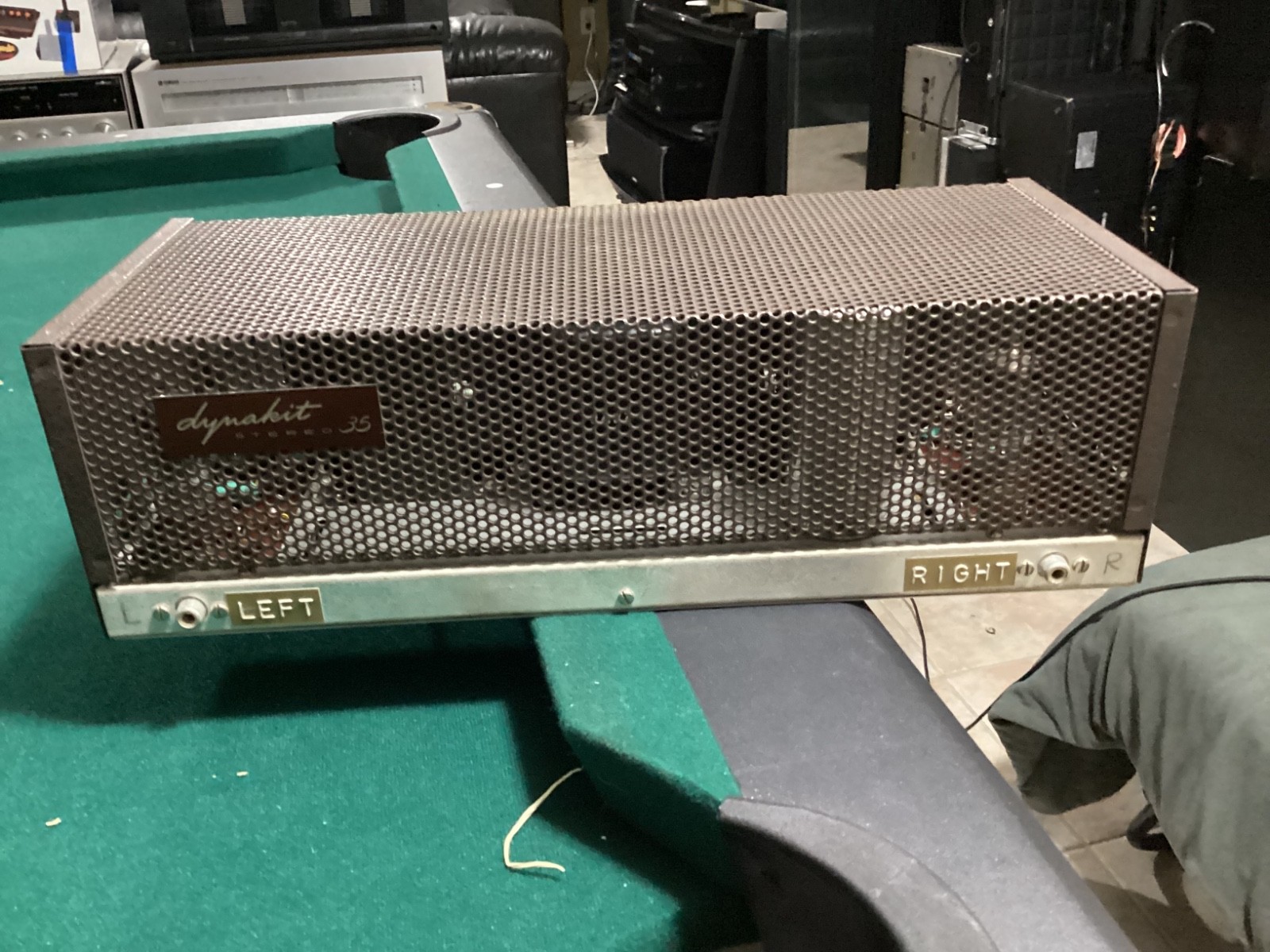
The Dynaco ST-35 — sold as the Stereo 35, and remembered among collectors as "the Baby Dynaco" — arrived in 1959 from David Hafler and Herb Keroes' Dynamic Audio Company. It was a push-pull, class AB stereo tube amplifier, offered as a kit with factory-assembled versions also available, and the pitch was simple: genuine high-fidelity performance at a price a hobbyist could justify. The company's own assembly manual opens by calling it a dual power amplifier of "deceptively simple appearance," and that phrase has aged well. Behind the plain steel chassis sits an ultra-linear output stage, a circuit configuration Dynaco helped popularize, in which taps on the output transformer's primary winding feed a portion of the output signal back to the screen grids of the output tubes. The result is much of the low distortion of triode operation without surrendering pentode power.
Each channel is rated at 17.5 watts into an 8-ohm load, using a pair of 6BQ5/EL84 output tubes per side. The figure looks almost comically modest today, and that is precisely the point: this is an amplifier that trades wattage for iron and circuit quality. The stock power amp boards run roughly 27dB of gain, a number that matters to anyone restoring a Dynaco preamp — the ST-35's boards are a documented drop-in substitution for the higher-gain boards in the passive line stage of the SCA-35, where builders report they sound better and simply fit. That shared DNA is worth noting: the ST-35 and SCA-35 share both topology and the Z-565 output transformer, so the two models are effectively siblings, one with a preamp bolted on.
Input sensitivity is 1 volt for 17.5 watts output per channel, which made the amp compatible with the preamplifiers and early stereo tuners of its day, and the input complement is deliberately spare: two inputs, one for high-level sources like tape decks and one for standard line-level signals. Controls amount to a power switch, an input selector, and a volume knob. There is no tone control at all — Dynaco's purist stance, and one reason the signal path stays as short as it does. Frequency response is specified as ±1 dB from 10 cps to 40,000 cps, and distortion at less than 0.5% at full power. Those numbers, from the period documentation, are the ones to trust; retail listings circulating today quote everything from 35 watts per channel to "2x20W," and none of those figures match the manufacturer's own rating.
Key Features
Ultra-Linear Output Stage with the Z-565 Transformer
The heart of the ST-35 is the special Dynaco Z-565 output transformer, a patented design tailored specifically to this circuit. The manual claims the transformer is free of resonances, has extended frequency response from 6 to over 60,000 cycles, and is wound by special techniques on a carefully designed core to keep distortion low across a wide spectrum. Whether or not every claim survives modern measurement, the Z-565 has become the amp's calling card — owners describe the early Z565 units as the original and best-sounding iron, and reproduction and upgrade transformers are sold specifically for ST-35 and SCA-35 rebuilds. One caveat worth knowing before buying upgrades: aftermarket transformers built on larger cores are not drop-through replacements and require chassis work.
6BQ5/EL84 Output Tubes and 6SN7 Driver Stage
Four 6BQ5/EL84 output tubes — a pair per channel — do the heavy lifting, driven by two 6SN7 dual triode tubes per channel. The EL84 is a famously musical little pentode, and running a pair per side in class AB is what produces the amp's characteristically smooth midrange and extended, never-bright top end. The amplifier's transient behavior got explicit attention in the design: Dynaco's own documentation notes that pulse and square-wave testing shaped the operating parameters, and that the payoff shows up on percussive material — drums, piano, cymbals — reproduced with a transparency and absence of blurring that only comes from extended response without overshoot. The manual also makes a point of the amp's graceful recovery from overload, which matters when a low-efficiency speaker asks for a peak the little amp can't quite supply.
Modular Construction and Steel Chassis
The ST-35 follows Dynaco's modular design philosophy — circuit boards, transformers, and wiring laid out in an open, uncluttered chassis that the assembly manual claims can be wired in a few hours. The chassis itself is heavy-gauge steel in gray hammertone paint, utilitarian and unapologetic. The circuit boards are supplied with components pre-mounted in kit form, and the PC-13 board designation shows up repeatedly in parts listings and rebuild threads. That modularity is why the amp survives: individual sections can be repaired or replaced rather than scrapped. One design note from the DIY community deserves flagging for anyone pushing the amp hard — circuits like the ST-35 that place the output transformer inside a negative-feedback loop are vulnerable to core saturation induced by the low-frequency error-correction signal, so transformer quality is not a luxury here, it is the design.
Historical Context
The ST-35 followed Dynaco's earlier Mark III monoblocks and was succeeded by the far more powerful ST-70, which became one of the best-selling tube amplifiers of all time. It competed against considerably more expensive brands, McIntosh and Marantz among them, and the kit model is what let it do so — thousands of units sold, according to the available documentation, because the buyer supplied the labor. The ST-35 is widely described as one of the first affordable, high-quality stereo tube amplifiers available to the general public, a claim that comes from the source material rather than independent verification, but the sales record behind it is not in dispute. Contemporary coverage in Vacuum Tube Valley noted the ST-35's use of the EL84/6BQ5 output tube as a defining feature of its design.
Production end dates are not confirmed in the available documentation, and original pricing is not documented either, so treat any figure you see quoted for a "new" ST-35 with suspicion. What is documented is a German test report covering the ST-35 alongside the ST-70, ST-120, SCA-35, and PAS-3, dated to likely 1966 — evidence the amp was still being reviewed and sold well into the decade. The ST-35's place in the family tree is secure regardless: it shares its Z-565 output transformer and its topology with the SCA-35, and it sits between the Mark III and the ST-70 in the arc of Dynaco's tube amplifier development.
Collectibility & Value
Here is the uncomfortable truth about the ST-35: it is regularly described as the rarest of Dynaco's tube amps and very difficult to find these days, which is a strange fate for a kit amplifier that sold in the thousands. The explanation is simple attrition — a 50-plus-year-old amplifier built around capacitors that dry out, tubes that wear out, and transformers that can degrade. Finding a fully functional original is a genuine challenge, and most examples that surface are advertised as rebuilt, recapped, or electrically restored. Prices reflect the scarcity: a serviced unit has been listed at $1,099.99, and an eBay listing for a "Dynaco ST-35 Stereo Tube Power Amplifier – 4-Way Independent" carried a $1,150 asking price. Note that reproduction PCBs with EFB power-supply boards sell for a tiny fraction of that — around EUR 45 — because they are boards, not amplifiers.
Buyers should know the ST-35's one chronic complaint before handing over money. Owners report the power transformer runs hot, and the reason is mechanical: the three transformers sit almost touching inside the chassis, with as little as 1/16 of an inch between the power transformer and the two output transformers. It is a thermal design compromise baked into the layout, not a fault you can fix with a recap. Recapping — replacing electrolytic and paper capacitors — is the standard restoration step and the one most commonly performed, with replacement capacitors, tubes, and reproduction parts all readily available. Some owners go further, upgrading power cords, tubes, or output transformers outright. The DIYTube Dynaco ST35 kit that once served builders is discontinued, but Gillespie boards and EFB power-supply modifications remain in circulation, and reproduction Z-565 transformers and upgraded power transformers are still sold for the ST-35 and SCA-35 alike. One restoration note from the field: at least one owner replaced the original RCA connectors with a Tiffany-style connector and found the substitution isolated the ground from the chassis, a change worth understanding before making it.
What the ST-35 asks of its owner is patience and appropriate speakers. It can still shine in a modern system when paired with high-sensitivity speakers — the amp drives the efficient models of its own era, AR-3, Advent, and Klipschorns among them, without complaint. It works best in small to medium rooms where high volume is not the goal. What it delivers in return is the character owners keep chasing: a smooth midrange, highs that extend without glare, and a forgiving softness on poorly recorded material that makes it a natural companion for jazz, classical, and vocal records. For collectors, restorers, and tube enthusiasts, the ST-35 is a piece of audio history that earns its reputation one honest watt at a time.
eBay Listings



As an eBay Partner, we earn from qualifying purchases. This helps support our independent vintage technology research.
Related Models
- Dynaco 400 Van Alstine Modified
- Dynaco 400
- Dynaco Mark-III (1957)
- Dynaco Mark-VI
- Dynaco MK-VI (1975)
- Eico 3150 (1967)
- Fisher CUSTOM-ELECTRA-I (K-14/K-15) (1957)
- Fisher CUSTOM-ELECTRA IV (E33/E44) (1960)
- Akai AM-2400 (1978)
- Akai AM-2600 (1977)