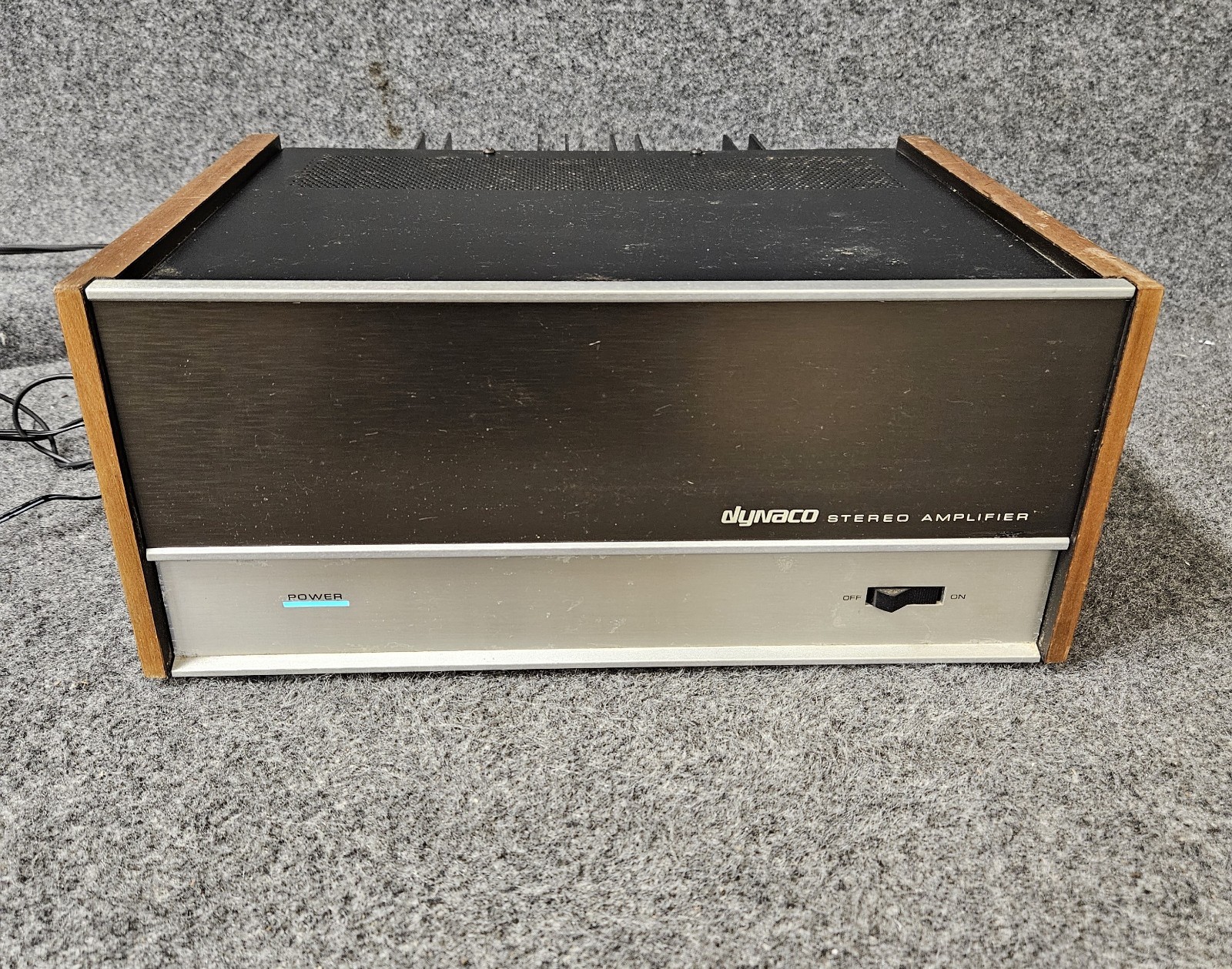
Dynaco Stereo 150 (circa 1975)
The kit amplifier that borrowed its bigger brother's voice, then dared anyone to build it
Overview
Dynaco spent two decades convincing the audio world that building your own gear was no compromise. By the mid-1970s the company had its kit formula well refined, and the Stereo 150 was the latest example. It was pitched as the smaller sibling to the range-topping Stereo 400. Dynaco's own advertising in Audio (August 1975, p.15) promised the "exceptional sound quality" of the flagship, scaled to "more modest power." The pitch was simple: Stereo 400 sonics, a power supply that could handle peaks without flinching, and heat sinks the company described as the biggest per watt in the business.
The Stereo 150 went after the first-time builder harder than any earlier Dynaco kit. Previous kits assumed a certain baseline of soldering courage. This one came with an ad campaign that dared the hesitant: "Any Body Can." The amplifier shipped with fully prepared printed circuit boards, which removed the most intimidating step for novices. High Fidelity (December 1976, p.35) noted that building the ST-150 kit saved buyers $130 over the factory-assembled version, while the matching PAT-5 preamplifier kit saved an even steeper $160.
Dynaco's marketing positioned the Stereo 150 as the sensible sweet spot. You didn't need the Stereo 400's brute-force output unless you were running genuinely inefficient speakers in a large room. For everyone else, the Stereo 150's massive power supply, the same design philosophy scaled down, promised to handle musical transients cleanly. The idea was to avoid the hardening of texture that plagued lesser solid-state amplifiers when pushed near their limits. The optional front-panel meter kit, sold separately, gave a visual confirmation of output for the practical-minded buyer who wanted to see proof of the power he'd wired up himself.
The Kit Experience
The "Any Body Can" campaign ran across multiple publications, including HiFi-Stereo (January 1976, p.69) and Audio (April 1976, p.61). It was built around a simple observation: a lot of people who wanted high-end sound had been scared away from kits by reputation alone. The copy said so directly - "if you've been scared away from stereo gear in kit form, let the new Stereo 150 amplifier change your mind" - and then laid out why this one was different. Dynaco had been refining its kit documentation for twenty years by this point. Clear instructions decided whether a customer became a lifelong Dynaco buyer or a one-time experimenter with a half-soldered box in the closet.
The surviving advertisements don't say how the Stereo 150 holds up under real use, and owners have had to find that out for themselves over the decades. The heat sinks, those "biggest per watt" units Dynaco touted, do genuine thermal work. It's not a 400. Push it hard enough and you'll find the ceiling, but that ceiling is gentler than the spec-chasers would expect.
System Matching
Dynaco designed the Stereo 150 as half of a deliberate pairing with the PAT-5 preamplifier, a solid-state control unit that had already earned a reputation for transparency in a market still suspicious of transistors. HiFi-Stereo (September 1975, p.99) presented the combination as the logical step up: "Combine it with our new PAT-5 - already famous for the very finest solid state sound." The ads stopped short of claiming the pairing was unbeatable at any price. They settled for the more restrained pitch that "even on a cost-no-object basis, you still may not believe your ears."
Optional accessories rounded out the package. The Stereo 150 could be fitted with a meter package that displayed output levels on the front panel. It was hardly essential for listening, but it gave anyone who'd just spent a weekend building the thing visual confirmation that it was doing what the schematic promised. The PAT-5 offered a wood cabinet option, photographed in the ads with a warmth that contrasted with the amplifier's businesslike metal faceplate. Together, the two components made a visually coherent stack that looked more expensive than the kit pricing suggested.
Market Position and Legacy
The Stereo 150 arrived at a pivot point. The Stereo 400 had already made the case that Dynaco could do transistors without losing the warmth and dimensionality that defined the house sound. A kit amplifier at this price had to justify itself on sonic grounds, because the convenience argument had already been lost to the receiver manufacturers.
The Stereo 150 has survived in working condition in enough numbers to still surface on the used market four decades later. That says something about the build quality, and about the owners who assembled them. A well-built kit lives or dies by the builder's patience. The Stereo 150 that fires up on the first try in 2025 was probably assembled by someone who read the manual twice before picking up the soldering iron. The one that hums and crackles has likely been through several owners, each less invested than the last.
eBay Listings


As an eBay Partner, we earn from qualifying purchases. This helps support our independent vintage technology research.