Dual 1219 (circa 1970)
There is a mechanical certainty in the Dual 1219's arm movement that feels less like playing a record and more like operating precision machinery.
Overview
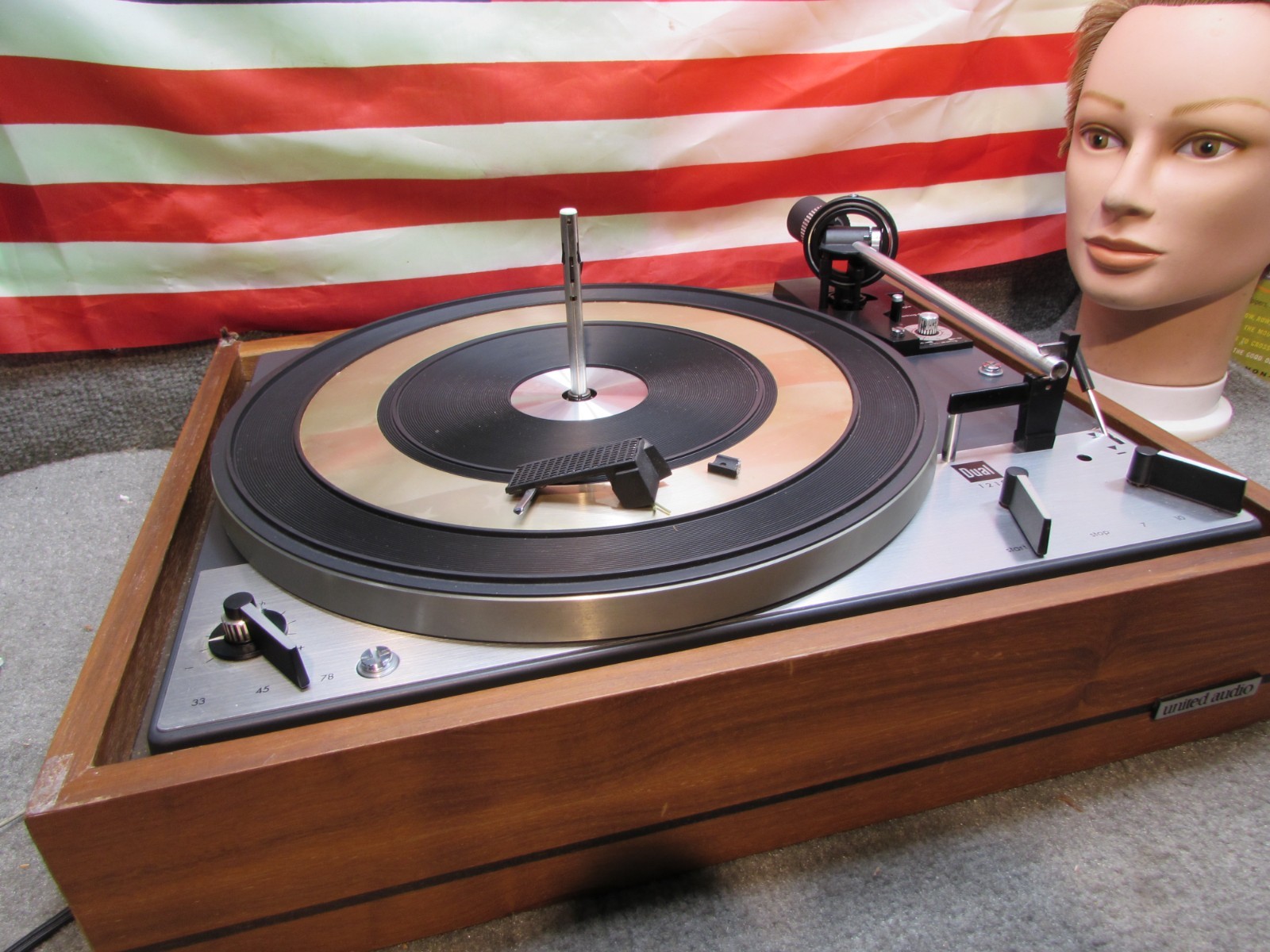
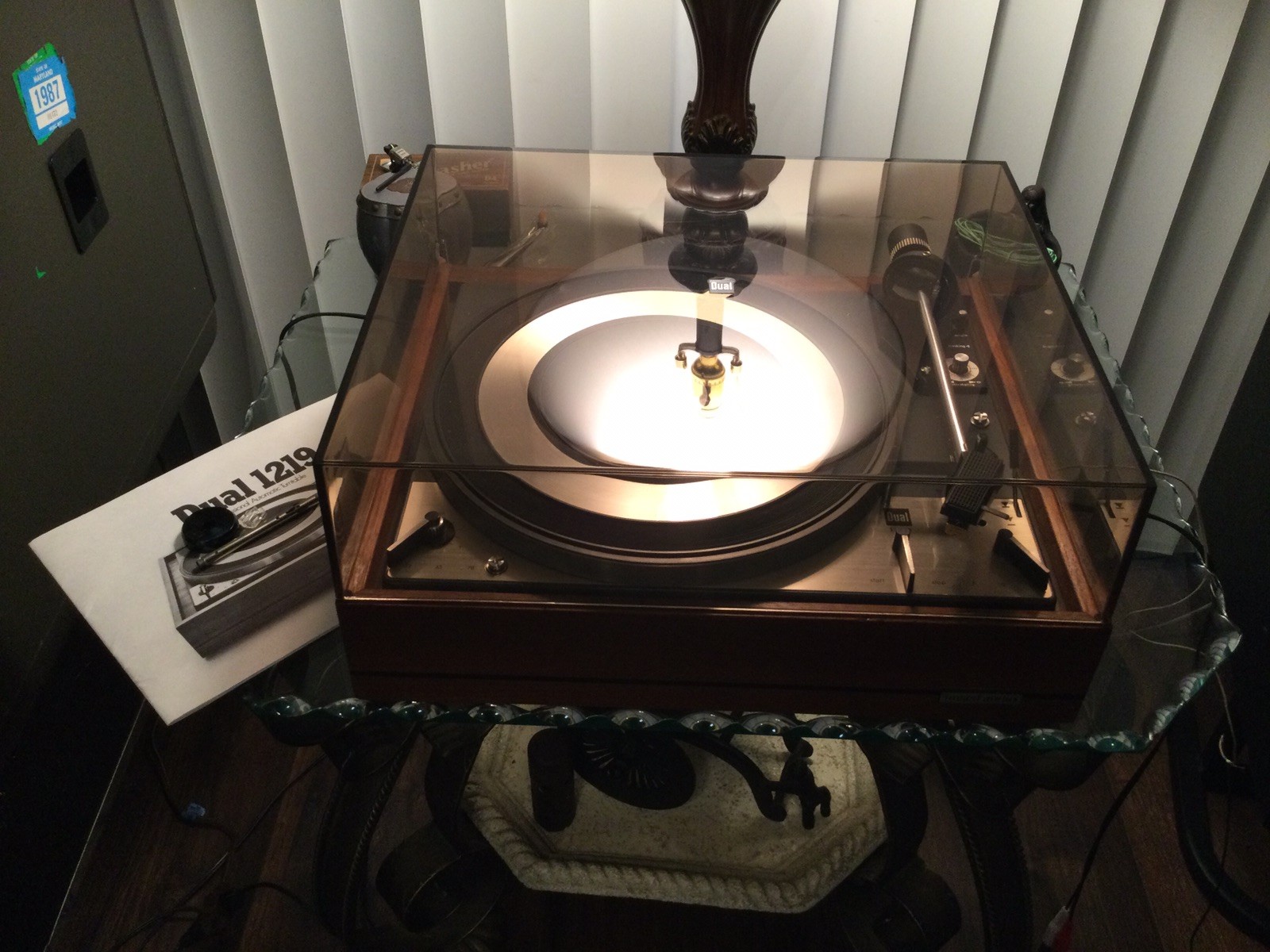
The Dual 1219 stands as a monument to the era when versatility was not a compromise but a engineering challenge solved with German precision. While purists often dismiss auto-changers as mere convenience tools, this model demands respect for its ability to function as a single-play turntable with stability rivaling fixed-arm designs. The chassis exudes a heavy, grounded confidence, weighing in at 6.8 kilograms without a cabinet, ensuring that resonance remains an external visitor rather than an internal resident. At the heart of the operation lies a 30.5 cm aluminum die-cast platter, mass-loaded to 3.1 kg, which spins with a synchronous continuous pole motor capable of driving three standard speeds: 33 1/3, 45, and 78 rpm.
What distinguishes the 1219 from its predecessors is the introduction of a dual gimbal bearing system in the tone arm, a feature that maintains a vertical angle of 15 degrees regardless of whether the unit is stacking six records or playing one. This gyro-gimbal type dynamic balance tone arm eliminates the friction typically associated with multi-play spindles, utilizing a unique single-play spindle that rotates with the turntable itself. The result is a tracking error kept below 1 degree 30 minutes, a figure that allows the unit to hold its own against modern turntables costing significantly more. Owners report that the pitch control function offers a 6% variable adjustment, allowing each of the three speeds to be tuned by approximately half a tone, providing enough flexibility to match drifts in older recordings or align with contemporary systems.
Operation is governed by a mode selector that dictates the behavior of the oil dump type arm lifter, often referred to as a silicon dump cue control. This mechanism allows the arm to rise and descend with a fluid, hydraulic resistance rather than a mechanical click, reducing shock to the cartridge during engagement. The anti-skating mechanism is continuously variable, adjusted via a direct-reading dial that accounts for both needle pressure and the type of cone or ellipse needle employed. For those managing a library of varying formats, the unit accommodates three record size selectors for 30, 25, and 17 cm diameters, ensuring that 7-inch singles and 12-inch LPs are handled with equal mechanical care. The head shell is designed to be attached and removed by moving the fingers back and forth, facilitating quick cartridge swaps without the need for tools.
Specifications
| Manufacturer | Dual (Gebrüder Steidinger) |
| Production Years | circa 1970 (Early 1970s) |
| Original Price (USA) | $175 (less cover and base, Jan 1970) |
| Original Price (Japan) | ¥ 59,900 |
| Motor Type | Synchronous continuous pole motor |
| Drive Mechanism | Idler Drive |
| Turntable Material | Light alloy die-cast (Aluminum) |
| Turntable Diameter | 30.5 cm (12 inches) |
| Turntable Weight | 3.1 kg |
| Playback Speeds | 33 1/3, 45, 78 rpm |
| Pitch Control Range | 6% variable adjustment |
| Wow and Flutter | ± 0.06% or less (DIN45 507) |
| Tone Arm Type | Extra Long Pipe Arm |
| Tone Arm Support | 4-point Gimbal (Needle Bearing) |
| Tracking Error | 1° 30' or less |
| Cartridge Weight Range | 1g ~ 12g |
| Tracking Force Adjustment | 0 ~ 5.5g (Direct Reading Dial) |
| Anti-Skating Mechanism | Direct-Reading Dial (Variable) |
| Cue Control Type | Oil dump type arm lifter (Silicon dump) |
| Record Size Selectors | 30 cm, 25 cm, 17 cm |
| Unit Weight | 6.8 kg |
| Chassis Dimensions | 14 3/4 inches by 12 inches |
| Required Clearance | 4 inches above, 3 inches below |
| Dedicated Cabinet | DB-31 (¥ 9,500) |
| Alternative Cabinet | DB-3 + DCOV-3 (¥ 7,000) |
Key Features
The Dual Gimbal Tone Arm
The introduction of the dual gimbal bearing system marked a significant departure from the single-pivot arms common in auto-changers of the late 1960s. Documentation shows that this 4-point gimbal support allows the tone arm to maintain a consistent vertical angle of 15 degrees, regardless of the stacking mode selected. This geometric stability ensures that the cartridge remains perpendicular to the record surface even when navigating the stack of a multi-play sequence. Service technicians observe that this design reduces lateral friction significantly, allowing the arm to track grooves with a fidelity that contradicts the typical expectations of a changer mechanism. The extra long pipe arm design further minimizes tracking error, keeping deviation under 1 degree 30 minutes across the playing surface.
Frictionless Single-Play Spindle
A unique engineering solution addresses the common complaint of record damage during single play. In the center of the turntable sits a spindle that rotates with the platter rather than remaining static. This eliminates friction against the center hole of the record, a detail that protects the vinyl from scratching during rotation. Collectors note that this feature allows the 1219 to function as a manual turntable just like a normal player, bridging the gap between convenience and audiophile care. The die-cast aluminum platter provides sufficient mass to dampen vibrations, ensuring that the motor's synchronous continuous pole drive does not transmit unwanted noise into the signal chain.
Hydraulic Cue Control
The oil dump type arm lifter provides a soft, resisted motion when engaging the cue function. Unlike spring-loaded lifts that can snap the arm down with abrupt force, the silicon dump mechanism offers a fluid descent. This protects both the record surface and the needle tip from impact shock. The mechanism is integrated into the mode selector, allowing the user to keep the vertical angle consistent while switching between single, multi, or repeat play modes. The repeat play function allows the same record to be played continuously, a feature utilized by radio stations and enthusiasts who favor deep immersion into a single album without manual intervention.
Historical Context
The Dual 1219 emerged from the Black Forest town of St. Georgen, where the Steidinger brothers Christian and Joseph had established a precision mechanics factory in 1900. Initially producing watch components and hand-wound drive systems for gramophones, the company transitioned toward electric motors as electrification spread through Europe and the United States. By 1927, the company had reinvented itself with the Dual Motor, a hybrid drive combining a clock spring mechanism and an electric motor, securing a flood of capital from international markets. The 1219 represents the culmination of this decades-long evolution, moving away from hybrid drives to a fully electric synchronous motor while retaining the mechanical reliability inherited from watchmaking traditions.
In the early 1970s, the industry moment favored versatility. Music lovers were beginning to switch to tape recorders and compact disc players in the following decades, but at this specific juncture, vinyl remained dominant. Competition came from the likes of Thorens and Garrard, who offered stiff alternatives in the auto-changer category. The 1219 was Dual's first turntable to feature a 30-cm platter and dual gimbal bearings, positioning it above the popular 1019 model which had utilized a smaller platter and simpler arm geometry. StereoLife Magazine notes that the 1019 was very popular in the US market, and the 1219 was introduced four years later to capitalize on that demand with improved specifications. The unit was designed to incorporate manual and automatic functions into the criteria of a professional-grade turntable, appealing to both domestic users and semi-professional environments.
Collectibility & Value
Market availability for the Dual 1219 remains robust, with used units listed on over 400 second-hand hi-fi sites and shops. Original pricing in the United States was set at $175 less cover and base in 1970, while Japanese markets saw a price of ¥ 59,900. Today, restored units command a premium, with enthusiasts arguing that a functioning 1219 holds its own against any modern turntable under $1,000. The collectibility hinges heavily on condition; a unit that looks and feels brand new after restoration is highly desirable. Common failures include wear on the big rubber idler wheel underneath the chassis, as well as dried lubrication in the motor, drive, and arm mechanisms.
Buying advice suggests bringing a flashlight and examining the faceplate at a raking angle to check for corrosion or pitting on the aluminum die-cast surface. Service technicians observe that the motor, drive, and arm require relubing and adjustment to perform flawlessly. A restored unit typically involves replacing the idler wheel and ensuring the silicon dump cue control retains its hydraulic resistance. The dedicated cabinet DB-31 adds value, featuring cartridge shells and spindles in the front lid, though the conventional cabinet DB-3 with DCOV-3 is also a viable alternative. Maintenance budgets should account for the cost of replacement kits for the foam surround if applicable to the specific cartridge setup, though the turntable itself requires mechanical service rather than electronic repair. Owners report that once restored, the turntable works flawlessly, offering a tactile experience that modern plastic units cannot replicate.
eBay Listings


As an eBay Partner, we earn from qualifying purchases. This helps support our independent vintage technology research.
Service Manuals & Schematics
- Service Manual — archive.org
- Manual — archive.org
- Manual — archive.org
- Manual — archive.org
- Service Manual — archive.org
Related Models
- Luxman PD-272 (1983)
- Garrard 2025tc (1968)
- Onkyo CP-1010 (1976)
- Pioneer PL-15R (1975)
- Pioneer PL-250 (1979)
- Pioneer PL-40 (1977)
- Pioneer PL-514 (1978)
- Pioneer PL-516 (1978)
- Pioneer PL-61 (1973)
- Pioneer PL-6A (1977)