Denon PRA-2000: The Quiet Master of High-End Preamplification
In the late 1970s, Japanese audio manufacturers were locked in a quiet arms race to produce the most refined, sonically transparent, and technically advanced components for the burgeoning high-fidelity market. Denon, already renowned for its excellence in turntable and cartridge engineering, entered the amplifier arena with a series of components that signaled a serious commitment to audiophile-grade electronics. Among these, the Denon PRA-2000 stands out as a landmark preamplifier—a meticulously engineered, no-compromise design that exemplifies the pinnacle of Denon’s analog philosophy during its golden era.
Though not as widely discussed as some of its contemporaries from brands like Accuphase or Sansui, the PRA-2000 has earned a loyal following among vintage audio enthusiasts for its exceptional build quality, musical neutrality, and timeless design. Released in 1979, it was positioned as Denon’s flagship preamplifier, designed to pair seamlessly with high-performance power amplifiers and source components of the era, including Denon’s own DRA series power amps and DP turntables.
Technical Specifications
The PRA-2000 was engineered with a focus on signal purity, low noise, and wide bandwidth—hallmarks of high-end preamp design in the late '70s. It features a fully discrete, dual-mono signal path with no integrated circuits in the audio circuitry, a design choice that was both technically demanding and sonically rewarding. Its construction reflects Denon’s obsession with precision, using high-quality resistors, capacitors, and hand-selected transistors throughout.
| Specification | Detail |
| Model | Denon PRA-2000 |
| Year of Release | 1979 |
| Category | Preamplifier |
| Circuit Type | Fully discrete, dual-mono design |
| Gain Stages | Multiple low-noise discrete transistor stages |
| Inputs | 2x Line (RCA), 1x MM Phono (RCA), Tape In |
| Outputs | Main Out, Tape Out, Headphone Out |
| Frequency Response | 5Hz – 100kHz (+/-1dB) |
| Total Harmonic Distortion | < 0.01% (1kHz, rated output) |
| Signal-to-Noise Ratio | > 90dB (A-weighted) |
| Input Sensitivity | Line: 150mV, Phono: 3.5mV |
| Output Level | 1.5V (max) |
| Power Supply | Internal linear transformer, regulated |
| Power Consumption | 30W |
| Dimensions (W×H×D) | 430 × 146 × 360 mm |
| Weight | 12.5 kg (approx.) |
| Finish | Black or silver aluminum front panel |
The PRA-2000 also includes a high-quality headphone amplifier with a dedicated output on the front panel, a feature uncommon in high-end preamps of the time. This was a thoughtful inclusion, reflecting Denon’s user-centric design philosophy.
Sound Characteristics and Performance
The sonic signature of the Denon PRA-2000 is best described as transparent, balanced, and effortlessly detailed. It doesn’t impose its own coloration on the music; instead, it acts as a clear window into the source material. This neutrality made it an ideal partner for a wide range of power amplifiers and speakers, allowing system builders to tailor their sound without interference from the preamp.
The phono stage, designed specifically for MM (moving magnet) cartridges, is a standout feature. With wide bandwidth and ultra-low noise, it extracts fine detail from vinyl records while preserving dynamics and tonal accuracy. In direct comparison with other high-end preamps of the era—such as the Marantz CC24 or the Yamaha CA-2000—the PRA-2000 holds its own with a slightly more refined, less colored presentation.
Its line stage is equally impressive, offering a wide soundstage, precise imaging, and excellent bass control. The dual-mono design ensures excellent channel separation, contributing to a three-dimensional listening experience. Whether playing orchestral recordings, jazz trios, or rock albums, the PRA-2000 delivers music with authority and emotional engagement.
Notable Features and Innovations
Several design elements set the PRA-2000 apart from its peers:
- Fully Discrete Circuitry: At a time when many manufacturers were beginning to adopt op-amps, Denon stuck with discrete transistors throughout the signal path, ensuring maximum control over performance and sound quality.
- Dual-Mono Construction: The left and right channels are physically and electrically isolated, minimizing crosstalk and interference.
- Regulated Power Supply: A heavily filtered, regulated power supply ensures stable voltage delivery, critical for low-noise operation.
- Precision Attenuator: The stepped volume control uses high-quality resistors for accurate, repeatable level settings—no potentiometer drift or channel imbalance.
- Tape Loop & Monitoring: Full tape in/out with source monitoring, allowing for recording without signal degradation.
- Front-Panel Headphone Output: A rare luxury in high-end preamps, with a dedicated amplifier circuit for optimal headphone performance.
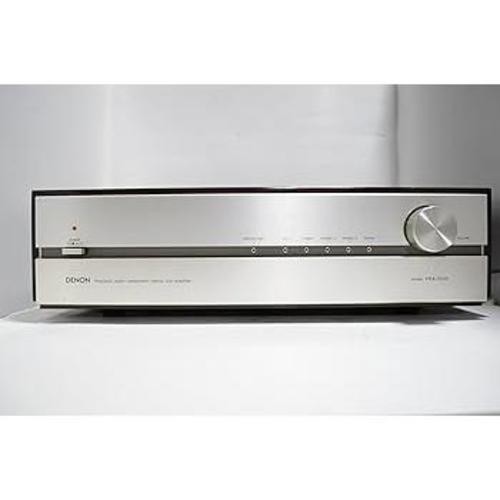
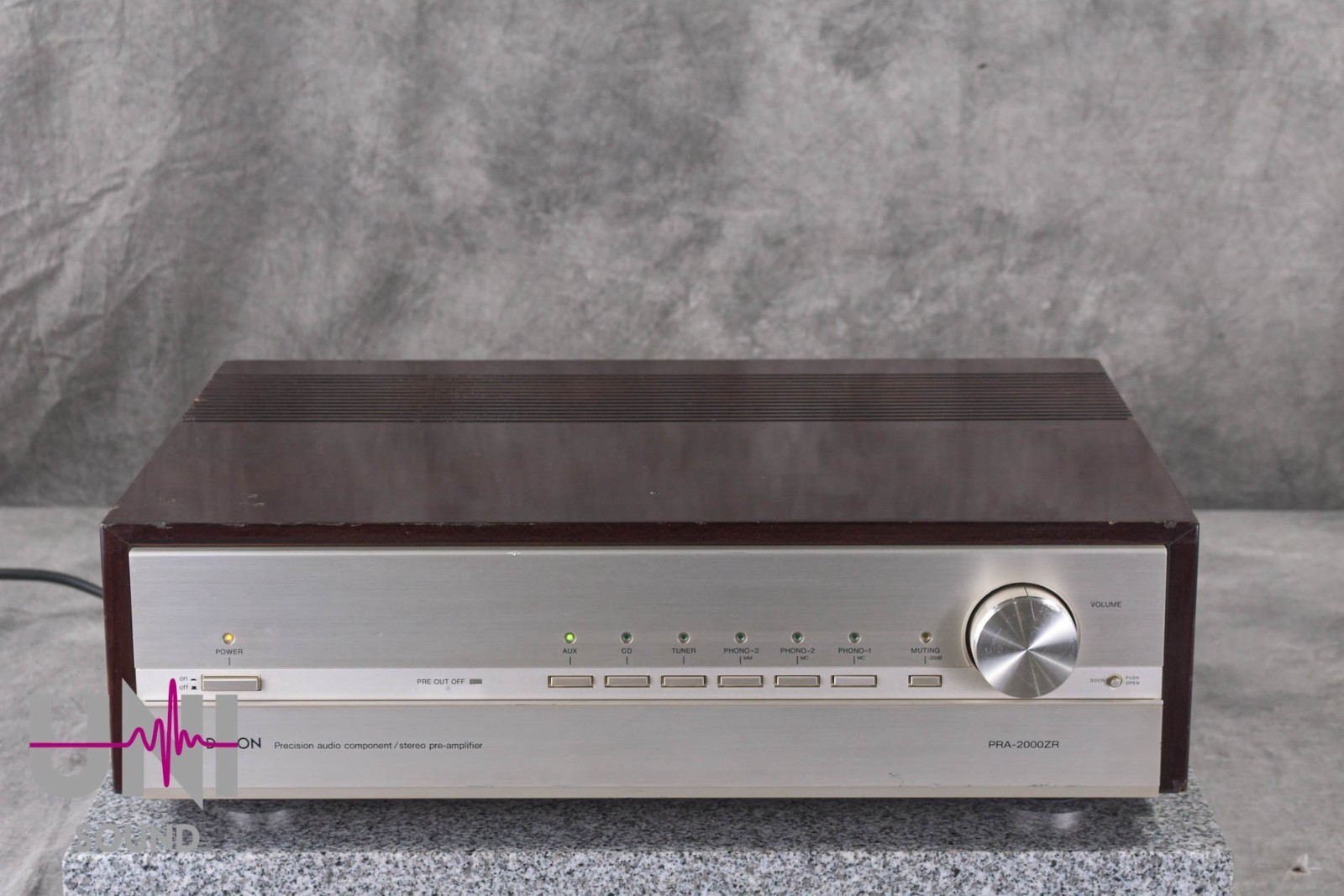
The front panel is minimalist yet elegant, with a large central volume knob, source selector, and illuminated VU meters (on some variants) that add both functionality and visual appeal. The build quality is exceptional—thick aluminum faceplate, heavy steel chassis, and high-grade internal wiring all contribute to a sense of enduring craftsmanship.
Common Issues and Maintenance
Like all vintage electronics, the Denon PRA-2000 benefits from careful maintenance. After 40+ years, certain components may degrade:
- Electrolytic Capacitors: The power supply and signal-path capacitors should be checked or replaced if the unit has not been serviced recently. Old caps can lead to hum, reduced performance, or even damage.
- Relays and Switches: The input selector and tape monitor relays can accumulate oxidation. Cleaning with contact cleaner or professional servicing may be needed.
- Volume Control (Attenuator): While not a traditional pot, the resistor ladder can develop crackling if oxidized. A gentle application of contact cleaner may help, but disassembly should be done carefully.
- Tubes?: No—this is a solid-state design. No tube replacement needed, which simplifies long-term ownership.
It’s recommended to have the unit evaluated by a qualified technician familiar with vintage Japanese gear before extended use. A recapped and properly calibrated PRA-2000 can perform as well today as it did in 1979.
Current Market Value and Collectibility
The Denon PRA-2000 is not as common on the vintage market as some other Japanese preamps, which contributes to its allure among collectors. Units in excellent cosmetic and working condition typically sell between $600 and $1,000, depending on region and included accessories. Fully serviced examples with original packaging can command higher prices, especially in Europe and Japan.
Its collectibility is growing, driven by renewed interest in vintage Japanese high-end audio. While Denon is better known today for AV receivers and home theater, the PRA-2000 reminds us of a time when the brand competed at the very top of the analog audio world.
Conclusion and Legacy
The Denon PRA-2000 is more than just a preamplifier—it’s a statement of engineering excellence and audiophile intent. In an era when many brands chased power ratings and flashy features, Denon focused on refinement, transparency, and musicality. The PRA-2000 embodies that philosophy.
Today, it remains a compelling choice for vintage system builders seeking a preamp that combines technical sophistication with genuine musicality. Paired with a high-quality power amplifier and analog sources, it delivers a listening experience that rivals modern high-end gear—often at a fraction of the cost.
For those who appreciate the quiet confidence of understated excellence, the Denon PRA-2000 is a hidden gem worth discovering. It may not shout for attention, but once you listen, you’ll understand why it’s still revered decades later.
eBay Listings


As an eBay Partner, we earn from qualifying purchases. This helps support our independent vintage technology research.
Related Models
- Denon DRA-800 (1985)
- Denon PMA-350Z (1980)
- Denon POA-1500 (1979)
- Denon PRA-1500 (1979)
- Denon DRA-350 (1985)
- Luxman L-530 (1975)
- Luxman R-404 (1975)
- Luxman RV-371 (1975)
- Luxman SQ-38U (1975)
- Luxman T-14 (1972)