Denon POA-800 (1986–1991)
A late-80s sleeper that delivers weight, control, and surprising finesse—once you accept it’s not going to dazzle on paper.
Overview
It doesn’t announce itself with flashy meters or towering heat sinks, but the Denon POA-800 has a way of sneaking into your system and refusing to leave. Slotted into Denon’s lineup between 1986 and 1991, this stereo power amplifier arrived during a transitional phase for the brand—no longer the analog-only purist of the 1970s, but not yet the digital-centric AV titan it would become. The POA-800 sits quietly in that middle ground: a no-frills, dual-mono design that prioritizes stability, bass authority, and long-term reliability over headline-grabbing specs. And while it may not have won awards or broken sales records, owners who’ve lived with it swear by its ability to anchor a system with composure and drive.
Positioned below Denon’s exotic monoblocks like the POA-8000 but above the entry-level integrateds, the POA-800 was the workhorse of its era—a “prosumer” amplifier built for serious listeners who wanted Denon’s engineering rigor without the price tag of their flagship models. It wasn’t trying to be flashy. It was built to disappear into the background of a high-end two-channel setup, letting the preamp and speakers do the talking while handling current demands with quiet confidence.
What stands out decades later isn’t its raw power, but its demeanor. Unlike some Japanese amps of the late ’80s that leaned bright or clinical, the POA-800 leans warm without being soft, offering a midrange that feels grounded and instruments that occupy real space. It doesn’t hyperventilate over detail; it lets the music breathe. This makes it a natural partner for forward speakers or sources that benefit from a touch of damping and neutrality. Pair it with a bright electrostatic or a lean solid-state preamp, and the POA-800 can act as a sonic ballast—smoothing edges without smearing transients.
It’s also a reminder that not every amplifier from this period chased maximum wattage. With 50 watts per channel into 8 ohms and 90 into 4, the POA-800 won’t power stadium-sized rooms, but it has no trouble driving sensible loads like the KEF LS50 of its day or vintage Tannoy dual-concentrics. More importantly, its power supply and output stage are overbuilt relative to its rating, meaning it rarely strains, even when asked to deliver dynamic peaks. That kind of headroom—quiet, unadvertised—is what separates competent amplifiers from ones you grow old with.
Specifications
| Manufacturer | Denon |
| Production Years | 1986–1991 |
| Original Price | Not documented |
| Power Output | 50 WPC @ 8Ω, 90 WPC @ 4Ω |
| THD | Not documented |
| IM Distortion | Not documented |
| Frequency Response | Not documented |
| S/N Ratio | Not documented |
| Input Sensitivity | 1V (typical for era) |
| Load Impedance | 4–8Ω |
| Damping Factor | Not documented |
| Inputs | 1 pair RCA |
| Outputs | 1 pair binding posts per channel |
| Protection Circuitry | Thermal, over-current, DC offset |
| Power Supply | Single toroidal transformer, dual-rail |
| Amplifier Class | Class AB |
| Weight | 12.5 kg (approx.) |
| Dimensions (W×H×D) | 430 × 145 × 335 mm |
| Finish | Black chassis, brushed aluminum front panel |
| Cooling | Passive heatsinks, no fan |
Key Features
Dual-Mono Layout Without the Price Tag
Denon didn’t just slap two channels into a box and call it a day—the POA-800 uses a dual-mono topology with separate power regulation for each channel, minimizing crosstalk and channel interaction. While it doesn’t go as far as the POA-8000’s monoblock architecture, this internal separation is a step above budget designs that share a single power supply rail. The result is a stereo image with better focus and layering than you’d expect from a mid-tier amplifier of the late ’80s. The circuit layout avoids unnecessary complexity, favoring discrete transistors over op-amps in the signal path, which contributes to its direct, uncolored presentation.
Overbuilt Power Supply for Its Class
One of the first things service technicians notice when opening a POA-800 is the size of its transformer relative to its output rating. It’s not massive by monoblock standards, but for a 50-watt amplifier, it’s generous. Paired with a solid bank of filtering capacitors (originally 10,000µF per rail), the power supply delivers consistent voltage under load. DIYers on audio forums have long noted that upgrading these capacitors—either in value or quality—can further improve bass control and dynamics, especially when driving low-impedance loads. The original Marcom or Hitachi caps are known to degrade over time, but replacements are readily available and within reach of most technicians.
Conservative, Reliable Protection System
The POA-800 includes a multi-stage protection circuit that monitors for DC offset, thermal runaway, and short circuits. If triggered, the output relays disengage, safeguarding both the amplifier and speakers. While this system is effective, it can be sensitive—especially in older units where capacitor drift or transistor aging causes false trips. Some owners report the amp cutting out during high-volume playback, only to return after a cooldown. This isn’t a design flaw per se, but a sign that the unit needs servicing. Unlike some Denon models from the same era, the POA-800 doesn’t feature a self-diagnostic display, so troubleshooting requires a multimeter and a service manual.
Historical Context
The POA-800 emerged when Denon was balancing its legacy in high-end analog with the rise of digital audio and home theater. While brands like Accuphase leaned into opulence and NAD championed value, Denon occupied a middle ground—engineering-focused, understated, and reliable. The POA-800 wasn’t marketed as a statement piece. It didn’t have the futuristic flair of the POA-8000, nor the mass-market appeal of Denon’s receivers. Instead, it was the amplifier you’d find in a well-considered two-channel stack, often paired with the PRA-1500 preamplifier or similar.
Its main competitors were models like the Yamaha B-7, Marantz PM-80, and Sansui AU-D30000—all offering similar power ratings and build quality. What set the POA-800 apart was its conservative tuning and robust construction. While some of those rivals leaned bright or emphasized high-frequency sparkle, the Denon favored balance and control. It was also built to last: heavy steel chassis, high-quality RCA jacks, and a layout that allowed for decent internal airflow. In an era when some manufacturers were beginning to cut corners for cost, Denon held firm on mechanical integrity.
Interestingly, the POA-800 shares little DNA with Denon’s more celebrated amplifiers. It doesn’t use the company’s “non-feedback” topology or Real Bias systems. It’s a conventional Class AB design, but executed with care. That makes it less of a technological showcase and more of a practical tool—an amplifier for people who cared more about long-term performance than cutting-edge innovation.
Collectibility & Value
The POA-800 isn’t a trophy piece. You won’t find collectors bidding it up on auction sites for five figures. But it’s not disposable, either. In recent years, working units in good condition have traded between $200 and $400, with prices creeping higher for fully serviced examples. Fully restored models—especially those with recapped power supplies and cleaned controls—can reach $500, particularly when sold as part of a matching preamp-and-amp set.
Its value proposition lies in its reliability and sonic neutrality. For someone building a late-’80s Japanese hi-fi system, the POA-800 offers authentic performance without the fragility of more exotic designs. It’s also a favorite among DIYers who appreciate its serviceable layout and potential for modest upgrades—larger power supply capacitors, improved grounding, or even external power supply mods.
Common failure points are typical of the era: dried-up electrolytic capacitors, oxidized input jacks, and occasional output transistor failure due to heat stress. The original thermal paste has likely degraded, so any unit that’s been powered on after years of storage should be inspected for proper heatsink contact. While not as notoriously unstable as the POA-8000, the POA-800 still benefits from a full recapping every 25–30 years. Labor costs for a full service run $150–$250, depending on location and technician.
When buying, check that both channels play at equal volume, that there’s no DC offset at the speaker terminals (should be under 50mV), and that the protection circuit doesn’t trip under moderate load. A faint hum is common but shouldn’t be loud. If the amp powers on and stays on, plays cleanly at low and high volumes, and doesn’t overheat within 30 minutes of use, it’s likely in decent shape. Cosmetic condition varies—brushed aluminum fronts can scratch, and rubber feet often disintegrate—but the chassis itself rarely warps or corrodes.
eBay Listings
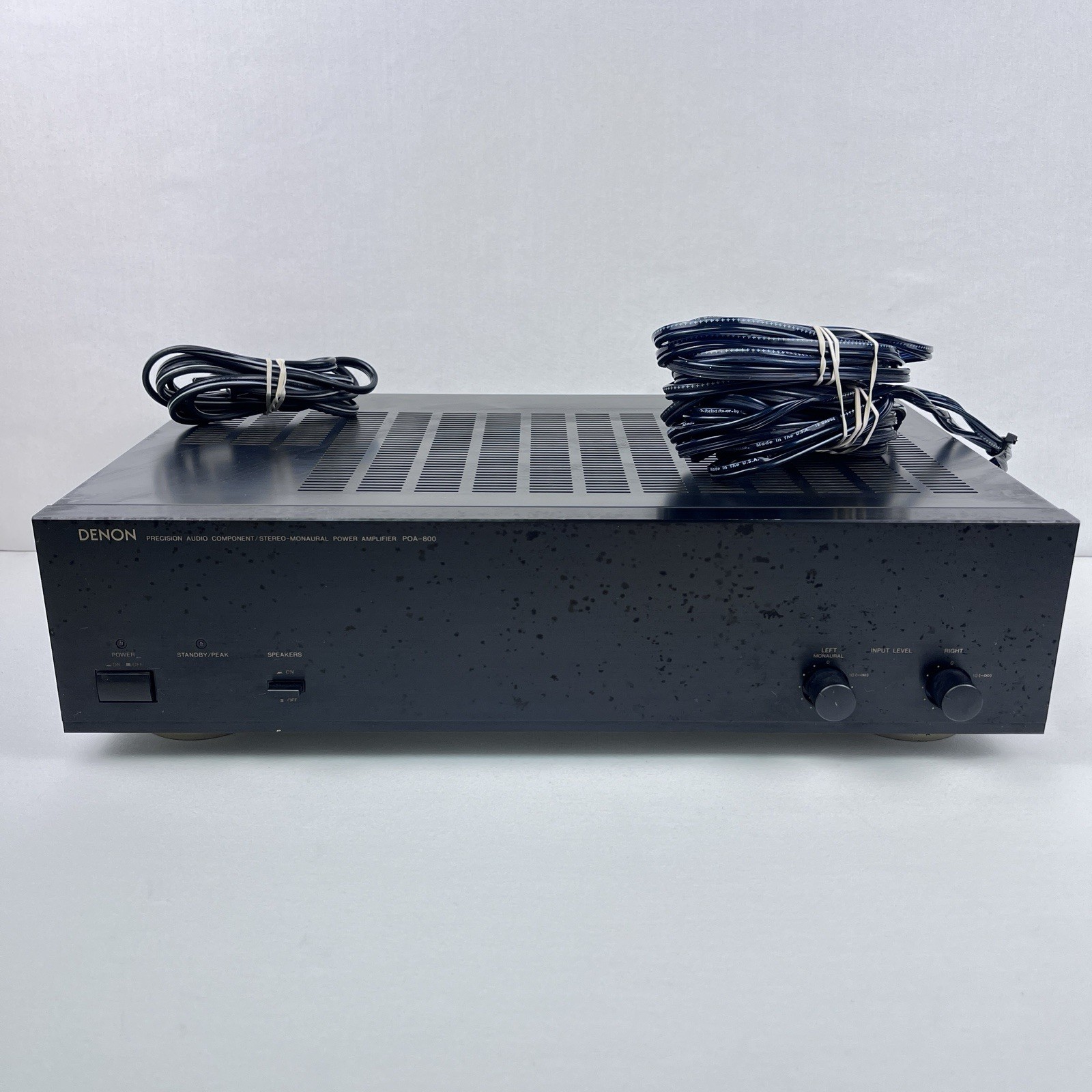
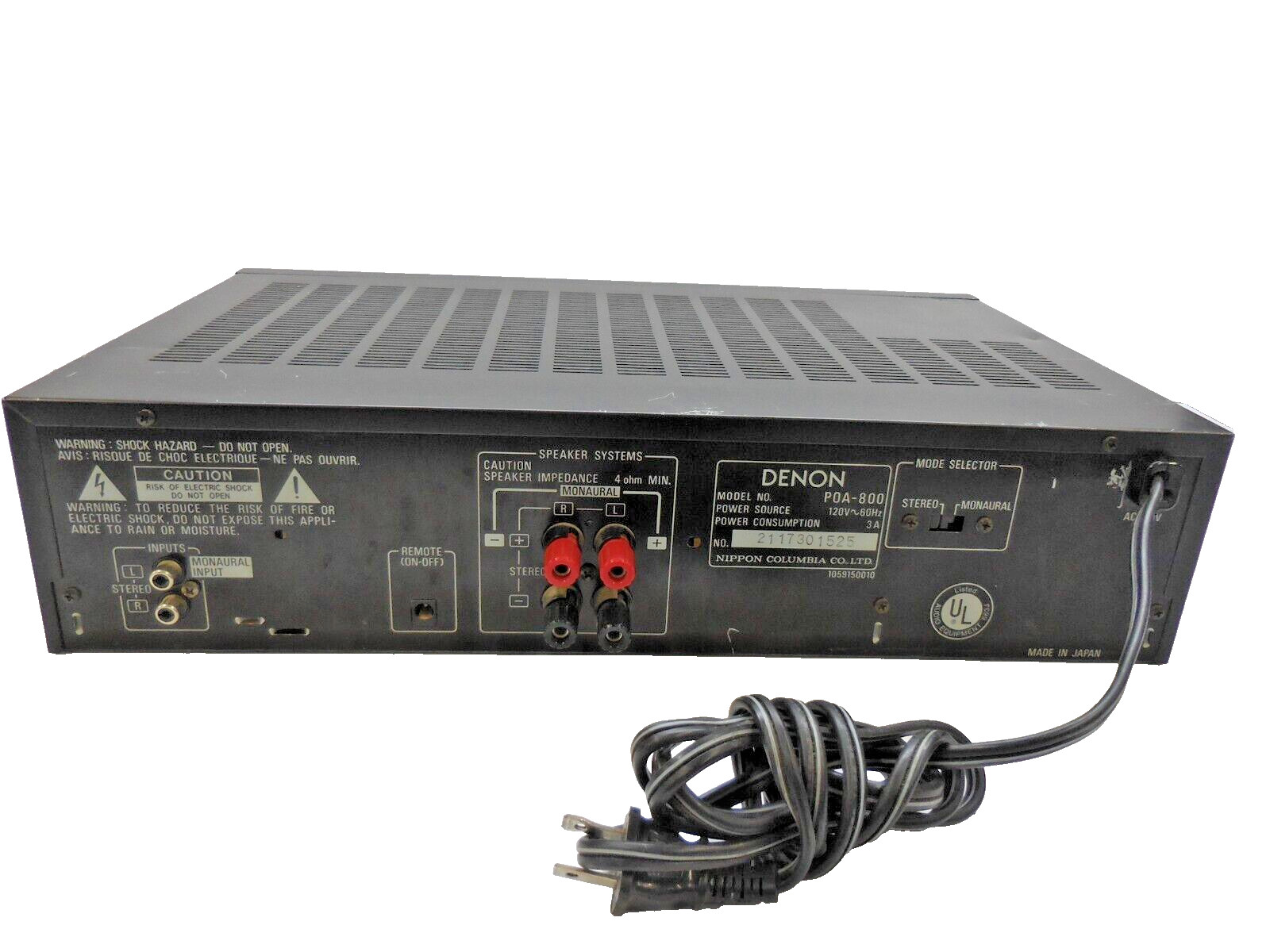

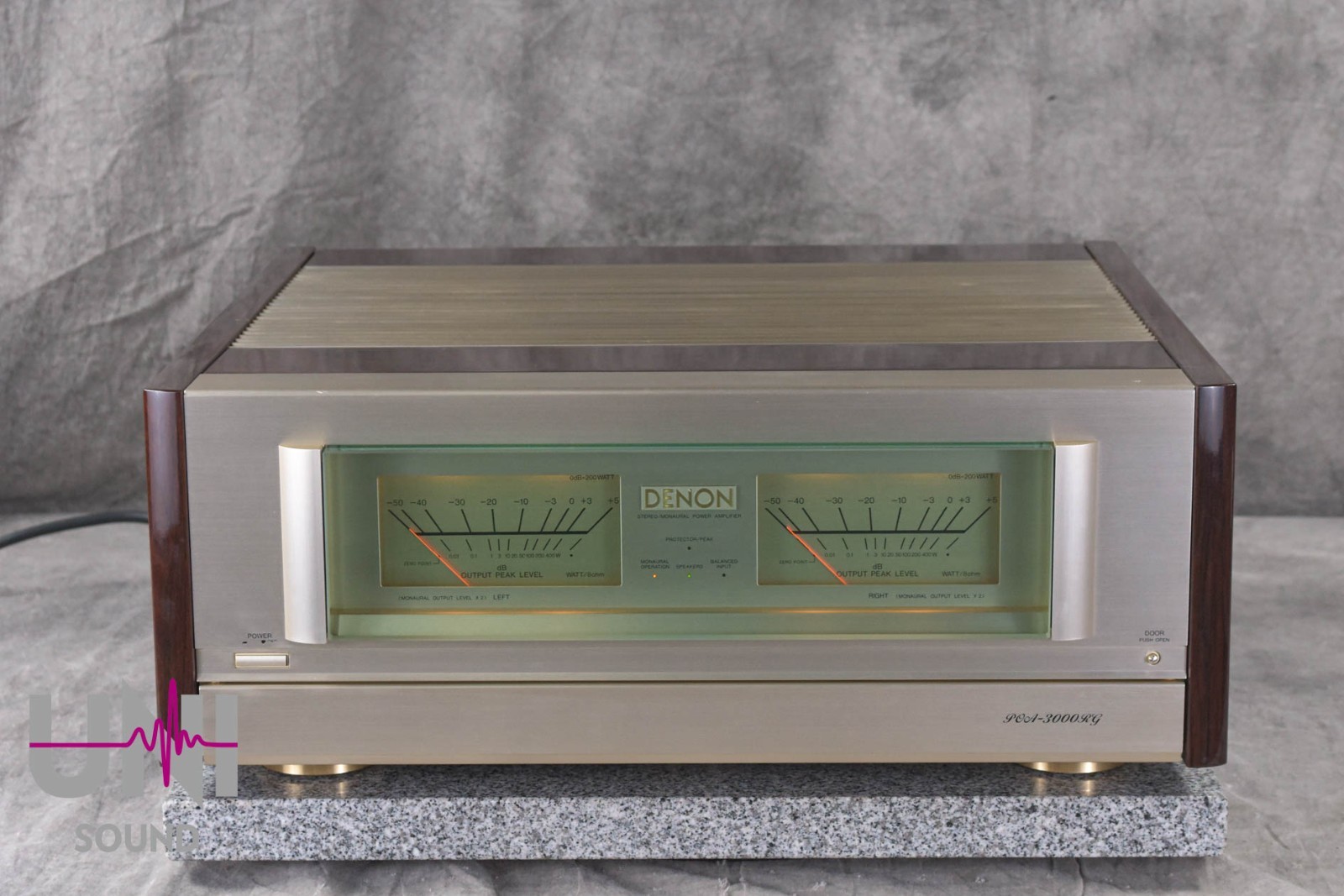
As an eBay Partner, we earn from qualifying purchases. This helps support our independent vintage technology research.
Related Models
- Denon DRA-800 (1985)
- Denon PMA-350Z (1980)
- Denon POA-1500 (1979)
- Denon PRA-1500 (1979)
- Denon DRA-350 (1985)
- Luxman L-530 (1975)
- Luxman R-404 (1975)
- Luxman RV-371 (1975)
- Luxman SQ-38U (1975)
- Luxman T-14 (1972)