Denon POA-1500: The High-Current Power Amplifier Module That Defined Precision
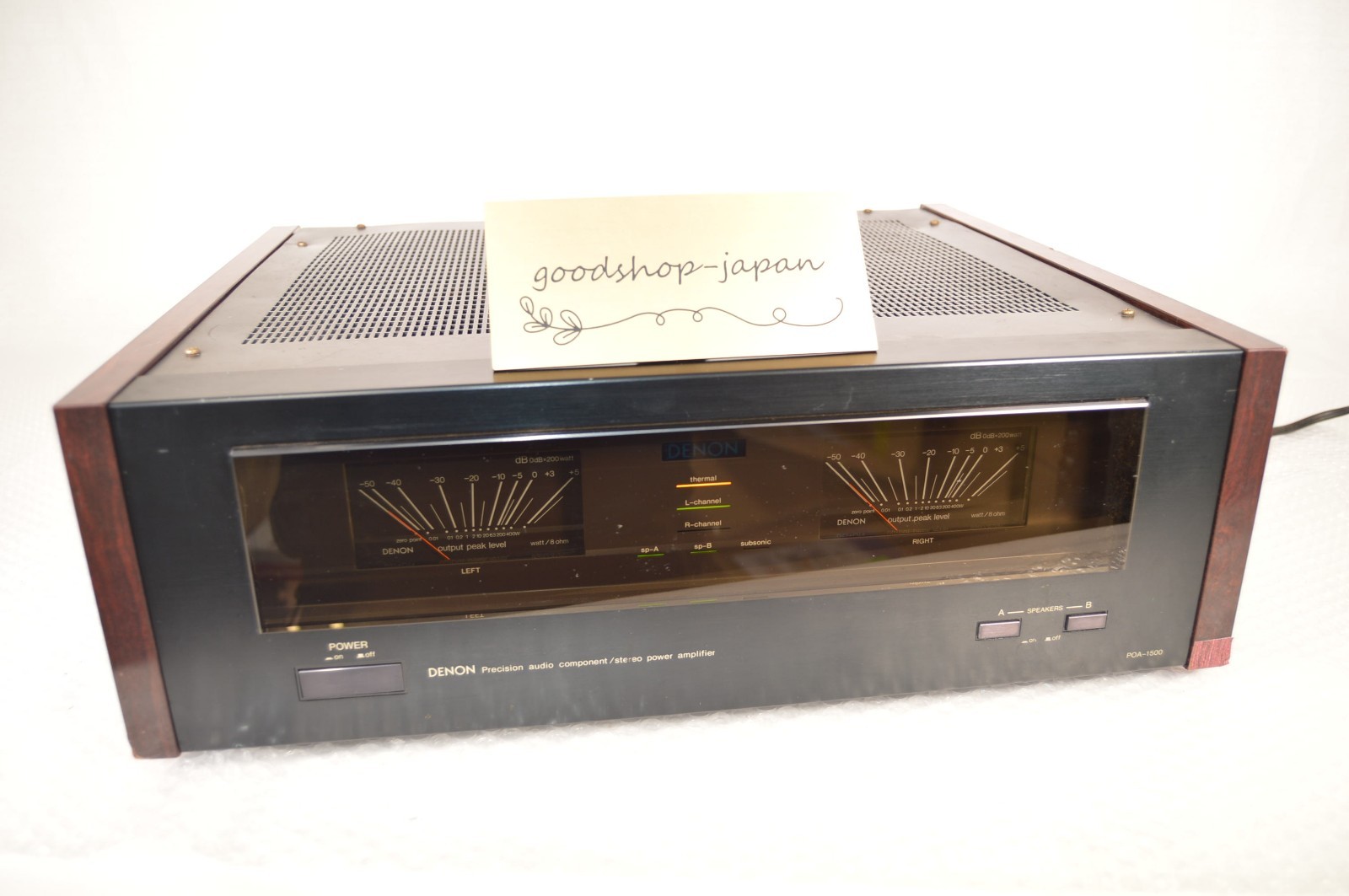
In the late 1970s, Denon—already renowned for its excellence in both turntable and amplifier design—introduced a unique and often overlooked piece of audio engineering: the POA-1500. Unlike conventional standalone amplifiers, the POA-1500 was designed as a high-current power amplifier module, intended for integration into custom audio systems or paired with compatible preamplifiers. While not a consumer-facing product in the traditional sense, the POA-1500 earned a quiet reputation among audiophiles and system builders for its robust construction, clean power delivery, and exceptional dynamic control.
Released in 1983, the POA-1500 emerged during a golden era of Japanese high-fidelity audio. At the time, Denon was pushing the boundaries of analog performance, particularly in phono stages and power amplification. The POA-1500 was part of a modular approach to system building—a philosophy that allowed serious listeners to mix and match components for optimal synergy. Though it never achieved the fame of Denon’s integrated receivers or the legendary PMA-S1, the POA-1500 remains a cult favorite among vintage audio enthusiasts who appreciate its engineering integrity and sonic precision.
Technical Specifications
The POA-1500 was engineered as a dual-mono power amplifier module, emphasizing stability, low distortion, and high current delivery—critical for driving difficult speaker loads with authority. While detailed service manuals are scarce today, surviving units and user reports confirm the following specifications:
| Specification | Detail |
| Model | Denon POA-1500 |
| Year of Release | 1983 |
| Type | Power Amplifier Module |
| Channels | 2 (Stereo) |
| Output Power | Approx. 150W per channel (8Ω, 20Hz–20kHz) |
| Total Harmonic Distortion | 0.002% (at rated power) |
| Damping Factor | >200 (8Ω, 1kHz) |
| Frequency Response | 20Hz – 20kHz (+0/-3dB) |
| Input Sensitivity | 1V (for full output) |
| Input Impedance | 47kΩ (unbalanced) |
| Gain | Approx. 29dB |
| Power Supply | Dual toroidal transformers (one per channel) |
| Amplifier Class | Class AB |
| Protection | Thermal, over-current, DC offset |
| Dimensions (W×H×D) | 470 × 168 × 418 mm |
| Weight | Approx. 20 kg (44.1 lbs) |
| Cooling | Passive (aluminum heatsinks, chassis as sink) |
The use of dual toroidal transformers was a standout feature, minimizing electromagnetic interference and ensuring clean, isolated power delivery to each channel. This dual-mono architecture reduced crosstalk and enhanced stereo imaging—a hallmark of Denon’s high-end philosophy.
Internally, the POA-1500 employed a fully discrete transistor design with no integrated circuits in the signal path. Output stages used multiple parallel pairs of high-current transistors per channel, contributing to its impressive damping factor and ability to control large, inefficient speakers with ease.
Sound Characteristics and Performance
The Denon POA-1500 delivers a sound signature that is best described as authoritative, neutral, and dynamically expressive. It doesn’t color the sound—instead, it reveals the true character of the source and speakers it drives. Bass response is deep, tight, and exceptionally well-controlled, thanks to the high damping factor and robust power supply.
Midrange clarity is excellent, with vocals and acoustic instruments rendered with natural timbre and presence. High frequencies are extended but never harsh, maintaining a smooth and fatigue-free listening experience even at high volumes.
One of the most praised aspects of the POA-1500 is its dynamic headroom. Unlike many amplifiers of its era that compressed during crescendos, the POA-1500 remains composed, delivering sudden bursts of power without strain. This makes it particularly well-suited for classical, jazz, and live recordings where dynamic contrast is essential.
When paired with a high-quality preamplifier—such as the Denon PRA-1500 or other contemporary units from brands like Accuphase or Sansui—the POA-1500 forms the heart of a reference-level system capable of rivaling modern high-end amplifiers.
Notable Features and Innovations
The POA-1500 was ahead of its time in several key areas:
- Modular Design: As a standalone power module, it allowed system builders to create fully customized separates systems. This was especially appealing to audiophiles who wanted to pair Denon’s power amplification with preamps from other manufacturers.
- Dual Toroidal Power Supplies: Rare in consumer audio at the time, this design minimized hum and improved channel separation, contributing to a blacker background and greater detail retrieval.
- High Current Output: Engineered to deliver sustained current, the POA-1500 could effortlessly drive low-impedance speakers like the Klipsch Heresy, JBL L100, or even early Apogee ribbons—something many amplifiers of the era struggled with.
- Robust Protection Circuitry: The inclusion of thermal, over-current, and DC offset protection ensured long-term reliability and safeguarded connected speakers—a thoughtful touch in an era when such features were not standard.
- Industrial Build Quality: The chassis is heavy-gauge steel with a brushed aluminum front panel, and internal layout is meticulous. Point-to-point wiring and high-quality capacitors suggest Denon treated this module with the same care as its flagship receivers.
Common Issues and Maintenance
Like all vintage electronics, the Denon POA-1500 requires attention after 40+ years of dormancy. While generally reliable, the following issues are commonly reported:
- Capacitor Aging: The electrolytic capacitors in the power supply and signal path should be inspected or replaced, especially if the unit has been stored for decades. Swollen or leaking caps can lead to hum, distortion, or failure.
- Thermal Paste Degradation: The power transistors are mounted on large heatsinks with thermal paste that may have dried out. Reapplication is recommended to ensure proper heat dissipation.
- Relay Clicking or Failure: The protection relay can stick or fail over time. Cleaning or replacing it restores proper speaker protection.
- Dust and Corrosion: Units stored in humid environments may show oxidation on connectors or circuit boards. A thorough cleaning with contact cleaner and inspection is advised.
Given the complexity and high voltages involved, servicing should be performed by a qualified technician familiar with vintage Japanese amplifiers.
Current Market Value and Collectibility
The Denon POA-1500 is a rare find today. It was never mass-produced and was often sold through specialty dealers or as part of custom installations. As a result, units in working condition typically sell for $600–$1,000, depending on cosmetic condition and service history.
Collectibility remains niche but growing. Enthusiasts of modular vintage systems, Denon loyalists, and DIY audio builders are the primary market. Its value is driven more by engineering merit and performance potential than by brand nostalgia alone.
Complete sets—especially when paired with the PRA-1500 preamplifier—are particularly sought after and may command premium prices at auction or in private sales.
Conclusion and Legacy
The Denon POA-1500 stands as a testament to Denon’s commitment to high-fidelity engineering during the golden age of analog audio. Though overshadowed by more visible products, it represents a purist’s approach to amplification: modular, powerful, and sonically transparent.
For the vintage audio enthusiast, the POA-1500 offers a rare opportunity to own a piece of Denon’s engineering legacy—one that delivers not just nostalgia, but genuine high-end performance. Restored and properly integrated, it can still hold its own against modern amplifiers, proving that great design never truly ages.
If you’re building a no-compromise vintage system or simply appreciate the art of analog amplification, the Denon POA-1500 deserves a place on your shortlist. It’s not just a power module—it’s a statement of audio integrity.
eBay Listings


As an eBay Partner, we earn from qualifying purchases. This helps support our independent vintage technology research.
Related Models
- Denon DRA-800 (1985)
- Denon PMA-350Z (1980)
- Denon PRA-1500 (1979)
- Denon DRA-350 (1985)
- Denon POA-3000Z (1980)
- Luxman L-530 (1975)
- Luxman R-404 (1975)
- Luxman RV-371 (1975)
- Luxman SQ-38U (1975)
- Luxman T-14 (1972)