Denon PMA-707: The Unsung Powerhouse of Late '80s Hi-Fi
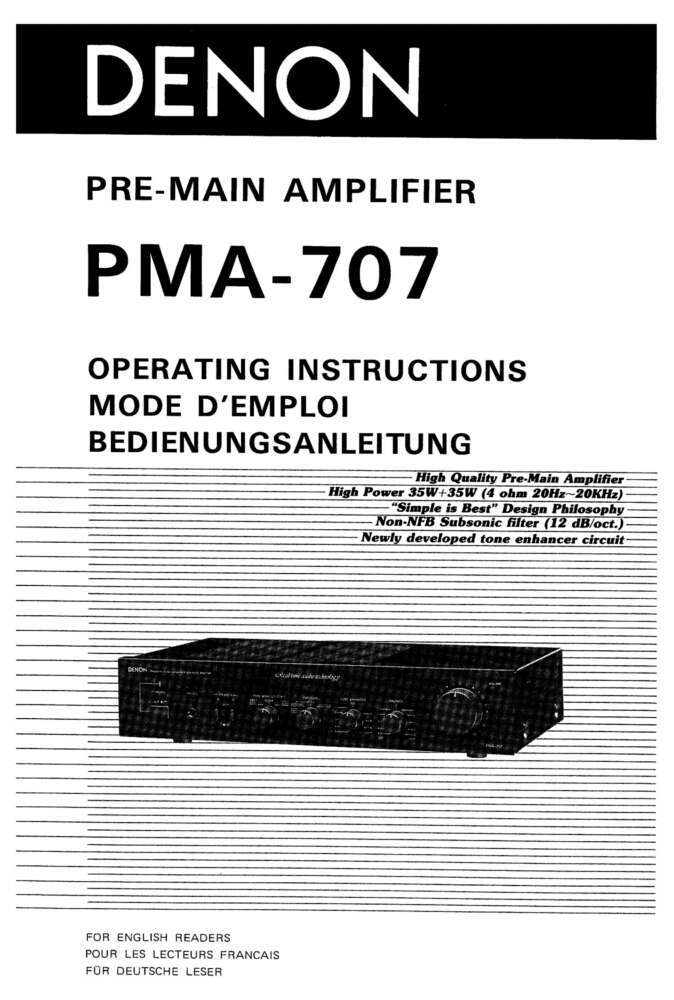
In the late 1980s, Denon solidified its reputation as a serious contender in the high-fidelity audio world, producing amplifiers and tuners that balanced technical precision with musical warmth. Among these was the Denon PMA-707, an integrated amplifier that, while not as widely celebrated as some of its siblings like the PMA-S1 or PMA-550, represents a quiet triumph of engineering and build quality from a golden era of Japanese audio manufacturing.
Released in 1989, the PMA-707 arrived at a time when solid-state amplification had matured, and manufacturers were refining their designs to deliver cleaner power, tighter bass control, and greater transparency. Denon, already renowned for its high-end turntables and CD players, applied the same meticulous attention to circuit layout, power supply design, and component selection in its amplifiers. The PMA-707 is a testament to that philosophy—compact in stature but formidable in performance.
Though it lacks the flashy aesthetics or massive heatsinks of some contemporaries, the PMA-707 was built for serious listening. It was positioned as a mid-to-upper-tier model in Denon’s lineup, offering audiophiles a blend of refinement, reliability, and dynamic punch that could drive a wide range of speakers with authority.
Technical Specifications
| Specification | Detail |
| Model | Denon PMA-707 |
| Year Introduced | 1989 |
| Type | Solid-state integrated amplifier |
| Power Output | 80W per channel (8Ω, 20Hz–20kHz, THD 0.03%) |
| Frequency Response | 10Hz – 100kHz (+0, -1dB) |
| Total Harmonic Distortion | 0.03% (rated at full power) |
| Input Sensitivity | 250mV (for rated output) |
| Input Impedance | 47kΩ |
| Signal-to-Noise Ratio | 100dB (IHF-A weighted) |
| Damping Factor | 80 (8Ω, 1kHz) |
| Speaker Impedance | 4–16Ω |
| Inputs | 4 line-level (RCA) |
| Outputs | Preamp out, tape monitor loop |
| Power Supply | Toroidal transformer (estimated 500VA) |
| Dimensions (W×H×D) | 430 × 145 × 340 mm |
| Weight | 14.5 kg (approx. 32 lbs) |
| Finish | Black or silver (brushed aluminum front panel) |
The PMA-707 features a dual-mono preamp stage with discrete circuitry, minimizing crosstalk and enhancing channel separation. Its power supply is centered around a high-quality toroidal transformer—common in Denon’s higher-end models—delivering clean, stable power to the output stage. The amplifier uses a fully complementary symmetry push-pull design with multiple parallel output transistors, enabling high current delivery essential for controlling difficult speaker loads.
Sound Characteristics and Performance
The Denon PMA-707 is often described by owners as having a "live" and dynamic sonic signature. It doesn’t lean into the overly warm or romantic sound of some Japanese receivers from the era, nor does it adopt the clinical precision of certain European designs. Instead, it strikes a balanced middle ground with excellent clarity, tight bass, and a smooth, extended treble.
Bass response is tight, fast, and well-controlled, thanks to the high damping factor and robust power supply. This makes the PMA-707 particularly effective with bass-reflex and transmission-line speakers that demand current. Midrange is clean and articulate, with vocals rendered with natural timbre and presence. The treble is detailed without being harsh—a hallmark of Denon’s measured approach to high-frequency reproduction.
One of the amplifier’s strengths is its ability to scale with source components. Paired with a high-quality turntable or CD player, the PMA-707 reveals a surprising level of resolution and soundstage depth. It’s not the last word in transparency by modern standards, but for a late-'80s integrated, it holds up remarkably well against today’s competition—especially when maintained properly.
Notable Features and Innovations
While the PMA-707 may appear conservative in design, it incorporates several thoughtful engineering choices:
- High-Current Output Stage: Designed to deliver consistent power into 4Ω loads, making it compatible with demanding speakers like the KEF LS50 (in later years) or Apogee ribbons.
- Discrete Preamp Circuitry: Avoids op-amps in favor of discrete transistors, contributing to a more organic, dynamic sound.
- Tape Monitor Loop: Fully buffered, allowing for easy integration with cassette decks or external processors.
- Preamp Output: Enables future expansion with a separate power amplifier.
- Heavy-Duty Construction: Thick steel chassis, high-quality potentiometers, and gold-plated RCA jacks reflect Denon’s commitment to durability.
The front panel is minimalist—featuring only a large volume knob, source selector, tape monitor switch, and basic tone controls (bass, treble, and loudness). The absence of a remote control (common at this price point in 1989) may deter some, but purists appreciate the direct, tactile interface.
Common Issues and Maintenance
Like all vintage electronics from this era, the Denon PMA-707 benefits from periodic servicing. While generally reliable, a few issues are known to arise after 30+ years:
- Capacitor Aging: The electrolytic capacitors in the power supply and signal path may degrade over time, leading to hum, channel imbalance, or reduced bass response. A full recapping by a qualified technician is recommended for units that haven’t been serviced.
- Potentiometer Noise: The volume and tone controls can develop crackling or channel dropouts. Cleaning with contact cleaner may help, but replacement with modern Alps or Noble pots is often the best long-term fix.
- Thermal Protection: The amplifier includes thermal cutoffs, but dust buildup on heatsinks can impair cooling. Regular cleaning with compressed air is advised.
- Fuse Integrity: Original glass fuses can weaken over time. Using the correct slow-blow replacement (typically 3.15A) is crucial.
With proper care, the PMA-707 can continue to perform reliably for decades. Its modular internal layout makes servicing relatively straightforward compared to more densely packed modern gear.
Current Market Value and Collectibility
The Denon PMA-707 is not a high-profile collector’s item like the Marantz 2270 or Sansui AU-αL, but it has developed a loyal following among audiophiles who value understated performance and build quality. In working condition, it typically sells for $250–$400 USD, depending on cosmetic condition and whether it has been refurbished.
Fully serviced units with new capacitors and cleaned controls command a premium. Original boxes and manuals are rare but add value for collectors. While not yet a “grail” amplifier, its reputation is growing—especially among those building vintage Denon systems (e.g., pairing with the TU-707 tuner or DCD-707 CD player).
Conclusion and Legacy
The Denon PMA-707 may not have the fame of its more celebrated siblings, but it embodies the quiet excellence that defined Denon’s late-'80s engineering. It’s a no-nonsense, high-current integrated amplifier built to deliver dynamic, engaging sound with reliability and precision.
For the vintage audio enthusiast, the PMA-707 offers a compelling blend of performance, build quality, and value. It’s a reminder that not every classic needs flashy badges or sky-high prices to deliver a truly satisfying listening experience. In a world increasingly dominated by digital streaming and miniaturized gear, the Denon PMA-707 stands as a robust, analog statement—powered by current, grounded in craftsmanship, and alive with music.
eBay Listings

As an eBay Partner, we earn from qualifying purchases. This helps support our independent vintage technology research.
Related Models
- Denon DRA-800 (1985)
- Denon PMA-350Z (1980)
- Denon POA-1500 (1979)
- Denon PRA-1500 (1979)
- Denon DRA-350 (1985)
- Luxman L-530 (1975)
- Luxman R-404 (1975)
- Luxman RV-371 (1975)
- Luxman SQ-38U (1975)
- Luxman T-14 (1972)