Denon PMA-480R: The Compact Powerhouse of the Mid-80s
In the golden era of analog audio, when Japanese manufacturers were pushing the boundaries of performance, reliability, and value, Denon stood out as a brand committed to high-fidelity excellence. The Denon PMA-480R, introduced in 1984, is a shining example of this philosophy—a compact yet capable integrated amplifier that brought Denon’s renowned engineering to a wider audience. Though not as widely celebrated as some of its larger siblings like the PMA-S1 or PMA-700, the PMA-480R carved out a loyal following among audiophiles who appreciated its balance of performance, simplicity, and build quality.
Part of Denon’s mid-tier amplifier range during the early to mid-1980s, the PMA-480R was designed for listeners who wanted serious sound without the bulk or price tag of a high-end unit. It reflects the era’s shift toward more compact, efficient designs while maintaining the discrete transistor-based circuitry that defined Denon’s sonic signature. With its sleek front panel, minimalist layout, and robust internal construction, the PMA-480R remains a sought-after piece for vintage audio enthusiasts and those building a compact, high-quality analog system.
Technical Specifications
The PMA-480R delivers solid performance for its class, offering enough power to drive a wide range of bookshelf and small floorstanding speakers. It features a fully discrete amplifier design—no ICs in the signal path—which contributes to its clean, dynamic sound.
| Specification | Detail |
| Model | PMA-480R |
| Manufacturer | Denon Corporation |
| Year Introduced | 1984 |
| Type | Integrated Amplifier |
| Power Output (RMS) | 45W per channel (8Ω) |
| Frequency Response | 20Hz – 20kHz (±0.5dB) |
| Total Harmonic Distortion | <0.05% (1kHz, 8Ω) |
| Input Sensitivity | 2.5mV (MM), 150mV (Line) |
| Input Impedance | 47kΩ (Line), 1kΩ (MM) |
| Signal-to-Noise Ratio | 80dB (MM), 90dB (Line) |
| Damping Factor | 40 (8Ω, 1kHz) |
| Speaker Impedance | 4–16Ω |
| Inputs | 2 Line, 1 MM Phono |
| Outputs | Pre-out (Tape Monitor), Speaker A/B |
| Dimensions (W×H×D) | 420 × 132 × 318 mm |
| Weight | 9.5 kg |
| Power Supply | Linear Transformer, Dual Mono Design (claimed) |
Notably, the PMA-480R features a dedicated MM phono stage, making it ideal for turntable users in an era when vinyl was still king. The inclusion of a tape monitor loop and dual speaker outputs adds flexibility for system expansion.
Sound Characteristics and Performance
The PMA-480R is known for delivering a clean, neutral, and detailed sound—a hallmark of Denon’s design ethos during this period. It avoids the overly warm or colored tonal balance of some contemporaries, instead offering a transparent window into the music. Bass response is tight and well-controlled, thanks to a high damping factor and robust power supply, while the midrange remains clear and articulate—ideal for vocals and acoustic instruments.
Treble is smooth and extended without harshness, making the amplifier forgiving with lesser recordings or bright speakers. Its 45W per channel output may seem modest by today’s standards, but in practice, it’s more than sufficient for nearfield listening or small to medium-sized rooms, especially when paired with efficient speakers (87dB+ sensitivity).
One of the PMA-480R’s strengths is its low noise floor and excellent channel separation, resulting in a wide and stable soundstage. It handles complex passages with composure, never sounding strained or congested. While it may not have the sheer slam or dynamics of larger Denon models, it delivers a remarkably mature and balanced performance for its size and class.
Notable Features and Innovations
Though compact, the PMA-480R incorporates several design elements that reflect Denon’s commitment to quality:
- Discrete Amplifier Circuitry: Unlike many budget amplifiers of the time that used op-amps or integrated circuits, the PMA-480R uses fully discrete transistors in both preamp and power amp stages, contributing to its high fidelity.
- Dual-Mono Power Supply (Claimed): Denon advertised a partially dual-mono power supply layout, with separate rectification and filtering for left and right channels to reduce crosstalk and improve channel separation.
- High-Quality Internal Components: The use of metal-film resistors, polypropylene capacitors, and a toroidal-style power transformer (though not a true toroid) underscores its serious engineering.
- MM Phono Stage with RIAA Equalization: A built-in phono preamp allows direct connection of turntables, eliminating the need for an external stage—a convenience that many users appreciated.
- Compact Chassis with Heat Dissipation Fins: The slim profile fits easily into tight spaces, while the side-mounted heat sinks ensure reliable operation under load.
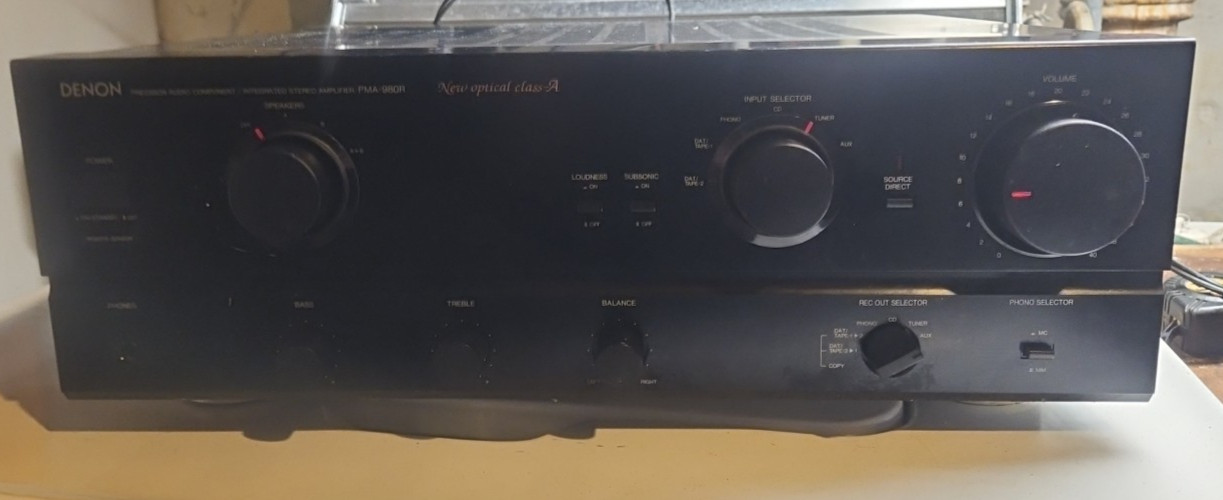
The front panel is minimalist: a large volume knob, source selector, bass/treble controls, loudness switch, and a simple VU meter for monitoring output levels. The build quality is excellent—thick steel chassis, solid knobs, and a brushed aluminum faceplate that resists scratches.
Common Issues and Maintenance
Like all vintage electronics, the PMA-480R benefits from proper maintenance. After nearly 40 years, the most common issues include:
- Dried-up Electrolytic Capacitors: The power supply and signal path capacitors may have degraded, leading to hum, reduced output, or channel imbalance. A full recapping is often recommended for units that haven’t been serviced.
- Dirty Pots and Switches: The volume and input selector pots can develop crackles or channel dropouts. Cleaning with contact cleaner (e.g., DeoxIT) often resolves this.
- Worn Phono Cartridge Loading: While rare, the MM input circuit can drift over time. Checking and recalibrating the input impedance may be necessary for optimal phono performance.
- Fuse and Power Cord Inspection: Ensure the original fuse is intact and the power cord is not frayed—especially important for safety.
For long-term reliability, a professional inspection and servicing are highly recommended before regular use. Replacing the thermal compound on output transistors and cleaning internal connectors can also extend its life.
Current Market Value and Collectibility
The Denon PMA-480R is not a rare amplifier, but well-maintained units in good cosmetic and electrical condition are increasingly hard to find. It trades in the $150–$300 range on the secondary market, depending on condition, provenance, and whether it has been refurbished.
While not as collectible as flagship Denon models, the PMA-480R has gained a cult following among fans of compact vintage gear. Its appeal lies in its reliability, sonic neutrality, and space-saving design—making it ideal for desktop setups, secondary systems, or minimalist living spaces.
Units with original packaging, manuals, or matching-number chassis may command a slight premium, especially in Japan and Europe where Denon’s reputation remains strong.
Conclusion and Legacy
The Denon PMA-480R may not have the wattage or feature set of a high-end receiver, but it exemplifies what made 1980s Japanese audio gear so respected: thoughtful engineering, clean sound, and solid build quality in a compact form. It’s a testament to Denon’s ability to deliver high-fidelity performance without unnecessary complexity.
Today, the PMA-480R serves as a reminder that great sound doesn’t require massive heatsinks or endless features. For vintage audio enthusiasts, it’s a reliable, musical amplifier that pairs beautifully with classic bookshelf speakers like the KEF Coda 1, Tannoy Embassy Sixes, or even modern high-efficiency designs.
If you’re building a compact analog system with vintage charm and real sonic substance, the Denon PMA-480R deserves a serious look. It’s a quiet classic—one that proves sometimes, less really is more.
eBay Listings


As an eBay Partner, we earn from qualifying purchases. This helps support our independent vintage technology research.
Related Models
- Denon DRA-800 (1985)
- Denon PMA-350Z (1980)
- Denon POA-1500 (1979)
- Denon PRA-1500 (1979)
- Denon DRA-350 (1985)
- Luxman L-530 (1975)
- Luxman R-404 (1975)
- Luxman RV-371 (1975)
- Luxman SQ-38U (1975)
- Luxman T-14 (1972)