Denon DRA-935R: A Compact Classic from the Early '90s
Step into any well-kept living room from the early 1990s, and you might have spotted the Denon DRA-935R perched neatly on a shelf or tucked into a modest entertainment center. This wasn’t one of Denon’s flagship separates commanding attention with raw power and polished heft. Instead, it was something quieter, smarter: a compact integrated amplifier with a built-in AM/FM tuner, designed for listeners who valued clean design, solid engineering, and real musicality—without needing a full rack of gear. Released in 1992, the DRA-935R brought Denon’s reputation for high-fidelity precision down to a more accessible scale, proving that great sound didn’t require a sprawling stereo system.
It arrived at a pivotal moment. CDs had taken center stage, cassettes still spun in bedrooms and cars, and streaming was a distant dream. Consumers wanted simplicity—something that looked good, worked reliably, and didn’t demand a degree in audio setup. The DRA-935R delivered exactly that. While it never stole the spotlight from Denon’s heavier hitters like the DRA-795R or DRA-875, it earned quiet respect for its thoughtful build, clean signal path, and unpretentious performance. For many, it was the perfect audio companion: small enough to fit anywhere, good enough to satisfy.
Technical Specifications
Built for efficiency and elegance, the DRA-935R is a no-frills stereo amplifier with a tuner baked right in—ideal for dorm rooms, small apartments, or secondary systems where space mattered. It doesn’t pack the punch of a 100-watt beast, but it wasn’t meant to. Instead, Denon focused on balance, clarity, and the kind of build quality that made even their compact models feel substantial.
| Specification | Detail |
| Model | DRA-935R |
| Year Introduced | 1992 |
| Type | Integrated Amplifier with AM/FM Tuner |
| Power Output | Approximately 20W per channel (8Ω) |
| Frequency Response | 20Hz – 20kHz (+/-1dB) |
| Total Harmonic Distortion | <0.5% (1kHz, rated power) |
| Input Sensitivity | 150mV (Line Inputs) |
| Input Impedance | 47kΩ (Line) |
| Signal-to-Noise Ratio | >80dB (IHF-A weighted) |
| Speaker Impedance | 6–16Ω |
| Tuner Bands | FM, AM (MW) |
| Inputs | 2x Line (RCA), Tape In |
| Outputs | Tape Out, Speaker A/B (switchable) |
| Power Supply | Standard AC 120V / 60Hz (North America) |
| Dimensions (W×H×D) | 430 × 129 × 295 mm (17 × 5.1 × 11.6 in) |
| Weight | 5.8 kg (12.8 lbs) |
| Finish | Black or Silver (depending on region) |
Its dual-speaker A/B switch is a standout—rare in a unit this size—letting you toggle between two sets of speakers with a flick of a button. Whether you're feeding sound to the living room and kitchen, or just comparing two bookshelf models, it’s a small feature that adds real flexibility. The chassis, with its clean faceplate and uncluttered layout, is pure early '90s minimalism: functional, understated, and built to last.
Sound Characteristics and Performance
Don’t expect room-shaking volume or a soundstage wide enough to swallow your couch. The DRA-935R’s ~20 watts per channel won’t drive power-hungry floorstanders to concert levels. But pair it with efficient bookshelf speakers—87dB sensitivity or higher—and you’ve got a system that sings in intimate spaces.
The sound is Denon through and through: balanced, clear, and refreshingly free of the harshness that plagued cheaper receivers of the era. Mids are articulate, vocals come through with warmth, and acoustic instruments feel present, almost tactile. Bass is tight and controlled, though not deep—limited more by physics than design flaws. It’s a polite low end, one that won’t rattle the walls but won’t muddy the mix either.
The built-in tuner holds its own. FM reception is solid, with decent stereo separation and sensitivity—especially when fed a proper wire antenna. AM is functional, though constrained by the unit’s size and the analog tech of the time. Still, for late-night jazz on the local station or Sunday morning talk radio, it gets the job done.
Put simply, the DRA-935R doesn’t impress with specs. It wins you over with coherence. It’s the kind of amp that lets you forget about gear and just listen—perfect for CDs, cassettes, or tuning in to your favorite broadcast.
Notable Features and Design
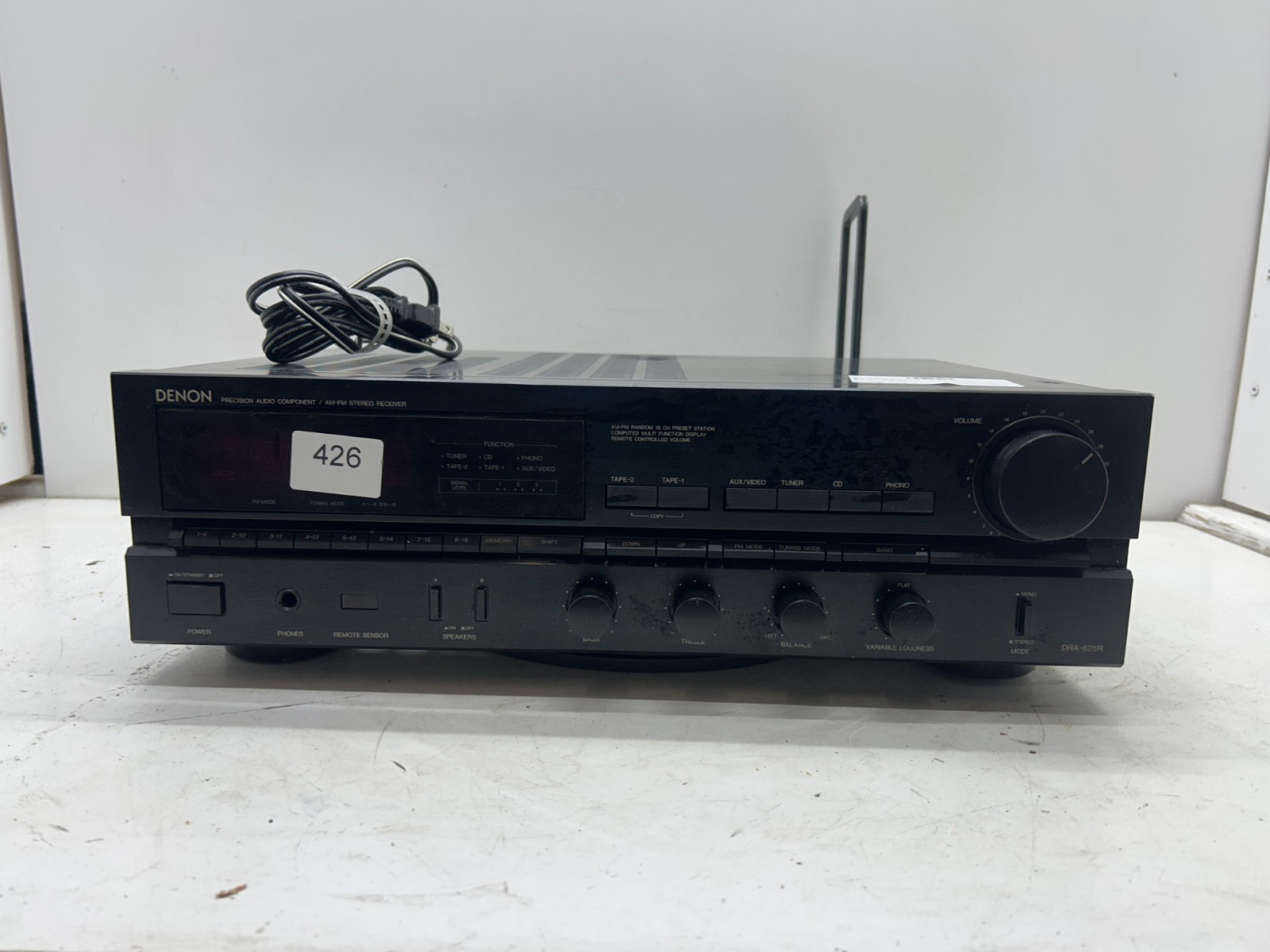
At just over 17 inches wide, the DRA-935R slips into tight spaces like a pro. No bulky transformers, no maze of buttons—just a large tuning dial, a volume knob, a source selector, and a simple display. Everything you need, nothing you don’t.
The Speaker A/B switch isn’t just convenient; it’s a nod to how people actually used these systems. Want background music in the kitchen while you cook? Done. Want to compare vintage KEFs with modern Sonus Fabers? Easy. The tape monitor function adds another layer of utility, letting you record from any source or listen to tape playback without switching inputs.
Inside, Denon didn’t cut corners. The metal faceplate feels solid, the internal layout is well-damped to resist vibration, and the use of discrete amplifier circuitry—instead of cheap op-amps—gives the signal path a cleaner, more dynamic character. The power supply is modest but stable, delivering consistent performance without flinching under normal loads.
Common Issues and Maintenance
After 30+ years, even Denon’s best can show their age. The DRA-935R is generally reliable, but watch for a few telltale signs of wear:
- Sticky or noisy pots: Volume and tuning knobs can develop crackles from dust or oxidation. A shot of contact cleaner often brings them back to life.
- Capacitor aging: Electrolytics in the power supply and signal path may dry out, leading to hum, weak output, or failure to power on. A recapping by a skilled tech can restore it to factory form.
- Tuner drift: Analog FM tuners can lose alignment over decades. Realignment restores sensitivity and stereo lock.
- Display dimming: Fluorescent or LED displays may fade or flicker as driver components age.
With basic care—cleaning jacks, checking speaker terminals, ensuring airflow—these units can keep spinning for years. And thanks to Denon’s service-friendly design, parts and schematics sometimes surface in enthusiast circles or vintage audio shops.
Current Market Value and Collectibility
The DRA-935R isn’t a blue-chip collector’s item like a Denon AVR-2800 or a PMA-S1. But it has its fans—especially among those building compact retro setups or restoring a 1990s-era listening space. Working units typically sell for $50–$120, with price depending on condition, included accessories, and regional demand.
Its appeal isn’t in rarity, but in usability. It’s a genuine Denon experience in a compact form—something you can actually use daily, not just display. In Japan and Europe, where space-saving audio never went out of style, it’s still quietly in demand. For the right listener, it’s not just nostalgia—it’s a smart, stylish system that still holds up.
Conclusion and Legacy
The Denon DRA-935R wasn’t built to dominate. It wasn’t loud, flashy, or packed with features. But it was smart, well-built, and honest in its sound. It represents a side of Denon often overshadowed by their high-end gear: the ability to deliver real audio quality in a simple, compact package.
For vintage audio lovers, it’s a reminder that great listening experiences don’t require complexity. Whether as a secondary system, a retro centerpiece, or a nod to simpler times, the DRA-935R proves that sometimes, less really is more. It’s not the loudest Denon ever made—but for many, it might be one of the most charming.
eBay Listings


As an eBay Partner, we earn from qualifying purchases. This helps support our independent vintage technology research.
Related Models
- Denon DRA-800 (1985)
- Denon PMA-350Z (1980)
- Denon POA-1500 (1979)
- Denon PRA-1500 (1979)
- Denon DRA-350 (1985)
- Luxman L-530 (1975)
- Luxman R-404 (1975)
- Luxman RV-371 (1975)
- Luxman SQ-38U (1975)
- Luxman T-14 (1972)