Denon DRA-400: The Compact Hi-Fi Workhorse of the 1980s
In the mid-1980s, Denon—already renowned for its high-performance turntables, CD players, and high-end amplifiers—expanded its reach into the more accessible end of the audio market with a series of compact integrated amplifiers. Among these was the Denon DRA-400, a modestly powered yet thoughtfully engineered receiver-style amplifier aimed at listeners seeking reliable performance without the bulk or price tag of high-end separates. Though not as celebrated as its larger siblings like the DRA-700 or DRA-1000, the DRA-400 carved out a quiet reputation as a dependable, sonically pleasing component for small to medium-sized listening environments.
Released around 1985, the DRA-400 arrived during a golden era for Japanese audio manufacturing. Compact stereo systems were gaining popularity, and Denon sought to balance affordability with the brand’s hallmark attention to detail. The DRA-400 wasn’t designed to drive demanding speaker loads or fill large rooms with sound, but rather to serve as the heart of a bedroom, study, or secondary system where musicality and build quality mattered more than raw power.
Despite its understated presence, the DRA-400 reflects Denon’s engineering philosophy of the time: clean signal paths, conservative power supply design, and a focus on tonal balance. It was typically paired with bookshelf speakers from brands like Yamaha, JBL, or even Denon’s own speaker lines, forming a cohesive and musical setup for casual listening and FM radio enjoyment.
Technical Specifications
The DRA-400 was built as a no-frills integrated amplifier with basic connectivity and modest power output. While exact specifications are scarce due to the model’s relative obscurity, surviving units and service manuals suggest the following:
| Specification | Detail |
| Model | Denon DRA-400 |
| Year of Release | 1985 |
| Type | Integrated Amplifier |
| Output Power (RMS) | ~18 watts per channel (8Ω, 20Hz–20kHz) |
| Total Harmonic Distortion | <0.05% (1kHz, rated power) |
| Frequency Response | 20Hz – 20kHz (±0.5dB) |
| Input Sensitivity | 2.5mV (Phono), 150mV (Line) |
| Input Impedance | 47kΩ (Line), 47kΩ / 100pF (Phono MM) |
| Output Impedance | 8Ω minimum speaker load |
| Tone Controls | Bass, Treble (±10dB at 100Hz/10kHz) |
| Inputs | 2x Line (RCA), 1x Phono (MM), 1x Tape In |
| Outputs | 1x Tape Out, Speaker A/B (switchable) |
| Tuner | AM/FM with analog tuning dial |
| Power Supply | Toroidal transformer (estimated) |
| Dimensions (W×H×D) | 420 × 125 × 305 mm |
| Weight | ~7.5 kg (16.5 lbs) |
| Finish | Black or silver metallic casing |
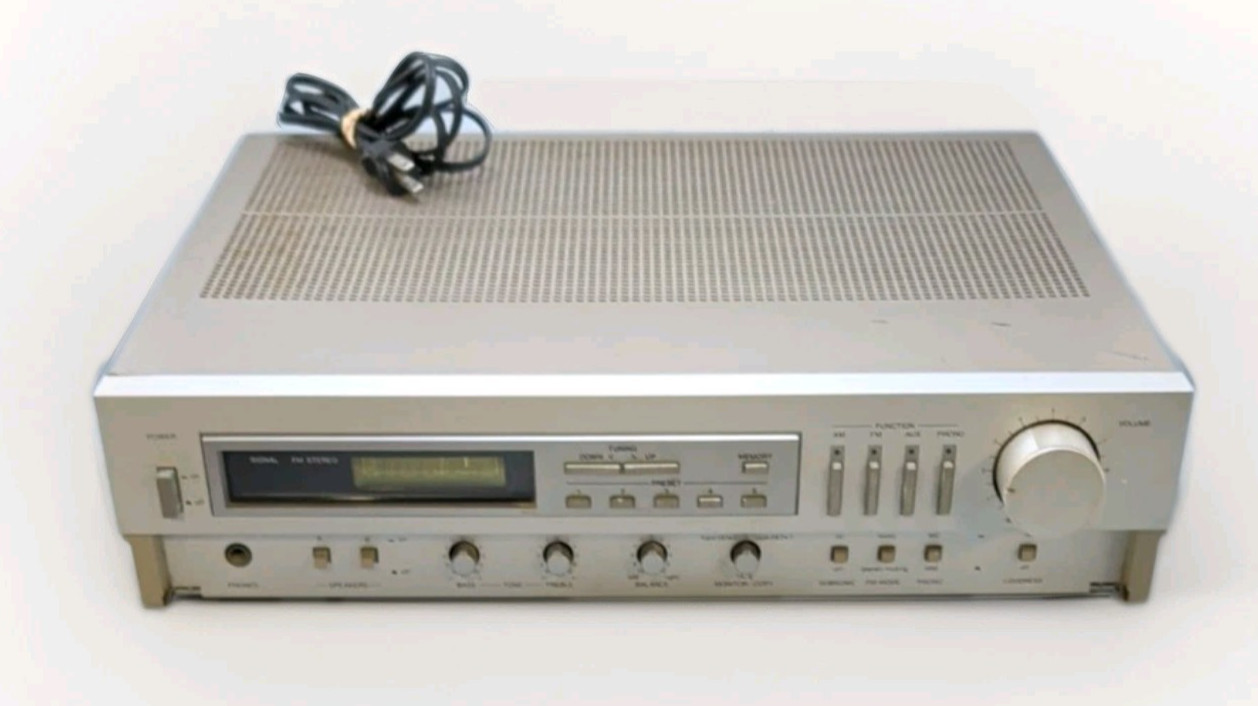
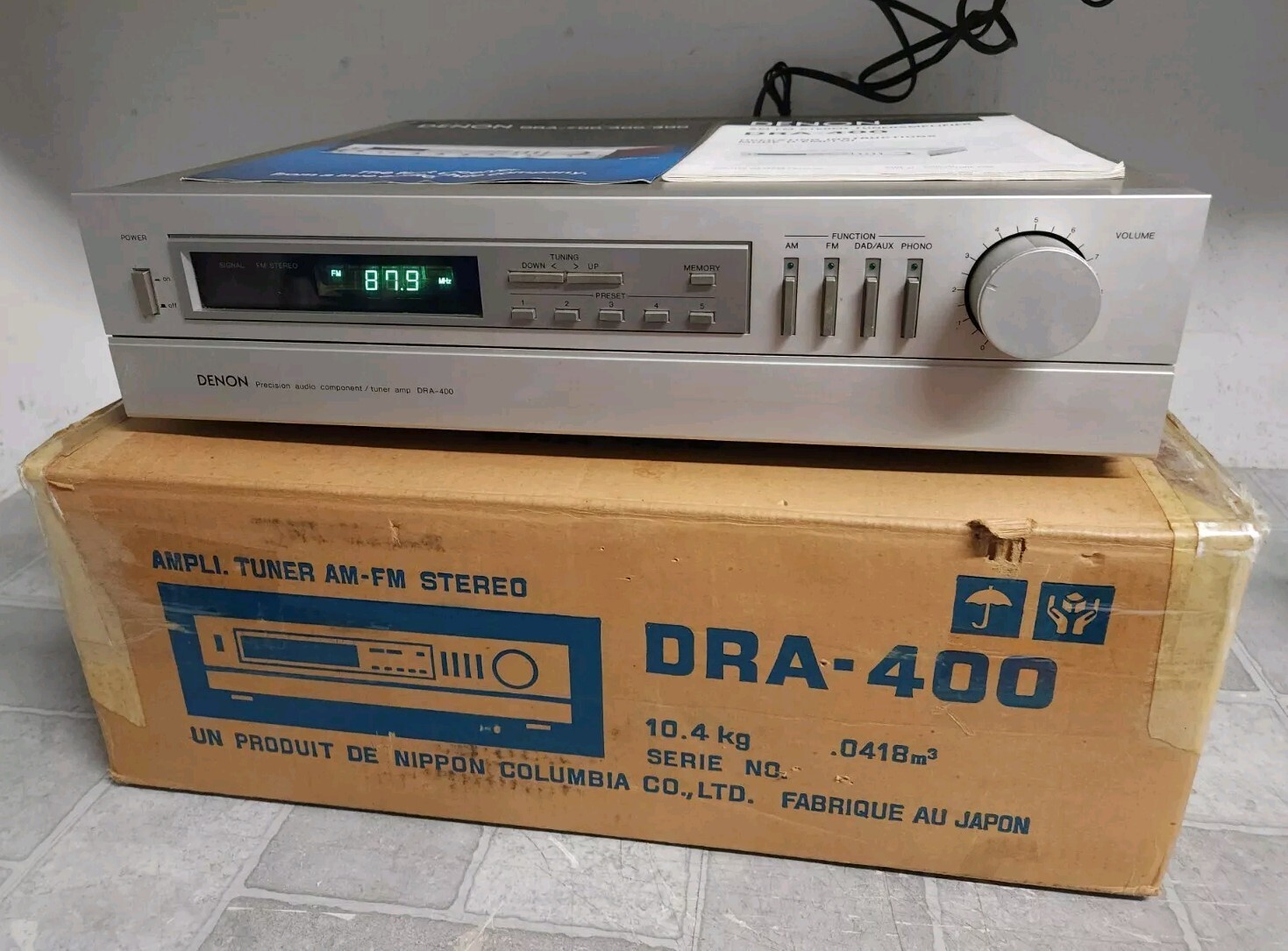
The amplifier features a dual-speaker switching system (A/B), allowing users to connect two pairs of speakers—a convenient feature for multi-room setups or A/B comparisons. Its front panel includes a large volume knob, source selector, tone controls, loudness contour switch, and a basic VU meter for visual feedback. The tuner section, while not a standout performer, delivers acceptable reception with a wire antenna input and manual tuning via a large knob and analog dial.
Sound Characteristics and Performance
The Denon DRA-400 delivers a sound signature typical of mid-tier Japanese amplifiers from the 1980s: warm, smooth, and forgiving. It doesn’t aim for clinical neutrality but instead emphasizes musical engagement and tonal richness. Bass response is tight but not overly deep, making it well-suited for smaller speakers with modest low-end extension. The midrange is clear and slightly forward, lending vocals and acoustic instruments a natural presence.
Treble is rolled off slightly compared to modern gear, which helps tame harsh recordings or bright speakers—ideal for late-night listening or less-than-ideal room acoustics. The overall presentation is coherent and balanced, with a soundstage that, while not expansive, is well-defined for its class.
Though its 18WPC output limits its ability to drive inefficient or large floor-standing speakers, the DRA-400 performs admirably with sensitive bookshelf models like the Yamaha NS-333, KEF Coda 1, or Sony SS-C3. Paired with such speakers, it offers a surprisingly immersive and dynamic listening experience, especially with jazz, vocal, and acoustic genres.
Notable Features and Design
One of the DRA-400’s strengths lies in its clean, functional design. The front panel is uncluttered, with clearly labeled controls and a symmetrical layout that reflects Denon’s minimalist aesthetic of the era. The inclusion of MM phono input was a welcome feature at the time, allowing direct turntable connection without an external preamp—a boon for vinyl enthusiasts building affordable systems.
The dual speaker switching (A/B) adds versatility, and the tape loop enables basic recording to cassette decks, which were still widely used in the mid-80s. The loudness contour switch boosts bass and treble at low volumes, compensating for the human ear’s reduced sensitivity at quiet levels—a thoughtful touch for late-night listening.
Internally, the DRA-400 uses discrete transistor circuitry rather than integrated op-amps, contributing to its robust and analog-like sound. While not as refined as Denon’s higher-end models, its build quality is solid, with point-to-point wiring in critical sections and a well-ventilated chassis to prevent overheating.
Common Issues and Maintenance
Like many vintage electronics from the 1980s, the Denon DRA-400 can suffer from age-related wear. Common issues include:
- Capacitor degradation: Electrolytic capacitors in the power supply and signal path may dry out, leading to hum, channel imbalance, or complete failure. A full recapping is recommended for units that have been dormant.
- Dirty potentiometers: The volume and tone controls can develop crackling noises due to oxidation. Cleaning with contact cleaner often resolves this.
- Tuner drift: The analog FM tuner may lose alignment over time, requiring realignment by a technician.
- Fuse failure: The main fuse can blow due to power surges or failing components. Always check the fuse before assuming deeper issues.
- Oxidized connectors: RCA jacks and speaker terminals may corrode; cleaning with isopropyl alcohol restores conductivity.
Regular maintenance—such as cleaning controls, checking solder joints, and replacing aging capacitors—can extend the life of the DRA-400 significantly. When properly serviced, it remains a reliable performer.
Current Market Value and Collectibility
The Denon DRA-400 is not a highly sought-after collector’s item, but it holds modest appeal among vintage audio enthusiasts who appreciate functional, compact systems from the 1980s. Units in good working condition typically sell for $75–$150, depending on cosmetic condition and whether they’ve been serviced.
Its value lies more in usability than rarity. For someone building a retro bedroom setup or restoring a period-correct audio system, the DRA-400 offers authentic Denon sound at a fraction of the cost of flagship models. It’s also a favorite among modders who upgrade capacitors, op-amps, or power supplies to extract better performance.
Conclusion and Legacy
The Denon DRA-400 may not have made headlines in its day, but it represents an important segment of Denon’s product lineup: accessible, well-built audio for everyday listeners. It embodies the Japanese audio industry’s commitment to quality engineering across all price points during the 1980s.
While overshadowed by more powerful or feature-rich models, the DRA-400 remains a charming and musical amplifier for those who appreciate vintage gear with character. It’s a testament to Denon’s philosophy that even entry-level components should deliver a satisfying, engaging listening experience.
Today, the DRA-400 serves as a reminder that great sound doesn’t always require high wattage or flashy specs. With proper care, it continues to bring warmth and musicality to vintage audio setups—quietly proving that sometimes, the unsung heroes of hi-fi history deserve a second listen.
eBay Listings


As an eBay Partner, we earn from qualifying purchases. This helps support our independent vintage technology research.
Related Models
- Denon DRA-800 (1985)
- Denon PMA-350Z (1980)
- Denon POA-1500 (1979)
- Denon PRA-1500 (1979)
- Denon DRA-350 (1985)
- Luxman L-530 (1975)
- Luxman R-404 (1975)
- Luxman RV-371 (1975)
- Luxman SQ-38U (1975)
- Luxman T-14 (1972)