Denon DRA-1000: The Pioneer of Digital Control in Analog Hi-Fi
In the late 1970s, as the audio world stood on the brink of the digital revolution, Denon—already renowned for its high-fidelity engineering and professional recording equipment—introduced a truly forward-thinking device: the Denon DRA-1000. Unlike conventional receivers or amplifiers of its era, the DRA-1000 was not a power amplifier or a full-featured receiver. Instead, it carved out a unique niche as one of the earliest digital audio controllers, a visionary product designed to integrate emerging digital audio sources with traditional analog hi-fi systems.
Released in 1978, the DRA-1000 predated the commercial availability of the CD player by nearly half a decade. Yet, Denon, having been deeply involved in digital audio research—including early PCM (Pulse Code Modulation) recording systems—anticipated the shift toward digital playback. The DRA-1000 was a bold conceptual leap: a control center engineered to manage both analog and future digital sources with precision, clarity, and a level of sophistication that was years ahead of its time.
Technical Specifications
While the DRA-1000 did not deliver amplification power in the traditional sense, it served as a high-grade preamplifier and system controller with digital logic at its core. Its design emphasized signal purity, source flexibility, and seamless integration with external power amplifiers.
| Specification | Detail |
| Model | DRA-1000 |
| Manufacturer | Denon Ltd., Japan |
| Year of Release | 1978 |
| Category | Digital Audio Controller / Preamp |
| Power Output | Not applicable (line-level controller) |
| Impedance | Not applicable |
| Inputs | 4 line-level analog inputs (RCA), 1 phono (MM), 1 tape loop |
| Outputs | Main out (to power amp), tape out, tuner out |
| Control System | Digital microprocessor-based switching |
| Display | Vacuum Fluorescent Display (VFD) |
| Remote Control | Optional wired remote (rare) |
| Dimensions | 430 mm (W) × 145 mm (H) × 340 mm (D) |
| Weight | 11.5 kg (25.3 lbs) |
| Power Supply | 100V AC, 50/60 Hz (Japan) |
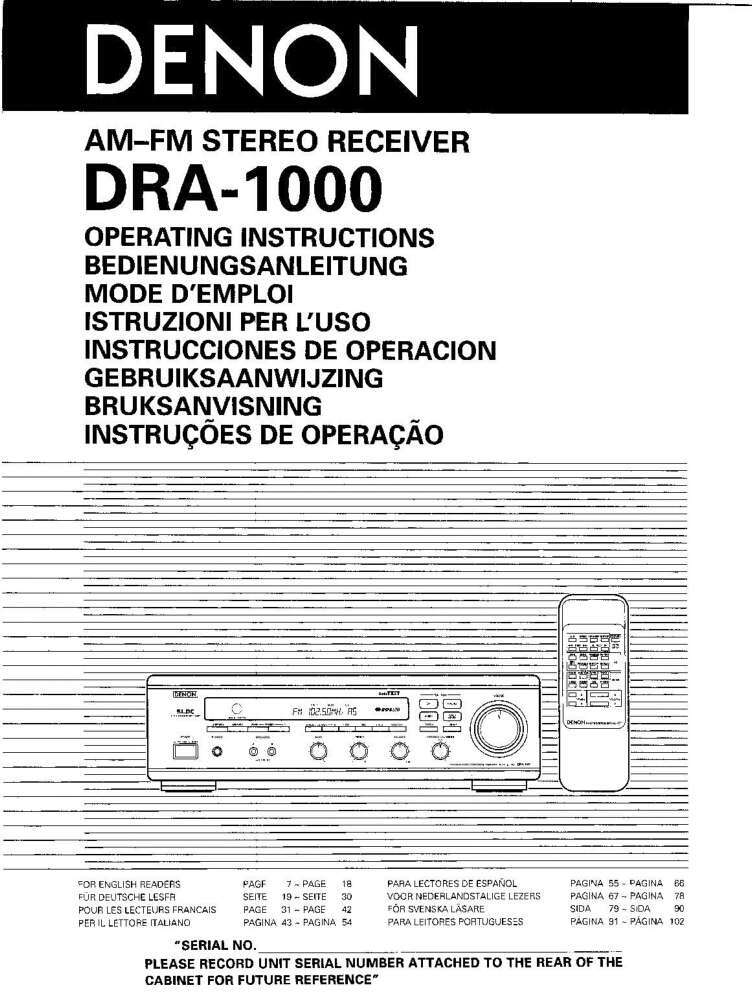
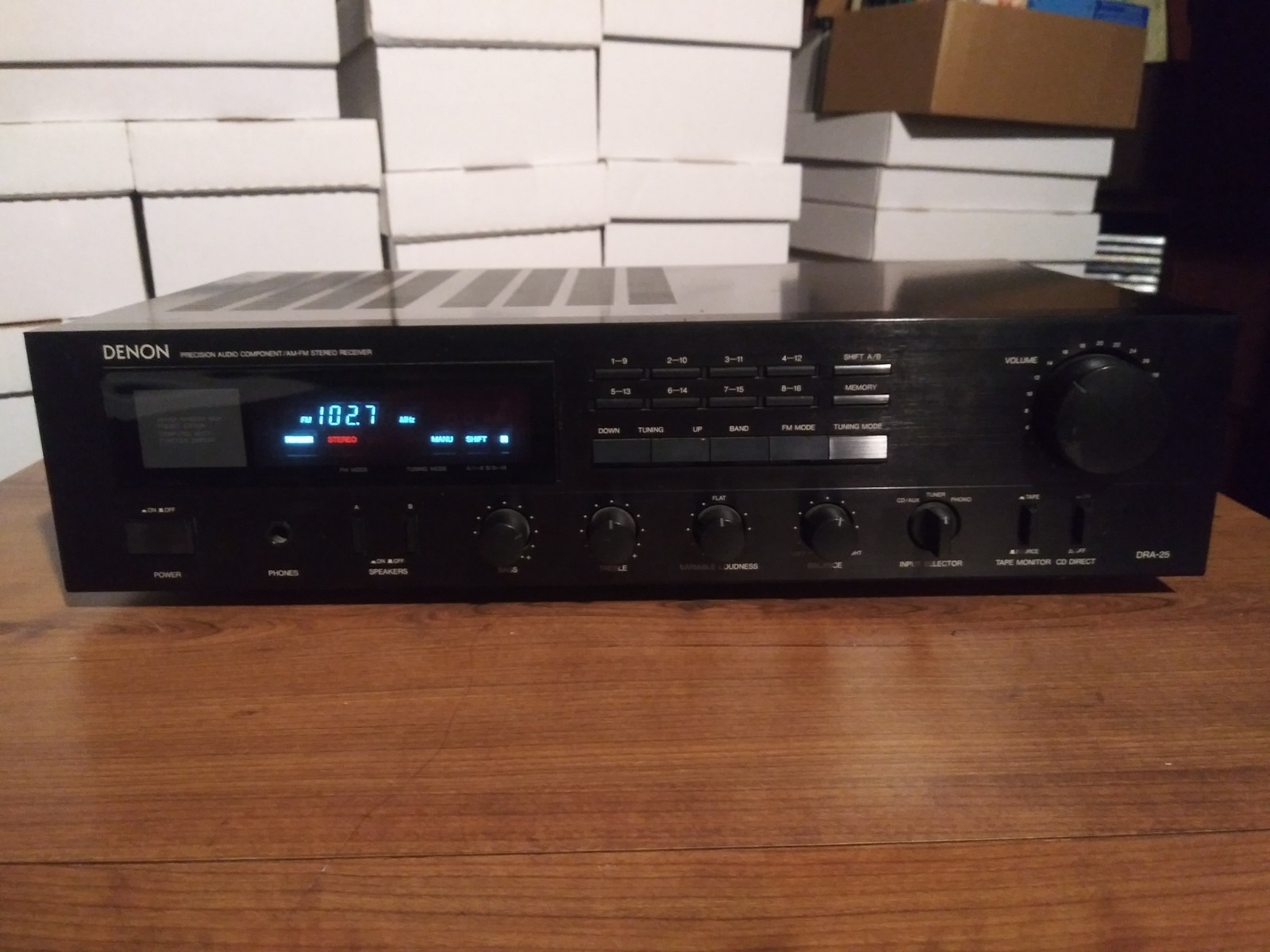
The DRA-1000 featured a robust, heavy chassis typical of high-end Japanese audio gear from the late '70s, with a brushed aluminum front panel, large rotary knobs for volume and balance, and a central VFD display that showed the selected source, volume level, and operational status. This display was a standout feature at the time—offering real-time feedback in an era when most preamps used simple mechanical indicators.
Sound Characteristics and Performance
As a preamplifier, the DRA-1000 was engineered for transparency and neutrality. It employed discrete transistor circuitry with minimal signal path interference, avoiding the op-amp-based designs that became common later. The phono stage was optimized for moving magnet (MM) cartridges and offered a clean, detailed response with low noise—crucial for vinyl playback in an era when turntables were the dominant source.
What set the DRA-1000 apart was not just its sound, but its system integration philosophy. It was designed to be the "brain" of a high-end audio system, allowing users to switch between sources, control volume, and manage tape monitoring with digital precision. The microprocessor-controlled relay switching ensured consistent channel balance and reduced wear on mechanical potentiometers.
Sonically, the DRA-1000 delivered a clear, well-extended frequency response with a slightly warm tonal balance—characteristic of Denon’s house sound during this period. It preserved the dynamics of orchestral recordings and handled complex rock mixes with composure. When paired with high-quality power amplifiers like the Denon PMA series or contemporary models from Luxman or Yamaha, it formed the heart of a reference-level analog system.
Notable Features and Innovations
The Denon DRA-1000 was a showcase of innovation for its time:
- Digital Source Readiness: Though CD players didn’t exist commercially in 1978, the DRA-1000 was designed with digital inputs in mind. While it didn’t have S/PDIF or AES/EBU (those standards came later), its internal architecture allowed for future digital board upgrades—some units were later modified by labs or broadcasters for early PCM playback.
- Vacuum Fluorescent Display (VFD): One of the first consumer audio units to feature a full alphanumeric VFD, providing clear, bright feedback on source selection and volume. This was a luxury feature at the time, usually reserved for test equipment or high-end test benches.
- Microprocessor Control: The DRA-1000 used a custom digital controller to manage input selection, muting, and tape monitoring. This reduced mechanical wear and improved long-term reliability compared to traditional selector switches.
- Modular Design: Internal circuit boards were designed for serviceability and potential upgrades—a rarity in consumer gear of the era. This modularity made the DRA-1000 a favorite among broadcast engineers and audiophiles who valued longevity.
- Optional Remote Control: While not standard, a rare wired remote was available, allowing volume and source control from a distance—an early step toward modern remote integration.
Common Issues and Maintenance
Today, the Denon DRA-1000 is a rare find, and surviving units require careful maintenance:
- Capacitor Aging: Like all electronics from the 1970s, electrolytic capacitors degrade over time. A full recapping of the power supply and signal path is strongly recommended for any unit that has been in storage.
- Relay Contact Oxidation: The microprocessor-controlled relays can develop resistance over decades of inactivity. Cleaning or replacing these ensures reliable switching.
- VFD Dimming or Failure: The vacuum fluorescent display may dim or fail entirely. Replacement tubes are scarce, though NOS (New Old Stock) units occasionally surface in Japanese audio markets.
- Potentiometer Noise: The volume and balance pots can develop crackling. These can often be cleaned, but replacement with modern conductive plastic pots may be necessary.
- Power Supply Sensitivity: Designed for 100V Japanese mains, units exported to 120V or 230V regions require a step-down transformer to avoid damage.
Restoration by a technician experienced in vintage Japanese gear is highly recommended before regular use.
Current Market Value and Collectibility
The Denon DRA-1000 is extremely rare on the vintage market. Unlike mass-market receivers from Pioneer or Sony, the DRA-1000 was a low-volume, high-cost component aimed at early adopters and professional users. As such, it has become a coveted collector’s item, particularly among Denon enthusiasts and historians of digital audio.
In working condition, a fully restored DRA-1000 can fetch $800 to $1,500 USD, depending on completeness (including original packaging, manuals, and remote). Non-working units sell for $300–$500 as restoration projects. Its value lies not in raw performance by modern standards, but in its historical significance as a bridge between analog fidelity and the digital future.
Conclusion and Legacy
The Denon DRA-1000 was never a mainstream product, but it was a visionary one. It embodied Denon’s commitment to innovation and high-end engineering at a time when most manufacturers were still refining analog designs. As one of the first consumer audio components to integrate digital control logic, it foreshadowed the smart, networked amplifiers of the 21st century.
While it lacked the raw power or flashy features of contemporary receivers, the DRA-1000 represented a philosophical shift: the idea that control, precision, and future-proofing were as important as wattage and tone controls. For collectors and audio historians, it stands as a milestone in the evolution of home audio—a rare artifact from the dawn of the digital age.
Owning a Denon DRA-1000 is not just about sound quality; it’s about owning a piece of audio history, a machine that listened to the future—and knew what was coming.
eBay Listings


As an eBay Partner, we earn from qualifying purchases. This helps support our independent vintage technology research.
Related Models
- Denon SC-M5K (1995)
- Denon DR-M2 (1985)
- Denon DA-1000 (1982)
- Denon DL-103 (1962)
- Denon DL-110 (1983)
- Akai AM-2850 (1975)
- Akai AP-206 (1975)
- Nakamichi BX-1 (1985)
- Acoustic Research research-ar-17 (1978)
- Acoustic Research AR-19 (1994)