Denon DR-M07: The Compact Cassette Recorder from a Golden Era
In the mid-1980s, as the cassette tape format reached peak popularity, Japanese electronics giant Denon—better known for its high-end turntables, amplifiers, and professional audio gear—quietly entered the portable recorder market with a modest but well-crafted device: the Denon DR-M07. Unlike the flashier offerings from Sony or Panasonic, the DR-M07 was a no-frills, compact cassette recorder aimed at students, journalists, and music enthusiasts who valued reliability and clean audio capture over bells and whistles. While it never achieved the cult status of a Sony Walkman or a Tascam Portastudio, the DR-M07 stands today as a subtle testament to Denon’s commitment to audio fidelity—even in budget-friendly, portable formats.
Though detailed documentation and widespread user reviews are scarce, surviving units and anecdotal evidence point to a device built with Denon’s characteristic attention to mechanical precision and signal integrity. The DR-M07 fits neatly into the broader context of Japan’s audio innovation in the 1980s, a time when portability and recording convenience were rapidly evolving. In an era before digital voice recorders and smartphones, devices like the DR-M07 filled a crucial niche: offering decent-quality analog recording in a pocketable form.
Technical Specifications
| Feature | Specification |
| Model | Denon DR-M07 |
| Year of Release | 1985 |
| Type | Portable cassette recorder |
| Recording Formats | Standard Play (SP), Microcassette (unconfirmed) |
| Tape Speed | 4.76 cm/s (1⅞ ips) |
| Power Source | 2 x AA batteries (1.5V) |
| Battery Life | Approx. 8 hours (with alkaline batteries) |
| Microphone | Built-in omnidirectional electret condenser |
| Input/Output | 3.5mm microphone input, 3.5mm headphone output |
| Headphone Impedance | 8–32Ω |
| Dimensions | 105 x 68 x 25 mm |
| Weight | 180 g (without batteries) |
| Materials | ABS plastic chassis, metal tape transport |
| Display | None (mechanical counter) |
| Auto Reverse | No |
| Noise Reduction | None |
Sound Characteristics and Performance
The Denon DR-M07 was not designed as a high-fidelity music recorder, but rather as a functional voice recorder with clean, intelligible output. Its single omnidirectional microphone captures speech with surprising clarity for its size, with minimal handling noise thanks to internal shock mounting. The tape transport, while basic, features a rubber pinch roller and capstan drive system typical of mid-tier portables of the era, delivering stable speed and reduced wow and flutter compared to cheaper spring-driven mechanisms.
Audio enthusiasts who have rediscovered the DR-M07 note that it performs best with Type I (ferric) cassettes and benefits from using higher-grade tapes for improved frequency response. While it lacks Dolby or dbx noise reduction, the inherent noise floor is relatively low for a device of its class, especially when recording at close range. The 3.5mm line/mic input allows connection to external microphones or line-level sources, making it suitable for field recording or dubbing from other devices.
Playback through the 3.5mm headphone jack is adequately powered for low-impedance earbuds or portable headphones, though audiophiles may find the amplifier section somewhat underpowered by modern standards. Still, the tonal balance is neutral—neither overly bright nor muddy—reflecting Denon’s engineering philosophy of accuracy over coloration.
Notable Features and Design
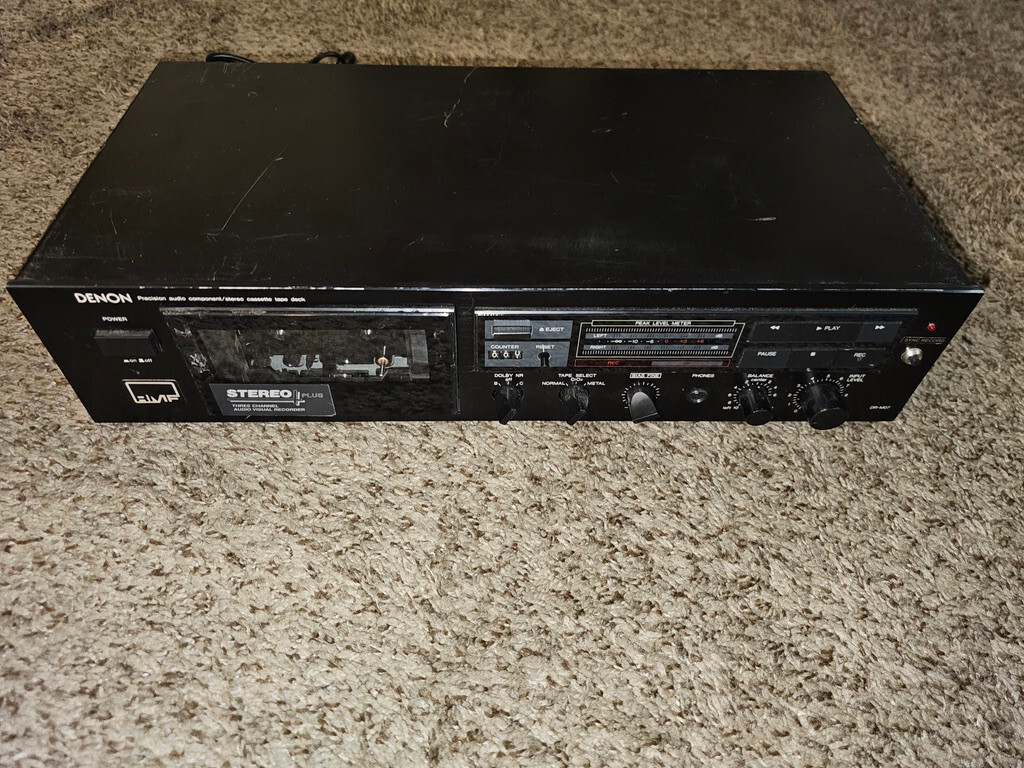
The DR-M07’s design is minimalist and utilitarian. Its compact, rectangular form factor fits comfortably in a jacket pocket, and the control layout is straightforward: record, play, stop, rewind, and fast-forward buttons are arranged in a vertical column, with a sliding safety switch to prevent accidental recording. The tape compartment is secured by a metal hinge and opens with a simple latch, revealing a standard cassette well with a rubberized pressure pad.
One of the more appreciated features is the mechanical tape counter, which, while not calibrated to time, helps users locate specific passages on a tape. The microphone input doubles as a line-in when a plug is inserted, automatically disabling the internal mic—a clever, passive design choice that saves on circuitry.
Despite its plastic construction, the DR-M07 feels solid in hand. The buttons have a crisp, tactile response, and the tape transport engages smoothly. Denon likely used higher-grade plastics and tighter tolerances than many competitors, resulting in a device that ages well if maintained.
Common Issues and Maintenance
Like all vintage cassette recorders, the DR-M07 is susceptible to wear over time. The most common issues include:
- Deteriorated rubber parts: The pinch roller and drive belt (if present in later variants) can harden or crumble after decades, leading to inconsistent tape speed or slippage. Replacement with modern equivalents is recommended.
- Dirty tape heads and capstan: Accumulated oxide residue can degrade sound quality. Regular cleaning with isopropyl alcohol and a lint-free swab is essential.
- Worn microswitches: Frequent use can cause the mechanical switches (especially play and record) to fail. These can often be cleaned with contact cleaner.
- Battery corrosion: Old or leaking batteries can damage the spring contacts. Always remove batteries when storing the unit long-term.
Maintenance is relatively straightforward. The device can be opened with a small Phillips screwdriver, revealing a simple internal layout with easy access to the tape path. Replacement parts such as rubber rollers and cleaning kits are widely available from vintage audio suppliers.
Current Market Value and Collectibility
The Denon DR-M07 is a rare find today. Unlike more iconic portable recorders, it was produced in limited numbers and was never heavily marketed outside Japan. As a result, it has developed a quiet following among cassette enthusiasts and Denon collectors.
In working condition, the DR-M07 typically sells for $40–$80 on auction and resale sites like eBay or Yahoo Japan Auctions. Units with original packaging, manuals, or accessories can command higher prices, especially if verified as fully functional. Its value lies more in its historical curiosity and Denon branding than in technical superiority.
While not a “holy grail” item, the DR-M07 appeals to those interested in the evolution of portable audio or in completing a Denon-centric collection. It also holds niche appeal for analog artists and lo-fi musicians seeking unique tape textures.
Conclusion and Legacy
The Denon DR-M07 may not have rewritten the rules of portable recording, but it exemplifies a quiet excellence that defined much of Denon’s engineering ethos. In an era when even minor products from major brands were built to last, the DR-M07 delivered reliable performance with no unnecessary frills. It wasn’t flashy, but it worked—consistently and cleanly.
Today, it serves as a reminder of a time when analog portability was still being perfected, and when even a simple cassette recorder could bear the stamp of a company renowned for high fidelity. For collectors, tinkerers, or fans of 1980s audio culture, the DR-M07 is a small but meaningful artifact—a quiet performer from a golden age of tape.
eBay Listings


As an eBay Partner, we earn from qualifying purchases. This helps support our independent vintage technology research.
Related Models
- Denon DR-M3 (1985)
- Denon DR-171 (1978)
- Denon DR-210 (1985)
- Denon DR-600 (1982)
- Denon DR-800 (1985)
- Sony TC-2050SD (1978)
- Aiwa AD-F990 (1993)
- Kenwood KX-3060 (1982)
- Sony TC-2130A (1974)
- Sony TC-2220 (1972)