Denon AU-340: The Quiet Contender in Vintage Preamplification
In the golden era of high-fidelity audio during the late 1970s, Denon—already renowned for its precision turntables and innovative amplifiers—quietly introduced a component that would appeal to a niche but discerning group of audiophiles: the Denon AU-340. Unlike the flashy receivers and power-hungry amplifiers dominating the market, the AU-340 was a passive preamplifier, a minimalist design choice that reflected a growing interest in signal purity and sonic transparency. While it never achieved the fame of Denon’s more powerful receivers like the PMA-500 or the legendary POA series, the AU-340 remains a cult favorite among vintage audio enthusiasts who value subtlety, craftsmanship, and uncolored sound reproduction.
Historical Context: Denon in the Late 1970s
By the late 1970s, Denon (then Nippon Columbia Co., Ltd.) had firmly established itself as a leader in both professional and consumer audio. Known for their meticulous engineering and high build quality, Denon components stood out in a crowded Japanese audio market that included giants like Pioneer, Yamaha, and Sansui. While many brands focused on increasing power output and adding features, Denon also invested in the subtler art of signal management—leading to the development of preamplifiers like the AU-340.
The AU-340 was released around 1978, a time when audiophiles were beginning to experiment with separates systems—matching high-quality preamps with powerful amplifiers for optimal performance. The AU-340 fit perfectly into this trend, offering a no-frills, passive design that avoided the coloration often introduced by active gain stages. It was part of a small family of passive preamps Denon produced during this period, including the AU-320 and AU-360, with the AU-340 positioned as a mid-tier option offering excellent value and performance.
Technical Specifications
The Denon AU-340 is a passive preamplifier, meaning it does not include an internal amplifier or power supply for signal gain. Instead, it relies on high-quality passive components—resistors, capacitors, and switches—to manage input selection and volume control. This design minimizes distortion and preserves the integrity of the original audio signal.
| Specification | Detail |
| Model | AU-340 |
| Manufacturer | Denon (Japan) |
| Year of Release | 1978 |
| Type | Passive Preamplifier |
| Inputs | 4 (Phono, Tape, Aux, Tuner) |
| Outputs | 1 Main Out, 1 Tape Out |
| Volume Control | Dual-gang potentiometer, 24dB attenuation |
| Tone Controls | None |
| Power Requirement | None (passive design) |
| Impedance | Not applicable |
| Frequency Response | 20Hz – 20kHz (±0.5dB) |
| Total Harmonic Distortion | <0.01% (at 1kHz) |
| Dimensions (W×H×D) | 420 × 140 × 310 mm |
| Weight | 6.8 kg (15 lbs) |
| Finish | Black or silver aluminum front panel |
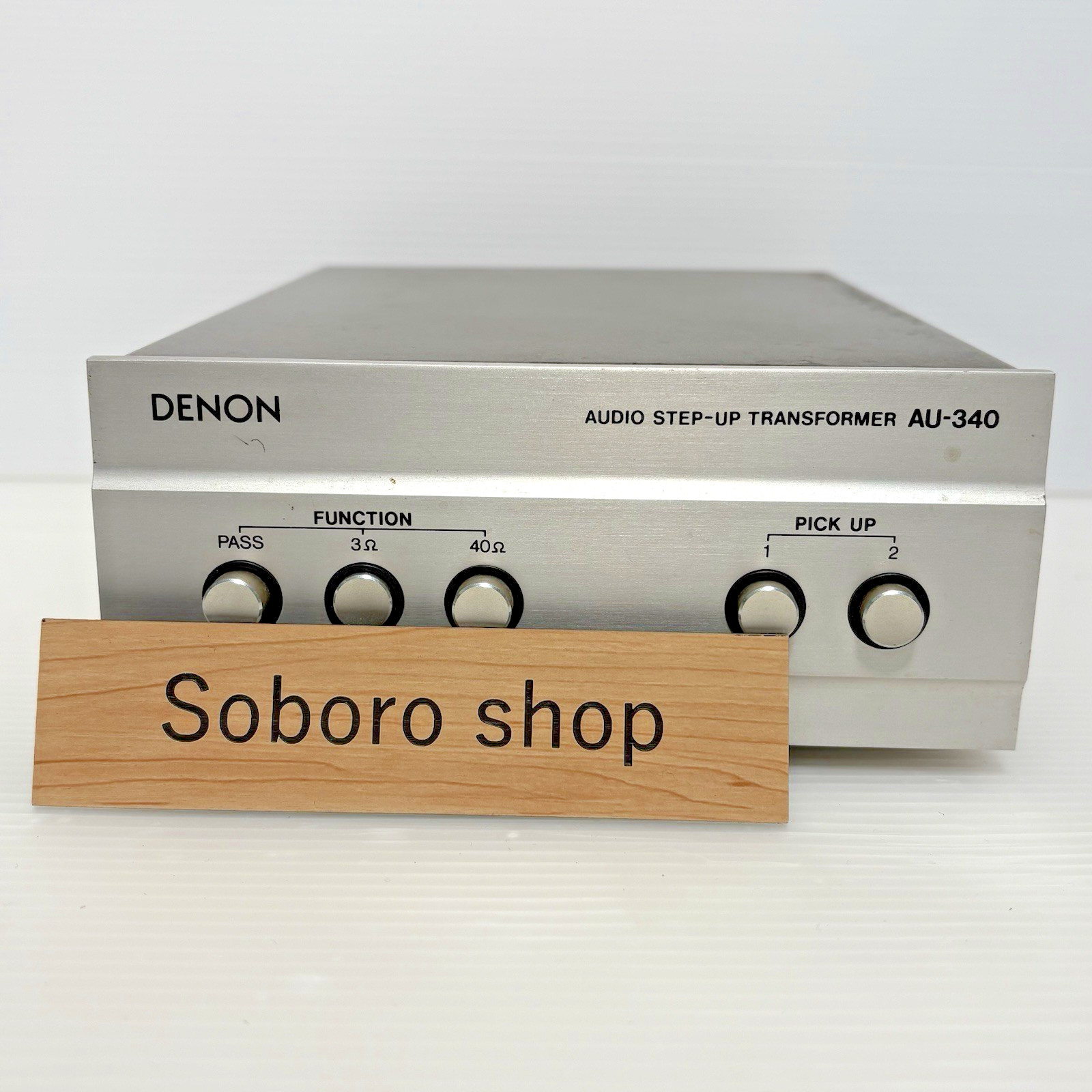
The build quality is typical of Denon’s standards from the era: a heavy steel chassis, a brushed aluminum front panel, and high-quality rotary switches. The lack of tone controls and power supply reflects its purist design philosophy—this is a preamp for listeners who want to hear the music as it was recorded, without added coloration.
Sound Characteristics and Performance
The Denon AU-340 is celebrated for its neutral, transparent sound signature. Without active circuitry, the preamp introduces minimal noise and distortion, allowing the source and amplifier to define the sonic character of the system. When paired with high-quality sources—such as a Denon DP series turntable or a Revox tape deck—the AU-340 delivers a clean, open soundstage with excellent imaging and detail retrieval.
Because it is passive, the AU-340 does not boost the signal. This means it works best when driving a high-input-sensitivity power amplifier (typically 0.5V to 1V). Users with low-output sources (like moving magnet cartridges without a dedicated phono stage) may find the volume levels insufficient. However, when properly matched, the AU-340 excels in clarity and dynamics, offering a sense of immediacy and realism that many active preamps struggle to match.
Its passive nature also means it handles transients with exceptional speed and precision. There’s no “slowing down” of the signal path, resulting in tight bass, articulate mids, and smooth highs. Audiophiles who appreciate acoustic jazz, classical, or vocal recordings often praise the AU-340 for its ability to render subtle nuances in performance.
Notable Features and Design Philosophy
The AU-340’s most notable feature is its simplicity. In an age where electronics were becoming increasingly complex, Denon chose to go minimal. There are no tone controls, no balance adjustments, no remote control—just input selection and volume. This purist approach appealed to listeners who believed that fewer components in the signal path meant better sound.
The use of high-quality passive components was key. Denon sourced precision resistors and low-loss signal path wiring to ensure consistent performance across all channels. The input selector switch is a robust rotary type, known for its durability and clean contact. The volume potentiometer is a dual-gang unit, carefully matched for channel balance.
Another subtle but important design element is the shielded internal layout. Despite having no active circuitry, Denon paid attention to minimizing crosstalk and interference by separating input and output paths and using grounded metal shielding where possible.
Common Issues and Maintenance
Because the AU-340 has no active electronics or power supply, it is generally very reliable. However, like any vintage component, it can develop issues over time—most commonly related to contact degradation.
- Dirty switches and potentiometers: After 40+ years, the input selector and volume control can become noisy or scratchy. Regular cleaning with contact cleaner (such as DeoxIT) can restore smooth operation.
- Oxidation on RCA jacks: The gold-plated RCA inputs and outputs may develop oxidation, leading to intermittent connections. Gentle cleaning with isopropyl alcohol and a soft brush is recommended.
- Capacitor aging (in associated gear): While the AU-340 itself has no capacitors in the signal path, users should ensure that connected equipment (especially phono stages) are in good condition, as the AU-340 passes signals unaltered.
No internal servicing is typically required, and there are no tubes or transistors to replace. This makes the AU-340 a low-maintenance option for vintage system builders.
Current Market Value and Collectibility
The Denon AU-340 is not a rare component, but it is increasingly sought after by audiophiles building vintage separates systems. Its value has risen modestly in recent years, with working units in good condition selling for $200–$400 USD, depending on finish, completeness, and geographic region.
Collectibility is driven more by performance than rarity. Unlike flashy receivers with glowing meters or wood cabinets, the AU-340 is understated. But for those who appreciate minimalist design and high-fidelity signal purity, it’s a hidden gem. It pairs especially well with other Denon classics like the PMA-520 or POA-2000, creating a cohesive, high-performance vintage system.
Conclusion: A Legacy of Purity
The Denon AU-340 may not have the wattage to impress at a show or the flashy features to grab headlines, but it represents something deeper in the world of vintage audio: a commitment to sonic truth. In an era of increasing complexity, it stands as a testament to the idea that sometimes, less is more.
For the modern audiophile exploring vintage separates, the AU-340 offers a rare opportunity to experience music with minimal electronic interference. It’s not for everyone—especially those with low-output sources or a desire for tone shaping—but for the right system and listener, it remains one of the most transparent and musically satisfying preamplifiers of its time.
If you stumble upon a clean, well-maintained AU-340, consider giving it a place in your setup. You might just discover that the quietest component in your system speaks the loudest.
eBay Listings


As an eBay Partner, we earn from qualifying purchases. This helps support our independent vintage technology research.
Related Models
- Denon DRA-800 (1985)
- Denon PMA-350Z (1980)
- Denon POA-1500 (1979)
- Denon PRA-1500 (1979)
- Denon DRA-350 (1985)
- Luxman L-530 (1975)
- Luxman R-404 (1975)
- Luxman RV-371 (1975)
- Luxman SQ-38U (1975)
- Luxman T-14 (1972)