Denon AU-320: The Quiet Master of Passive Preamplification
In the late 1970s, as the high-fidelity audio boom reached its zenith, Japanese manufacturers like Denon were at the forefront of engineering excellence, producing gear that blended meticulous craftsmanship with cutting-edge design. Among Denon’s refined lineup of the era, the AU-320 stands out as a distinctive and often overlooked gem—a passive preamplifier that defied the trend toward complex, powered control centers. Released around 1978, the AU-320 was designed for purists who valued signal transparency above all else. In an age when preamps were increasingly loaded with tone controls, balance adjustments, and elaborate circuitry, Denon took a minimalist approach: fewer components, shorter signal paths, and a commitment to preserving the integrity of the source.
Though not as widely recognized as Denon’s legendary power amplifiers or turntables, the AU-320 has earned a quiet reputation among vintage audio connoisseurs for its elegant simplicity and exceptional performance when paired with the right system. It represents a fascinating chapter in Denon’s history—a moment when the company explored the philosophical edge of high-end audio: What if the best preamp did almost nothing at all?
Technical Specifications
As a passive preamplifier, the AU-320 lacks active gain stages, relying instead on precision attenuators to control volume. This design choice eliminates the coloration introduced by transistors or tubes, offering a clean, neutral signal path. While detailed service manuals are scarce, surviving units and user reports confirm the following specifications:
| Specification | Detail |
| Model | Denon AU-320 |
| Year of Release | 1978 |
| Type | Passive Preamplifier |
| Gain | 0 dB (attenuation only) |
| Volume Control | Dual-gang precision potentiometer |
| Input Impedance | 47 kΩ |
| Output Impedance | <1 kΩ |
| Inputs | 4 line-level (RCA) |
| Outputs | 1 pair (RCA) |
| Power Requirement | None (passive design) |
| Dimensions (W×H×D) | 420 × 140 × 335 mm |
| Weight | 6.8 kg (15 lbs) |
| Chassis Material | Steel and aluminum alloy |
| Finish | Brushed black front panel, silver knobs |
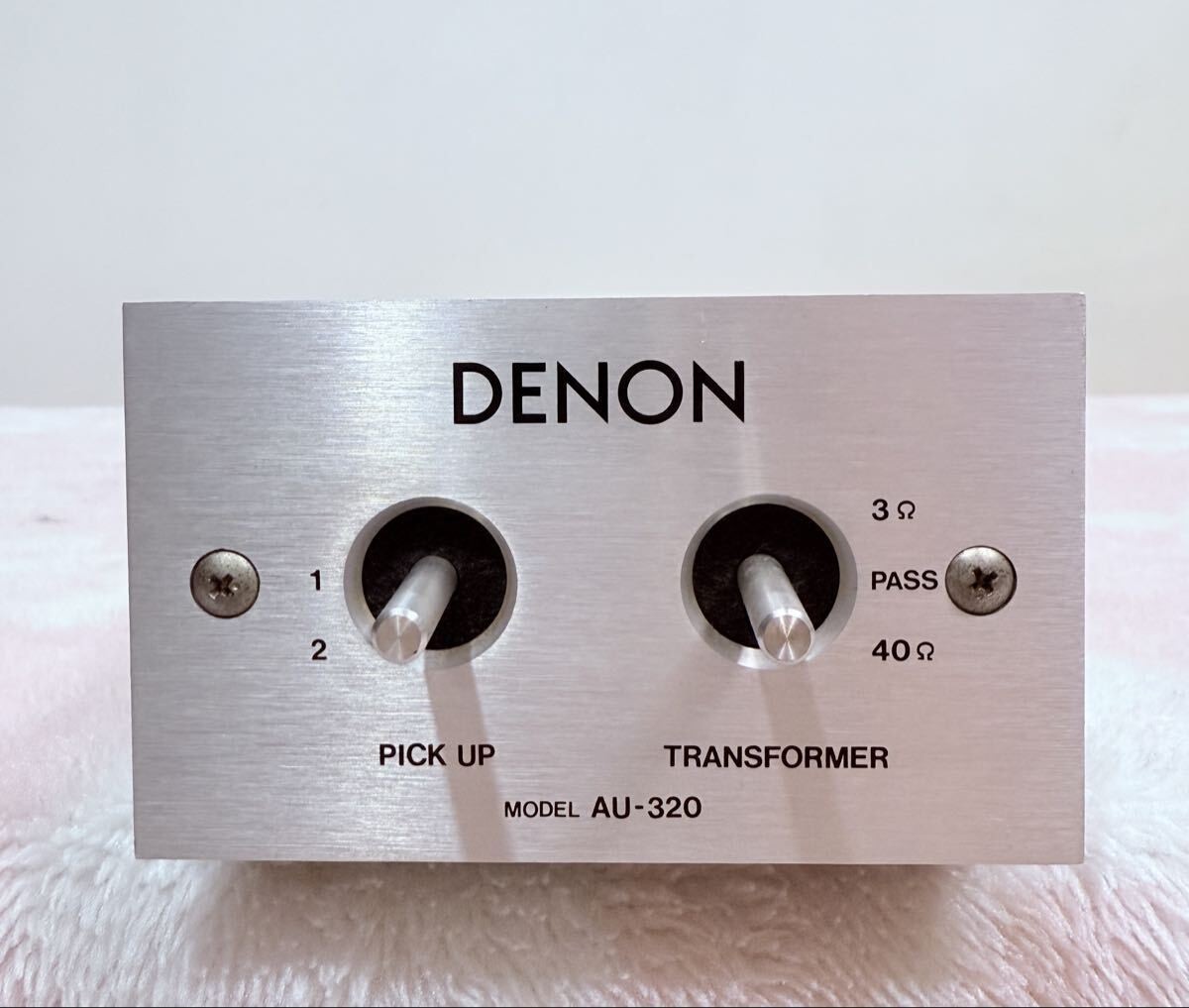
The AU-320 features a robust, no-frills chassis typical of Denon’s late-’70s aesthetic—sleek, understated, and built to last. The front panel is dominated by a large central volume knob and four input selectors, with a simple, symmetrical layout that reflects Denon’s engineering-first philosophy. Internally, the circuitry is minimal: high-quality resistors and passive switching, with gold-plated RCA jacks to minimize signal loss and oxidation.
Sound Characteristics and Performance
The sonic signature of the Denon AU-320 is best described as transparent, neutral, and dynamically articulate. Without active circuitry, there’s no added warmth, brightness, or harmonic distortion—just a faithful reproduction of what’s fed into it. This makes the AU-320 particularly well-suited for systems with rich, full-bodied sources or amplifiers that benefit from a clean, uncolored signal path.
Because it provides no gain, the AU-320 works best with high-output sources such as modern DACs, CD players, or tuners. It can struggle with low-output phono stages or vintage cassette decks unless paired with a separate buffer or line amplifier. However, when properly matched, the AU-320 reveals subtle nuances in recordings—microdynamics, spatial cues, and instrumental textures—with remarkable clarity.
Listeners often report a wide, stable soundstage and excellent channel separation, attributable to the precision-matched potentiometer and low-output impedance. The lack of power supply noise (since there isn’t one) further enhances its black background and low noise floor—ideal for quiet listening environments.
Notable Features and Innovations
While the AU-320 may seem basic by modern standards, its design reflects several thoughtful engineering choices:
- True Passive Design: Unlike many “passive” preamps that still use powered relays or buffers, the AU-320 is entirely passive. No batteries, no power supply, no active components—just resistors and switches.
- High-Quality Attenuator: The dual-gang potentiometer is widely praised for its smooth operation and channel matching, a critical factor in maintaining stereo imaging.
- Minimalist Signal Path: With only a few components between input and output, the AU-320 reduces phase shift and capacitance, preserving transient response.
- Durable Construction: Denon used thick steel chassis and high-grade internal wiring, ensuring longevity and resistance to microphonics and vibration.
- Input Flexibility: Four inputs were generous for a passive unit at the time, allowing users to switch between turntable (via external phono stage), tape, tuner, and auxiliary sources.
Denon’s decision to release a passive preamp during an era dominated by feature-rich active units was bold. It signaled a commitment to audiophile ideals over market trends—a philosophy that resonates strongly with today’s minimalist high-end movement.
Common Issues and Maintenance
The AU-320’s simplicity is both its strength and its Achilles’ heel. With no active components, there’s little to fail—but the mechanical and passive elements can degrade over time.
- Potentiometer Wear: The most common issue is crackling or channel imbalance due to oxidation or wear in the volume pot. Cleaning with contact cleaner (e.g., DeoxIT) can help, but replacement with a modern high-quality pot may be necessary for vintage units.
- Switch Contact Oxidation: Input selector switches may develop noise or intermittent connections. Regular use and occasional cleaning can prevent this.
- Cable and Jack Integrity: RCA jacks can loosen or corrode. Tightening and cleaning with isopropyl alcohol is recommended.
- No Protection Circuitry: As a passive device, the AU-320 offers no overload protection. Users should avoid connecting high-level signals (e.g., amplifier outputs) to prevent damage.
Due to its passive nature, the AU-320 requires no biasing, tube replacement, or power supply servicing—making it one of the lowest-maintenance vintage preamps available.
Current Market Value and Collectibility
The Denon AU-320 is a rare find on the vintage market. It was never produced in large numbers, and many units were likely retired or discarded as active preamps became more popular. Today, working examples in good condition typically sell for $250–$450, depending on cosmetics and functionality.
Its collectibility is growing among:
- Minimalist audiophiles who favor passive preamps like the Audible Illusions Mod 1 or early Naim NAC series.
- Denon enthusiasts seeking complete vintage Denon systems (e.g., paired with the PMA-350 or DRA-110).
- Modders and DIYers who appreciate its clean signal path for integration into modern setups.
While not yet a “blue chip” vintage item like a Marantz 2270 or Luxman SQ-38, the AU-320 is gaining recognition as a sleeper classic—especially as the high-end audio world rediscovers the virtues of passive design.
Conclusion and Legacy
The Denon AU-320 is more than just a preamp—it’s a statement. In an era of increasing complexity, it championed purity, restraint, and engineering integrity. It may not offer tone controls, remote operation, or digital inputs, but what it does offer—a transparent window into the music—is increasingly rare.
For the right listener, the AU-320 remains a compelling choice. It pairs beautifully with Denon’s own warm-sounding power amps or modern solid-state gear that benefits from a neutral control stage. It’s also a testament to Denon’s versatility beyond turntables and receivers, showcasing their deep understanding of signal integrity and circuit design.
As vintage audio circles continue to explore the nuances of passive electronics, the Denon AU-320 stands ready for rediscovery—not as a forgotten relic, but as a quiet master of its craft.
eBay Listings


As an eBay Partner, we earn from qualifying purchases. This helps support our independent vintage technology research.
Related Models
- Denon DRA-800 (1985)
- Denon PMA-350Z (1980)
- Denon POA-1500 (1979)
- Denon PRA-1500 (1979)
- Denon DRA-350 (1985)
- Luxman L-530 (1975)
- Luxman R-404 (1975)
- Luxman RV-371 (1975)
- Luxman SQ-38U (1975)
- Luxman T-14 (1972)