Dahlquist MX1: The Forgotten Architect of Precision Sound
In the golden era of high-fidelity audio during the late 1970s, few names commanded as much respect among discerning audiophiles as Dahlquist. Best known for their groundbreaking loudspeakers—especially the legendary DQ-10—the company was synonymous with time-aligned driver technology and a relentless pursuit of sonic accuracy. While much of the spotlight fell on their speakers, one lesser-known but pivotal component in their ecosystem was the Dahlquist MX1, an active crossover unit that quietly played a crucial role in unlocking the full potential of their speaker designs.
Though not a standalone amplifier or speaker, the MX1 stands as a testament to Dahlquist’s holistic approach to audio engineering. Designed during a time when active crossover technology was still in its infancy for consumer use, the MX1 represented a bold step toward system synergy and precision frequency management—long before digital signal processing became commonplace.
A Glimpse into the Era and Purpose
Released in 1978, the same period when quadraphonic sound was fading and bi-amping was gaining traction among high-end enthusiasts, the MX1 was engineered to meet a growing demand for cleaner signal paths and improved driver control. At a time when most home audio systems relied on passive crossovers housed within speaker cabinets—often introducing phase distortion, power loss, and impedance anomalies—Dahlquist saw an opportunity to elevate performance by moving crossover functions before the amplification stage.
The MX1 was not intended as a mass-market product. Instead, it catered to a niche group of audiophiles and custom installers who were building multi-amped systems, particularly those using Dahlquist’s own time-aligned speakers. By splitting the audio signal into discrete frequency bands before amplification, the MX1 allowed users to apply dedicated power amplifiers to each driver (e.g., one amp for tweeters, another for woofers), minimizing intermodulation distortion and maximizing dynamic control.
Technical Specifications
| Specification | Detail |
| Model | MX1 |
| Manufacturer | Dahlquist Acoustic Research |
| Year Introduced | 1978 |
| Type | Active Electronic Crossover |
| Channels | 2 (Stereo) |
| Crossover Bands | 2-way per channel (Low & High) |
| Crossover Frequency | Adjustable (Typical range: 500 Hz – 3 kHz) |
| Slope | 12 dB/octave (Butterworth) |
| Inputs | RCA (Line-level from preamp) |
| Outputs | Dual RCA per channel (to amps) |
| Power Supply | Internal linear power supply |
| Dimensions (approx.) | 17" W × 5" H × 12" D |
| Weight | 12 lbs (5.4 kg) |
| Impedance | Not applicable (line-level device) |
| Power Consumption | ~30 watts |
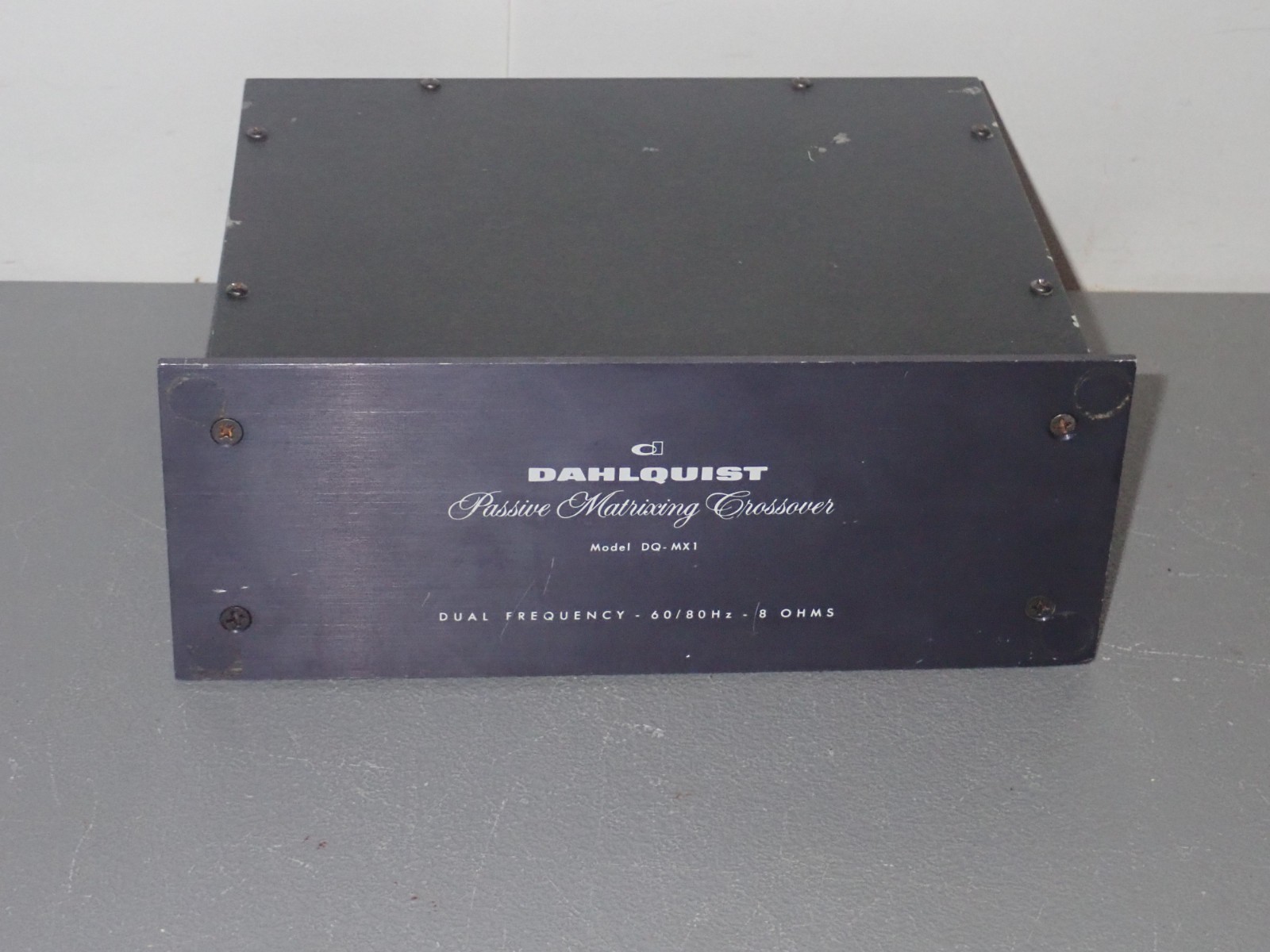
The MX1 featured a clean, minimalist front panel with large rotary knobs for setting crossover frequencies, accompanied by toggle switches to engage or bypass each section. The rear panel offered robust RCA jacks for input and output connections, designed to minimize signal degradation. Internally, it used discrete op-amp circuitry and precision passive components—typical of high-end gear from that era—emphasizing reliability and low noise over flashy features.
Sound Characteristics and Performance
As an active crossover, the MX1 doesn’t produce sound itself—but its influence on system performance is profound. When paired with capable amplifiers and time-aligned speakers like the DQ-10 or DQ-20, the MX1 delivered a noticeable improvement in clarity, imaging, and bass control.
By removing the passive crossover from the speaker cabinet, users eliminated a major source of signal loss and distortion. The result was tighter, more articulate bass (thanks to dedicated low-frequency amplification) and crisper high-frequency detail. Phase coherence improved significantly, especially when used with Dahlquist’s time-aligned designs, preserving the transient response and spatial accuracy that the brand was known for.
Many who have used the MX1 in restored vintage systems describe the sonic signature as “transparent” and “effortless”—a neutral handoff that lets the speakers and amplifiers shine without editorializing. It didn’t add warmth or brightness; instead, it removed obstacles between the source and the drivers.
Notable Features and Innovations
While not the first active crossover on the market, the MX1 stood out for its simplicity, build quality, and system integration with Dahlquist’s speaker lineup. Key innovations and features included:
- Adjustable Crossover Points: Uncommon in consumer gear at the time, this allowed users to fine-tune frequency splits based on room acoustics or amplifier capabilities.
- Dedicated Low-Noise Circuitry: Designed to preserve signal integrity, critical when dealing with low-level line signals.
- System Synergy: Engineered specifically to complement Dahlquist’s time-aligned speaker designs, ensuring optimal phase and amplitude alignment.
- Dual-Mono Architecture: Each channel operated independently, minimizing crosstalk and maintaining stereo precision.
The MX1 also reflected the broader trend in late-’70s high-end audio toward modular, component-based systems—where users could mix and match preamps, power amps, and signal processors for ultimate customization.
Common Issues and Maintenance
Today, the Dahlquist MX1 is a rare find, with few units still in working condition. As with any vintage electronic gear from the 1970s, aging components pose challenges:
- Capacitor Degradation: Electrolytic capacitors in the power supply and signal path are prone to drying out, leading to hum, noise, or complete failure.
- Oxidized Controls: Rotary pots and switches often suffer from crackling or intermittent contact due to oxidation.
- Power Supply Wear: The internal transformer and rectifier circuits may need inspection or replacement after 40+ years.
Restoration typically involves a full recapping, cleaning of all connectors and controls with contact cleaner, and verification of resistor values. Given the MX1’s low production numbers, replacement parts aren’t always available, making skilled technician intervention essential.
Additionally, users should be cautious about impedance matching when integrating the MX1 into modern systems. While it outputs line-level signals, ensuring compatibility with contemporary amplifiers’ input sensitivity is crucial for optimal performance.
Current Market Value and Collectibility
The MX1 is highly collectible among vintage audio enthusiasts, particularly those restoring classic Dahlquist speaker systems. However, due to its obscurity and limited original production, it remains undervalued compared to more famous components of the era.
In working condition, a restored MX1 can fetch between $300 and $600, depending on cosmetic condition and provenance. Units still in original packaging or with documentation may command higher prices, especially when sold alongside matching Dahlquist speakers.
Its rarity makes it a “holy grail” accessory for DQ-10 owners, who seek to recreate the full Dahlquist experience as intended in the late 1970s. While not a mainstream collectible like a Marantz PM-6400 or a McIntosh C22, the MX1 holds a special place for those who appreciate the engineering philosophy behind integrated high-end systems.
Conclusion and Legacy
The Dahlquist MX1 may never achieve the fame of its speaker siblings, but it embodies the same spirit of innovation and precision that defined the brand. As an early adopter of active crossover technology in the consumer space, it offered a glimpse into the future of high-fidelity audio—one where system synergy, phase accuracy, and signal purity were paramount.
Though overshadowed by more glamorous components, the MX1 remains a quiet pioneer. It represents a moment when audiophiles began to think beyond individual boxes and toward holistic system design. For those who value the purity of signal flow and the pursuit of time- and phase-coherent sound, the MX1 is more than just a crossover—it’s a philosophy in a chassis.
Today, finding a working MX1 is like uncovering a hidden blueprint to vintage audio perfection. For the restorer, the collector, or the curious listener, it offers a rare opportunity to hear music not just as it was recorded—but as it was meant to be heard.
eBay Listings


As an eBay Partner, we earn from qualifying purchases. This helps support our independent vintage technology research.
Related Models
- Dahlquist ALS-3 (1978)
- Dahlquist DQ-20I (1978)
- Dahlquist DQ-6C (1978)
- Dahlquist DQ-10 (1974)
- Dahlquist DQ-10A (1978)
- Akai AM-2850 (1975)
- Akai AP-206 (1975)
- Nakamichi BX-1 (1985)
- Acoustic Research research-ar-17 (1978)
- Acoustic Research AR-19 (1994)