Dahlquist DQM-7C: The Compact Precision of a Forgotten Classic
In the late 1970s, when high-end audio was rapidly evolving and speaker design was embracing both scientific rigor and bold experimentation, Dahlquist emerged as a brand synonymous with innovation and sonic integrity. While the legendary DQ-10 — with its time-aligned drivers and flat frequency response — remains the crown jewel of the Dahlquist legacy, the DQM-7C quietly carved out its own niche as a compact, high-performance bookshelf speaker aimed at audiophiles seeking accuracy and refinement in smaller listening environments.
Introduced around 1979, the DQM-7C was part of Dahlquist’s effort to bring the brand’s engineering philosophy — precision time alignment, low coloration, and neutral tonality — into a more accessible and space-conscious form factor. Though not as widely celebrated as its floor-standing sibling, the DQM-7C embodied the same design ethos and attention to detail that made Dahlquist a respected name among critical listeners of the era.
Technical Specifications
| Specification | Detail |
| Model | DQM-7C |
| Manufacturer | Dahlquist Acoustic Labs |
| Year Introduced | 1979 |
| Type | 2-way, sealed (acoustic suspension) |
| Driver Complement | 1" soft-dome tweeter, 6.5" mid-woofer |
| Crossover Frequency | ~2.8 kHz (estimated) |
| Frequency Response | 55 Hz – 20 kHz (±3 dB, estimated) |
| Sensitivity | 88 dB (2.83V/1m, estimated) |
| Nominal Impedance | 8 ohms (compatible with most tube and solid-state amps) |
| Recommended Amp Power | 20–100 watts |
| Enclosure Type | Sealed (acoustic suspension) |
| Dimensions (H×W×D) | 14" × 8" × 9" (approx.) |
| Weight | 22 lbs per speaker (approx.) |
| Finish Options | Walnut or rosewood veneer (typical for era) |
Sound Characteristics and Performance
The DQM-7C was engineered for clarity, coherence, and a natural midrange — qualities that reflect founder Jon Dahlquist’s commitment to time-accurate sound reproduction. The 2-way design features a 6.5-inch mid-woofer paired with a 1-inch soft-dome tweeter, both mounted in a carefully braced MDF cabinet. While the DQM-7C lacks the full-range extension of the DQ-10, it compensates with excellent transient response and a remarkably transparent midband.
Thanks to its sealed enclosure design, the DQM-7C delivers tight, controlled bass with minimal overhang — ideal for rhythmic precision and acoustic music. Bass extension reaches down to about 55 Hz, which is respectable for a speaker of its size, though it benefits from placement near a rear wall or corner for added warmth. The absence of a port means there’s no risk of "chuffing" or resonant coloration, contributing to its clean, uncolored sound.
The soft-dome tweeter provides smooth high-frequency response, avoiding the harshness that plagued some metal-dome designs of the era. Cymbals, strings, and vocal sibilance are rendered with delicacy and realism. While not as airy or extended as some electrostatics or ribbon tweeters, the DQM-7C’s highs are well-integrated and fatigue-free during long listening sessions.
Midrange performance is where the DQM-7C truly shines. Vocals are presented with lifelike presence and intimacy, making it an excellent choice for jazz, classical, and singer-songwriter genres. The time-aligned driver layout — a Dahlquist hallmark — ensures that sound from both drivers reaches the listener simultaneously, enhancing stereo imaging and focus. The result is a stable, three-dimensional soundstage with precise instrument placement, even in modestly sized rooms.
Notable Features and Innovations
While compact, the DQM-7C incorporates several design elements that reflect Dahlquist’s engineering pedigree:
- Time-Aligned Driver Geometry: Though not as pronounced as in the DQ-10, the DQM-7C features a slightly recessed tweeter or stepped baffle design to align the acoustic centers of the drivers. This improves phase coherence and off-axis response.
- High-Quality Internal Wiring: Early models used oxygen-free copper internal cabling, a rarity in bookshelf speakers of the time.
- Damped, Non-Resonant Cabinet: The thick MDF enclosure is heavily braced and lined with damping material to minimize cabinet coloration — a critical factor in achieving Dahlquist’s “listen to the music, not the speaker” philosophy.
- Neutral Voicing: Unlike many speakers of the era that leaned into bass or brightness for “impressive” showroom sound, the DQM-7C was tuned for accuracy, making it a favorite among recording engineers and purist listeners.
Common Issues and Maintenance
As with any vintage speaker from the late 1970s, the DQM-7C is now over four decades old, and certain components may require attention:
- Surround Rot: The foam or rubber surrounds on the mid-woofer can degrade over time, leading to flaking, loss of bass, or rattling. Re-foaming or full reconing is often necessary and readily available through specialist restoration services.
- Tweeter Aging: While soft-dome tweeters are generally more durable than foam domes, the diaphragm or surround can stiffen or deteriorate. A failing tweeter may sound dull or distorted at high volumes.
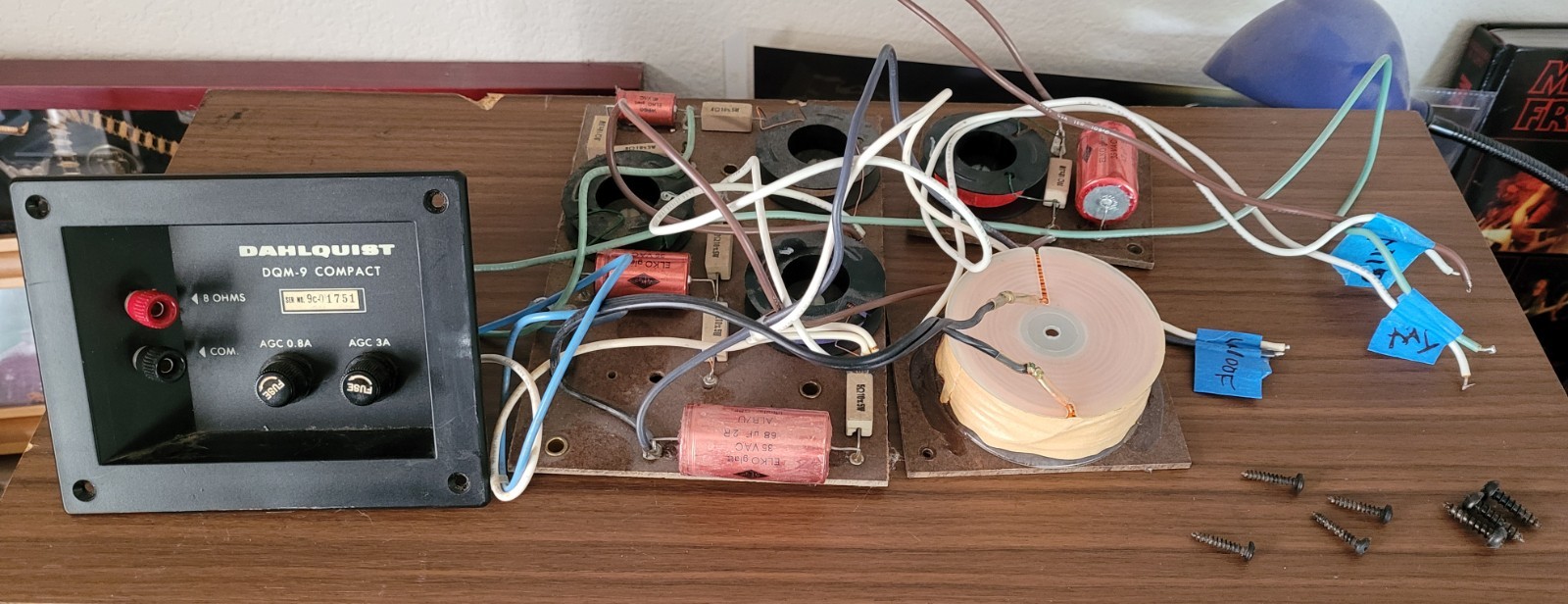
- Crossover Components: Electrolytic capacitors in the crossover may dry out, altering tonal balance. Upgrading to modern film capacitors can restore or even improve performance.
- Grille Fabric and Binding Posts: Original grilles may be torn or discolored. Replacement fabric in period-correct weaves is available from vintage audio suppliers. The original binding posts may also benefit from replacement with modern, high-grip models for better connectivity.
Regular inspection and preventive maintenance — such as checking for air leaks and ensuring secure driver mounting — can extend the life of a well-preserved pair.
Current Market Value and Collectibility
The Dahlquist DQM-7C is not as widely collected as the DQ-10, but it holds a quiet reverence among vintage speaker enthusiasts. Well-maintained pairs in good cosmetic and sonic condition typically sell in the $300–$600 range, depending on finish, originality, and restoration quality.
Factors that increase value include:
- Original finish with no veneer damage
- Fully functional drivers with no surround rot
- Original grilles and hardware
- Provenance (e.g., original purchase receipts or association with a notable owner)
While not a “blue chip” vintage speaker like the Quad ESL-57 or AR-3a, the DQM-7C is increasingly recognized for its engineering integrity and musicality. Its compact size also makes it appealing for modern desktop or secondary systems, especially when paired with low-feedback tube amplifiers or high-resolution digital sources.
Conclusion and Legacy
The Dahlquist DQM-7C may not have the iconic status of its larger siblings, but it stands as a testament to Jon Dahlquist’s unwavering commitment to truthful sound reproduction. In an era when many manufacturers prioritized bass impact or flashy aesthetics, the DQM-7C offered something rarer: clarity, coherence, and musical honesty in a compact package.
It represents a bridge between the grand ambitions of full-range time-aligned speakers and the practical needs of real-world listening spaces. For the vintage audio enthusiast, the DQM-7C is more than just a nostalgic artifact — it’s a window into a design philosophy that valued accuracy over artifice.
Today, with renewed interest in vintage high-fidelity and the resurgence of analog listening, the DQM-7C deserves a second look. Whether used as a primary system in a small apartment or as a refined secondary setup, it continues to deliver a listening experience that is both emotionally engaging and technically impressive — a true hidden gem of the late 1970s audio renaissance.
eBay Listings



As an eBay Partner, we earn from qualifying purchases. This helps support our independent vintage technology research.
Related Models
- Dahlquist ALS-3 (1978)
- Dahlquist DQ-20I (1978)
- Dahlquist DQ-6C (1978)
- Dahlquist DQ-10 (1974)
- Dahlquist DQ-10A (1978)
- Akai AM-2850 (1975)
- Akai AP-206 (1975)
- Nakamichi BX-1 (1985)
- Acoustic Research research-ar-17 (1978)
- Acoustic Research AR-19 (1994)