Dahlquist DQ-6C: The Forgotten Pioneer of Active Loudspeakers
In the late 1970s, when most high-end audio enthusiasts were chasing the holy grail of passive speaker perfection—massive cabinets, exotic crossovers, and hand-selected drivers—a quiet revolution was brewing in California. At the heart of it was Dahlquist, a company known for its groundbreaking DQ-10, the first production time-aligned loudspeaker. But while the DQ-10 remains the crown jewel of the brand’s legacy, the Dahlquist DQ-6C stands as a fascinating, lesser-known chapter in the company’s story—a bold experiment in active speaker design that was decades ahead of its time.
The DQ-6C, introduced around 1978, was not your typical bookshelf speaker. It was one of the earliest commercially available active loudspeaker systems in the high-fidelity world, integrating amplification, crossover electronics, and speaker drivers into a single, compact enclosure. At a time when separates ruled the audiophile world, the DQ-6C dared to challenge convention, offering a self-contained solution that prioritized precision, coherence, and time alignment—all hallmarks of reportedly founder John Dahlquist’s design philosophy.
Though production numbers were low and documentation scarce, the DQ-6C has since gained a cult following among vintage audio collectors and active speaker enthusiasts. It represents a rare fusion of engineering ambition and acoustic idealism, embodying the same time-coherent principles as its larger siblings but in a more accessible, modern form.
Technical Specifications
| Specification | Detail |
| Model | DQ-6C |
| Manufacturer | Dahlquist Acoustic Laboratory |
| Year Introduced | ca. 1978 (unconfirmed) |
| Type | 2-way active loudspeaker |
| Drivers | 1" dome tweeter, 6.5" mid-woofer |
| Crossover | Active 2nd-order electronic crossover |
| Amplification | Dual internal amplifiers (bi-amped) |
| Power Output | ~25W RMS per channel (estimated) |
| Frequency Response | 55 Hz – 20 kHz (±3 dB) |
| Sensitivity | 85 dB (2.83V/1m) |
| Impedance | Not applicable (active design) |
| Enclosure | Sealed, time-aligned baffle |
| Inputs | Line-level RCA (balanced capability?) |
| Dimensions (H×W×D) | 14" × 8" × 9" (approx.) |
| Weight | 22 lbs per cabinet (approx.) |
| Finish Options | Walnut veneer, black ash (limited) |
Note: Due to the rarity of surviving units and lack of original documentation, some specifications are based on user reports and technical extrapolation from contemporary Dahlquist designs.
Sound Characteristics and Performance
The DQ-6C was engineered to deliver a coherent, time-aligned soundstage—a signature trait of all Dahlquist speakers. By integrating active crossovers and bi-amping, the DQ-6C eliminated many of the compromises inherent in passive designs: phase shifts, power loss through passive components, and driver interaction.
With its sealed enclosure and carefully time-aligned drivers, the DQ-6C offered tight, controlled bass for its size, with a smooth midrange and a detailed, non-fatiguing treble. The active crossover allowed for precise tuning, ensuring that the tweeter and mid-woofer reached the listener in perfect phase, resulting in a remarkably three-dimensional soundstage and pinpoint imaging.
Despite its compact size, the DQ-6C was capable of surprising dynamics and clarity, especially when paired with high-quality source components. Audiophiles who encountered the DQ-6C in its era often remarked on its “effortless” presentation and natural tonality—qualities that remain desirable today.
It was not a speaker for bass-heavy rock or large-scale orchestral works (its 55 Hz lower limit reflects that), but for jazz, classical, and vocal recordings, the DQ-6C delivered a level of intimacy and realism that few contemporaries could match.
Notable Features and Innovations
The DQ-6C was a technological marvel for its time, incorporating several advanced features:
- Integrated Bi-Amping: Each speaker housed two internal amplifiers—one for the tweeter, one for the woofer—eliminating the need for external amps and ensuring optimal power delivery to each driver.
- Active Crossover Network: Unlike passive crossovers that degrade signal quality, the DQ-6C’s electronic crossover operated at line level, preserving signal integrity and allowing for precise frequency slope control.
- Time-Aligned Baffle: Following the DQ-10’s lead, the DQ-6C featured a stepped baffle design that acoustically aligned the drivers, ensuring sound from both reached the listener simultaneously—a key to accurate imaging.
- Compact, High-End Build: Despite its small footprint, the DQ-6C used high-quality materials, including real wood veneers and precision internal wiring, reflecting Dahlquist’s commitment to craftsmanship.
Perhaps most forward-thinking was the DQ-6C’s system-integrated approach—a concept that would not become mainstream until the rise of modern active monitors and smart speakers in the 2000s. In this sense, the DQ-6C was not just a speaker, but a vision of the future.
Common Issues and Maintenance
Today, finding a working DQ-6C is a challenge—not just because of rarity, but due to the age of internal electronics. The integrated amplifiers and crossover boards often suffer from:
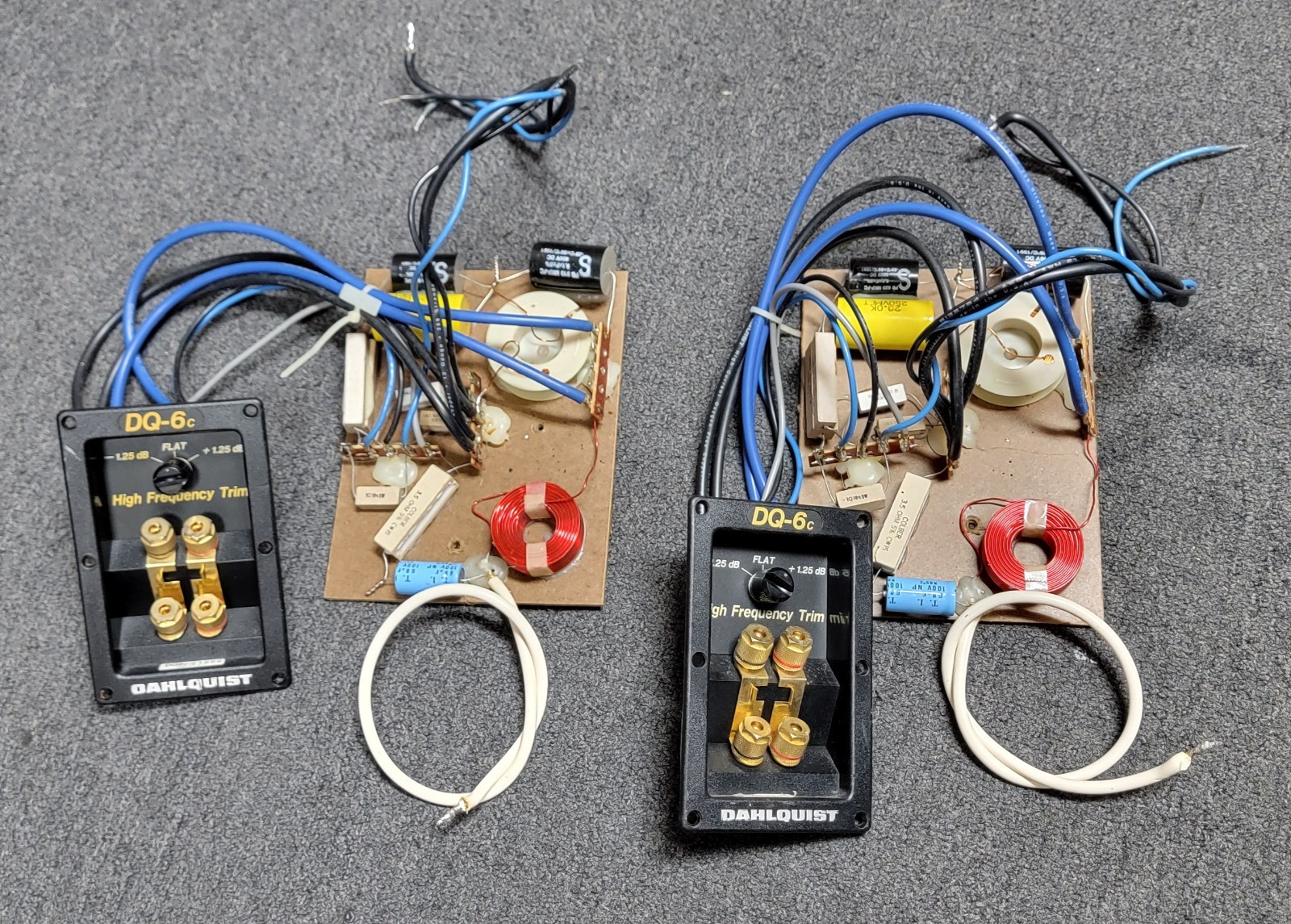
- Capacitor degradation: Electrolytic capacitors in the power supply and signal path are prone to drying out, leading to hum, distortion, or complete failure.
- Output transistor failure: The solid-state amps, while reliable for their time, can fail due to heat stress or power surges.
- Driver wear: Original tweeters and woofers may exhibit torn surrounds or voice coil damage, especially if not stored properly.
- Power supply issues: The internal linear power supply is vulnerable to transformer hum or rectifier failure.
Restoration typically requires a skilled technician familiar with vintage active electronics. Replacement drivers are extremely rare, though some enthusiasts have successfully reconed original units or adapted modern equivalents with careful voicing.
Because the DQ-6C was not mass-produced, service manuals and schematics are scarce, making repairs a true labor of love. However, for those willing to invest the effort, a restored pair can deliver a uniquely engaging listening experience.
Current Market Value and Collectibility
The DQ-6C is a rare find on the vintage audio market. When units do appear—often on audiophile forums, eBay, or specialty collector sites—they typically sell for $800 to $1,500 per pair, depending on condition and functionality. Fully restored, working systems command premium prices, especially when paired with original accessories or documentation.
While not as iconic as the DQ-10, the DQ-6C holds significant historical value as an early example of high-end active speaker design. It appeals to collectors interested in the evolution of speaker technology, California hi-fi innovation, and the legacy of John Dahlquist.
Its compact size also makes it attractive for modern minimalist setups, particularly when paired with vintage preamps or modern DACs. In recent years, there’s been renewed interest in active vintage speakers, driven by the popularity of studio monitors and high-resolution audio—making the DQ-6C more relevant than ever.
Conclusion and Legacy
The Dahlquist DQ-6C may not have achieved the fame of its larger sibling, but it stands as a bold and innovative footnote in the history of high-fidelity audio. It was a speaker that defied convention, merging amplifier and speaker into a single, time-coherent system at a time when such integration was considered heretical by many audiophiles.
Though limited by the technology of its era and hampered by low production numbers, the DQ-6C foreshadowed the future of audio—where precision, integration, and sonic accuracy would triumph over sheer size and power. Today, it remains a prized possession for those who appreciate both the engineering and the vision behind it.
For the vintage audio enthusiast, the DQ-6C is more than just a speaker—it’s a piece of audio history, a testament to a time when one small company dared to rethink how we listen. And for those lucky enough to hear a well-restored pair, the experience is nothing short of magical: clear, coherent, and utterly alive.
eBay Listings


As an eBay Partner, we earn from qualifying purchases. This helps support our independent vintage technology research.
Related Models
- Dahlquist ALS-3 (1978)
- Dahlquist DQ-20I (1978)
- Dahlquist DQ-10 (1974)
- Dahlquist DQ-10A (1978)
- Dahlquist DQ-12 (1977)
- Akai AM-2850 (1975)
- Akai AP-206 (1975)
- Nakamichi BX-1 (1985)
- Acoustic Research research-ar-17 (1978)
- Acoustic Research AR-19 (1994)