Dahlquist DQ-1W: The Pioneer of Time-Aligned Loudspeaker Design
In the pantheon of vintage loudspeakers, few names evoke the reverence and respect commanded by the Dahlquist DQ-1W. Introduced in 1974 by Swedish-American engineer and audio visionary John Dahlquist, the DQ-1W wasn't just another floorstanding speaker—it was a bold statement of acoustic philosophy, engineering integrity, and a relentless pursuit of sonic truth. Though produced in relatively limited numbers and only available for a few years, the DQ-1W left an indelible mark on high-fidelity audio, influencing generations of speaker designers and earning a cult following among audiophiles.
At a time when most loudspeakers prioritized raw output, flashy cabinets, or exaggerated tonal balance, the DQ-1W stood apart. It was one of the first commercially available speakers to implement time-aligned driver technology, a concept that ensured sound waves from each driver reached the listener’s ear simultaneously. This seemingly simple idea had profound implications for clarity, imaging, and realism—hallmarks of the DQ-1W’s legendary performance.
Technical Specifications
| Specification | Detail |
| Model | DQ-1W |
| Manufacturer | Dahlquist Acoustic Laboratory |
| Year Introduced | 1974 |
| Type | 3-way, time-aligned, floorstanding |
| Drivers | 12" woofer, 6.5" midrange, 1" tweeter |
| Crossover | Passive, 2nd order, time-aligned design |
| Frequency Response | 35 Hz – 20 kHz (±3 dB) |
| Sensitivity | 89 dB (2.83V/1m) |
| Nominal Impedance | 8 ohms |
| Recommended Amp Power | 20–100 watts |
| Enclosure | Veneered MDF, front-baffle time-stepped |
| Dimensions (H×W×D) | 44" × 12" × 16" (112 × 30 × 41 cm) |
| Weight | 75 lbs (34 kg) per speaker |
| Finish Options | Walnut, rosewood, black ash (rare) |
Sound Characteristics and Performance
The DQ-1W’s sonic signature is best described as transparent, coherent, and lifelike. Thanks to its time-aligned design, the speaker delivers an uncanny sense of spatial precision. Instruments are rendered with pinpoint accuracy, and the soundstage is wide, deep, and stable—even off-axis. This coherence stems from the physical staggering of the drivers along the front baffle: the tweeter is mounted furthest forward, the midrange slightly behind, and the woofer set back even further. This mechanical delay compensates for the differing path lengths of sound waves, aligning them in time at the listening position.
Listeners often describe the DQ-1W’s midrange as exceptionally natural and uncolored, making it ideal for vocal and acoustic recordings. The 6.5-inch midrange driver, typically a paper-cone unit, operates in a narrow band where it performs optimally, avoiding the strain that plagues full-range drivers. The 12-inch woofer provides solid bass extension down to 35 Hz, though it’s not a speaker for those seeking room-shaking sub-bass. Instead, its bass is tight, articulate, and well-integrated, avoiding the boominess common in many speakers of the era.
The tweeter—often a soft-dome or early fabric-dome type—delivers smooth, non-fatiguing highs. There’s no harshness or sibilance, even with bright recordings. This balanced top end contributes to the DQ-1W’s legendary ability to play for hours without listener fatigue.
Notable Features and Innovations
The DQ-1W’s most revolutionary feature was, without question, its time-aligned driver array. While the concept had been theorized earlier (notably by engineers at Altec and in academic circles), Dahlquist was the first to bring it successfully to the consumer market. This design required precise mathematical modeling and careful cabinet construction—no small feat in the mid-1970s.
Another key innovation was the modular crossover design. The DQ-1W used a passive crossover with high-quality components, including air-core inductors and polypropylene capacitors—unusual for the time, when many manufacturers still used iron-core coils and electrolytic caps. The crossover was also accessible from the rear, allowing for servicing and, in some cases, upgrades.
The cabinet itself was built with rigidity and resonance control in mind. Constructed from medium-density fiberboard (MDF) with internal bracing, it avoided the ringy, colored sound of particleboard or thin plywood cabinets common in budget speakers. The stepped baffle, while primarily functional, also gave the DQ-1W a distinctive, modernist look that set it apart from the boxy designs of its contemporaries.
Common Issues and Maintenance
As with any vintage speaker, the DQ-1W requires careful attention to maintain its performance. The most common issues stem from aging components:
- Foam Surrounds: The original foam surrounds on the woofer and midrange drivers degrade over time, leading to flaking, loss of compliance, and distorted bass. Re-foaming or reconing is highly recommended for any DQ-1W that hasn’t been restored.
- Crossover Components: Electrolytic capacitors in the crossover may dry out, and resistors can drift in value. A full inspection and, if necessary, recapping with modern equivalents can restore clarity and balance.
- Tweeter Fatigue: While generally robust, early fabric dome tweeters can suffer from oxidation or diaphragm fatigue. Some owners opt for careful re-doping or replacement with period-correct equivalents.
Finding original parts can be challenging, but a small but dedicated community of Dahlquist enthusiasts and vintage audio restorers keeps the legacy alive. Reputable speaker repair shops with experience in vintage gear can often source or fabricate suitable replacements.
Proper placement is also crucial. The DQ-1W performs best when positioned well away from walls, with a slight toe-in toward the listening position. Due to its time-aligned design, it is less sensitive to placement than many speakers, but optimal setup enhances its imaging and bass response.
Current Market Value and Collectibility
The Dahlquist DQ-1W is a highly collectible piece of audio history. Complete, unrestored pairs in fair condition typically sell for $800–$1,500, while fully restored models with upgraded drivers and crossovers can command $2,000–$3,000 or more, especially if accompanied by original documentation or rare finishes like black ash.
Its collectibility stems not just from its sound, but from its historical significance. The DQ-1W influenced later time-aligned designs from companies like KEF (with their Reference series) and even modern high-end brands such as Magico and Wilson Audio, who employ similar time-coherence principles.
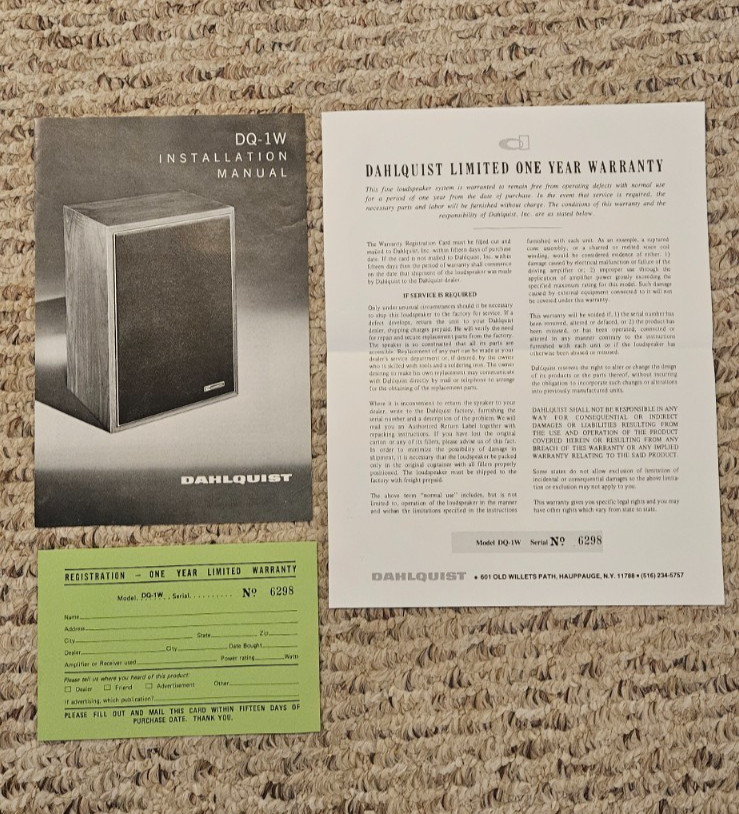
Because production was limited and many units were heavily used in their prime, finding a pair in good condition is increasingly rare. Original grilles, manuals, and warranty cards add significant value to any listing.
Conclusion and Legacy
The Dahlquist DQ-1W was more than a speaker—it was a manifesto. In an era of sonic excess, it championed accuracy, coherence, and engineering honesty. It proved that high fidelity wasn’t about loudness or visual flair, but about reproducing music as the artist intended.
Though John Dahlquist’s company did not survive long-term commercial competition, his ideas endured. The DQ-1W remains a benchmark of 1970s speaker innovation and a testament to the power of thoughtful design. For vintage audio enthusiasts, owning a pair is not just an investment in sound quality—it’s a connection to a pivotal moment in audio history.
If you’re lucky enough to hear a well-restored DQ-1W, you’re not just listening to music. You’re experiencing the birth of time-aligned audio—a legacy that continues to resonate.
eBay Listings


As an eBay Partner, we earn from qualifying purchases. This helps support our independent vintage technology research.
Related Models
- Dahlquist ALS-3 (1978)
- Dahlquist DQ-20I (1978)
- Dahlquist DQ-6C (1978)
- Dahlquist DQ-10 (1974)
- Dahlquist DQ-10A (1978)
- Akai AM-2850 (1975)
- Akai AP-206 (1975)
- Nakamichi BX-1 (1985)
- Acoustic Research research-ar-17 (1978)
- Acoustic Research AR-19 (1994)