Crown PSA-2: The Pioneer of Active Signal Management
In the early 1970s, as high-fidelity audio systems began to evolve beyond simple amplifiers and speakers, the need for more sophisticated signal control became apparent. Enter the Crown PSA-2, a groundbreaking device that helped define the role of active signal processing in both professional sound reinforcement and high-end home audio systems. Released in 1970, the PSA-2 was not an amplifier or a receiver, but rather a programmable signal analyzer and active crossover—a rare and innovative piece of gear for its time. Designed by the legendary engineering team at Crown International, the PSA-2 represented a bold step forward in system optimization, offering audiophiles and sound engineers unprecedented control over frequency response, phase alignment, and speaker management.
Though not widely known among casual vintage audio enthusiasts, the PSA-2 holds a special place in the history of audio technology. It was one of the first commercially available units to integrate active crossover networks with parametric equalization, allowing users to tailor their speaker systems with surgical precision. At a time when most systems relied on passive crossovers and flat frequency responses, the PSA-2 empowered users to correct room acoustics, match drivers, and optimize sound quality in ways previously reserved for laboratory environments.
Technical Specifications
The Crown PSA-2 was engineered with a modular, professional-grade design, reflecting Crown’s strong roots in the pro audio market. Its build quality was robust, featuring a heavy-duty steel chassis, high-quality potentiometers, and precision circuitry designed for reliability under continuous use.
| Specification | Detail |
| Manufacturer | Crown International |
| Model | PSA-2 |
| Year Introduced | 1970 |
| Type | Active Crossover & Parametric Equalizer |
| Channels | 2 (Stereo) |
| Crossover Sections | 2 per channel (Low-pass and High-pass) |
| Crossover Frequency Range | 100 Hz – 10 kHz (adjustable) |
| Equalization Bands | 3 per channel (Low, Mid, High) |
| Mid-Frequency Range | 100 Hz – 5 kHz (variable) |
| Q Factor (Bandwidth) | Adjustable (typically 0.5 to 5) |
| Gain Control | ±15 dB per band |
| Inputs | Balanced XLR and 1/4" TRS |
| Outputs | 4 total (2 for lows, 2 for highs) |
| Power Supply | Internal linear power supply |
| Dimensions | 19" rack width, 3.5" H, 12" D |
| Weight | ~15 lbs (6.8 kg) |
| Impedance | Not applicable |
| Power Consumption | Not applicable (line-powered) |
The PSA-2 operated as a line-level processor, meaning it sat between the preamplifier and power amplifiers in a system chain. It required two separate power amplifiers per stereo setup—one for the low-frequency drivers and one for the highs—making it ideal for bi-amped configurations. This was a sophisticated approach for the era, aligning more with professional PA systems than typical home audio setups.
Sound Characteristics and Performance
The sonic impact of the PSA-2 was transformative for systems that employed it. By allowing precise control over crossover points, the unit enabled users to eliminate phase cancellations and driver overlap that often plagued passive crossover designs. The result was tighter bass, clearer mids, and more detailed highs, with improved imaging and soundstage coherence.
The parametric EQ section was particularly advanced for its time. Unlike graphic equalizers with fixed frequency bands, the PSA-2’s parametric design allowed users to select the center frequency, bandwidth (Q), and gain for each midrange band. This made it possible to surgically correct room resonances or speaker deficiencies—something that wouldn’t become common in consumer gear for another two decades.
When properly calibrated, systems using the PSA-2 exhibited a level of clarity and neutrality that rivaled much more expensive setups. Audiophiles who paired it with high-quality drivers and amplifiers often reported a "live" quality to the sound, with excellent dynamic range and low distortion.
Notable Features and Innovations
The PSA-2’s most significant innovation was its integration of crossover and equalization in a single, user-adjustable unit. Prior to its release, such functions were typically handled by separate, often custom-built equipment. Crown’s decision to package these tools into a single rack-mountable unit made advanced system tuning accessible to a broader audience.
Other standout features included:
- Variable slope crossovers (typically 12 dB/octave), allowing users to match the acoustical behavior of their drivers.
- Phase inversion switches on each output, enabling correction of polarity issues between drivers.
- High-pass filtering to protect tweeters from damaging low-frequency energy.
- Precision calibration markings on knobs, allowing for repeatable settings—a boon for touring sound engineers and studio technicians.
The PSA-2 also reflected Crown’s commitment to reliability and serviceability. Its modular design made repairs and component replacement straightforward, a hallmark of Crown’s pro audio philosophy.
Common Issues and Maintenance
As with any vintage electronic equipment from the early 1970s, the PSA-2 is prone to certain age-related issues. The most common problems include:
- Capacitor degradation: The electrolytic capacitors in the power supply and signal path can dry out over time, leading to hum, noise, or channel dropouts.
- Potentiometer wear: The numerous knobs and sliders may develop crackling or intermittent contact. Cleaning with contact cleaner can help, but replacement may be necessary.
- Connector corrosion: XLR and 1/4" jacks can oxidize, especially if stored in humid environments.
- Transformer hum: While rare, the internal power transformer may develop a slight hum due to loose laminations.
Restoration of a PSA-2 typically involves a full recapping, cleaning of all controls and connectors, and verification of resistor values. Due to its professional build, most units respond well to refurbishment, and replacement parts are generally available thanks to Crown’s widespread service network.
Current Market Value and Collectibility
The Crown PSA-2 is a rare and sought-after unit among vintage pro audio collectors and DIY audio enthusiasts. While not as widely recognized as Crown’s later amplifiers like the DC-300, the PSA-2 is appreciated for its historical significance and technical sophistication.
In today’s market, a working PSA-2 typically sells for $400–$700, depending on condition and completeness. Units with original manuals, calibration charts, or factory packaging can command higher prices. Non-working units are often purchased for parts or restoration projects.
Its collectibility is enhanced by its low production numbers and niche application. Unlike mass-market receivers, the PSA-2 was sold primarily to professional users, universities, and high-end custom installers, making surviving examples relatively scarce.
Conclusion and Legacy
The Crown PSA-2 stands as a pioneer in active audio signal processing. It bridged the gap between laboratory-grade audio analysis and practical, real-world system tuning. Though overshadowed by Crown’s more famous power amplifiers, the PSA-2 was a visionary product that anticipated the modern era of digital room correction, DSP crossovers, and bi-amping.
Today, it serves as a reminder of a time when audio engineers were beginning to understand that great sound isn’t just about power and components—it’s about control. For vintage audio enthusiasts interested in the roots of system optimization, the PSA-2 is not just a collectible—it’s a piece of audio history that still has something valuable to say.
eBay Listings


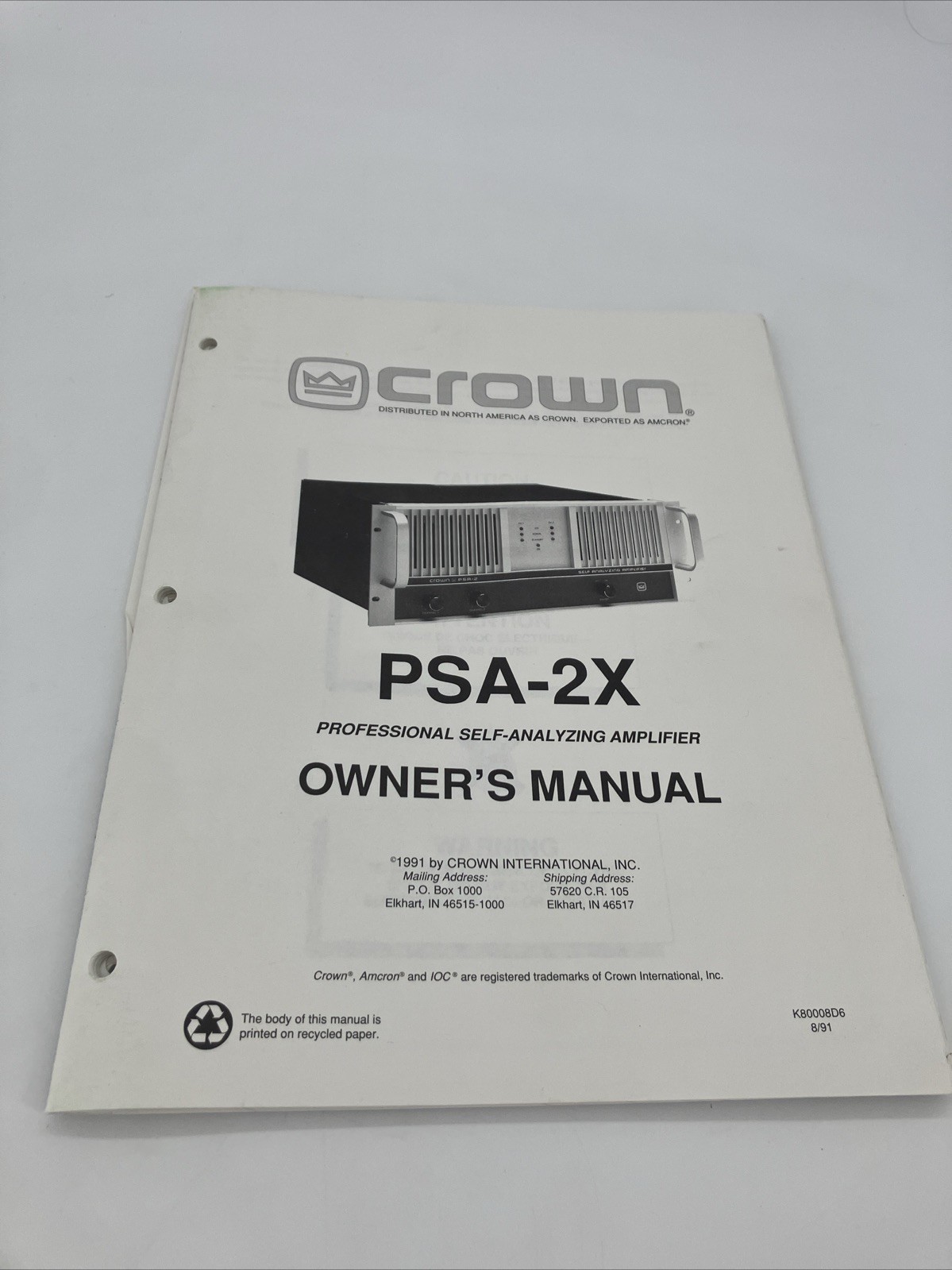
As an eBay Partner, we earn from qualifying purchases. This helps support our independent vintage technology research.
Service Manuals & Schematics
- Manual — archive.org
- Manual — archive.org
- Service Manual — archive.org
Related Models
- Crown COMPACT-LOUDSPEAKERS (1970)
- Crown ES14 (1978)
- Crown ES212 (1972)
- Crown POWER-LINE-ONE (1975)
- Crown PRO-800-SERIES (1975)
- Akai AM-2850 (1975)
- Akai AP-206 (1975)
- Nakamichi BX-1 (1985)
- Acoustic Research research-ar-17 (1978)
- Acoustic Research AR-19 (1994)