Crown POWER-LINE-ONE: The Pioneer of Powered Loudspeakers
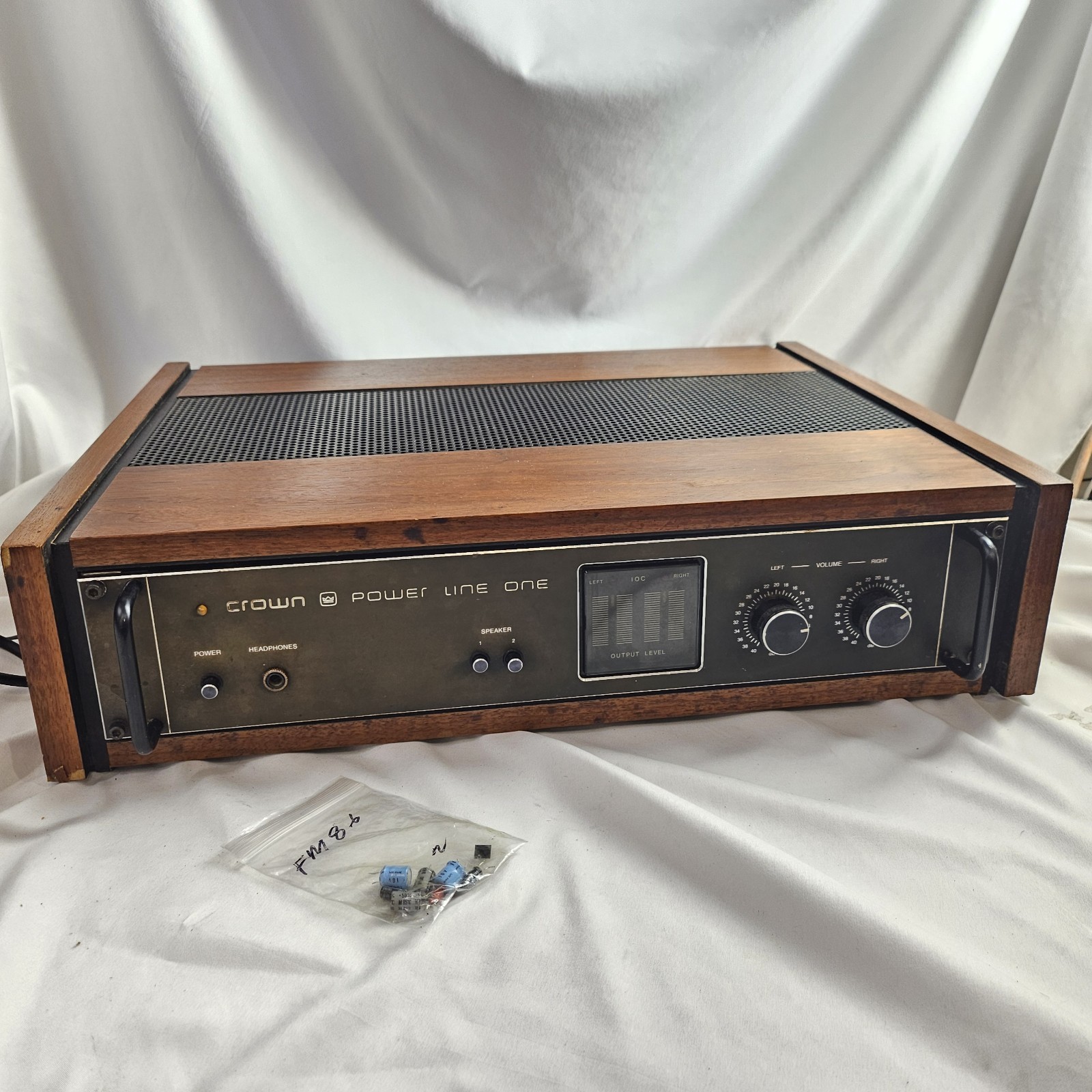
In the mid-1970s, when most audiophiles and sound engineers still relied on passive speaker systems paired with separate amplifiers, Crown International—a company already renowned for its robust, high-power amplifiers—dared to rethink the entire audio chain. The result was the Crown POWER-LINE-ONE, a groundbreaking active loudspeaker system that predated the modern era of powered speakers by decades. Though not widely recognized in consumer hi-fi circles today, the POWER-LINE-ONE holds a unique place in audio history as one of the first commercially available integrated amplifier-speaker systems designed for both professional and high-fidelity applications.
A Bold Vision: Integrated Amplification Meets Speaker Design
Introduced in 1975, the Crown POWER-LINE-ONE was more than just a speaker with a built-in amp—it was a holistic audio solution engineered from the ground up. Crown leveraged its deep expertise in solid-state amplifier design to create a system where the amplifier and loudspeaker were co-engineered for optimal performance. This integration allowed for precise control over driver behavior, reduced signal loss, and eliminated the variability introduced by external cabling and mismatched components.
The POWER-LINE-ONE was marketed as a "complete sound system in a cabinet," targeting not only audiophiles but also broadcasters, recording studios, and public address installations. Its design philosophy emphasized reliability, clarity, and efficiency—hallmarks of Crown’s engineering ethos.
Technical Specifications
| Specification | Detail |
| Model | POWER-LINE-ONE |
| Manufacturer | Crown International |
| Year Introduced | 1975 |
| Type | Active 2-way loudspeaker system |
| Built-in Amplifier | Yes (bi-amped design) |
| Amplifier Power | 50W LF, 25W HF (total 75W per cabinet) |
| Drivers | 12" woofer, 2" horn-loaded compression driver |
| Frequency Response | 55 Hz – 18 kHz (±3 dB) |
| Crossover | Active 12 dB/octave at 1.8 kHz |
| Inputs | Balanced XLR and 1/4" TRS |
| Enclosure Type | Bass-reflex, ported design |
| Dimensions (H×W×D) | 24" × 14" × 16" (61 × 35.5 × 40.6 cm) |
| Weight | 58 lbs (26.3 kg) |
| Finish | Textured black vinyl, steel grille |
| Impedance (Passive) | Not applicable (active system) |
| Power Requirements | 120V AC, 60 Hz |
The POWER-LINE-ONE featured a bi-amped configuration, with separate amplifier sections dedicated to the low-frequency and high-frequency drivers. This allowed for greater dynamic control and reduced intermodulation distortion—a significant advantage over passive systems of the era. The crossover network was active and located before the amplifiers, ensuring that each driver received only the frequencies it was designed to reproduce.
Sound Characteristics and Performance
The sonic signature of the POWER-LINE-ONE was clean, articulate, and surprisingly dynamic for its time. The 12-inch woofer delivered tight, punchy bass with minimal overhang, while the horn-loaded high-frequency driver provided clear, efficient treble response—ideal for voice reproduction and studio monitoring. The integration of Crown’s Class AB amplifiers ensured low distortion and high damping factor, resulting in excellent transient response and tight control over the woofer.
While not designed for deep sub-bass extension (it rolls off below 55 Hz), the POWER-LINE-ONE excelled in midrange clarity and vocal presence. Its sound was more "accurate" than "warm," aligning with professional monitoring standards rather than the lush, romanticized tone favored by some hi-fi systems of the 1970s.
In real-world use, the POWER-LINE-ONE was praised for its ability to maintain clarity at high volume levels—thanks in part to the efficiency of the horn-loaded tweeter and the thermal stability of Crown’s amplifier design. It was frequently used in broadcast booths, mobile recording rigs, and even as a stage monitor in early sound reinforcement setups.
Notable Features and Innovations
The POWER-LINE-ONE introduced several forward-thinking features:
- Active Bi-Amping: One of the first commercially available systems to implement true bi-amping with internal active crossovers.
- Integrated Design Philosophy: Unlike later powered speakers that simply added an amp to a passive box, the POWER-LINE-ONE was engineered as a unified system, with drivers and amplifiers optimized for each other.
- Professional-Grade Inputs: Equipped with balanced XLR and 1/4" inputs, it could be connected directly to mixers, microphones, or line-level sources without additional preamplification.
- Thermal and Overload Protection: Built-in safeguards prevented damage during prolonged high-volume operation—a hallmark of Crown’s reliability-focused design.
Its bass-reflex cabinet was constructed from thick MDF with internal bracing, minimizing resonance and coloration. The steel grille provided driver protection without sacrificing high-frequency clarity.
Common Issues and Maintenance
Today, surviving units of the POWER-LINE-ONE are rare and often require careful restoration. The most common issues include:
- Capacitor Aging: Electrolytic capacitors in the power supply and crossover circuits degrade over time, leading to hum, reduced output, or amplifier failure. A full recapping is often necessary.
- Driver Wear: The foam surrounds on the 12" woofer may have deteriorated. Re-foaming or reconing is typically required for optimal performance.
- Horn Diaphragm Fatigue: The 2" compression driver’s diaphragm can become brittle; inspection and possible replacement are recommended.
- Connector Corrosion: XLR and 1/4" jacks may suffer from oxidation; cleaning or replacement improves reliability.
Due to its integrated design, servicing the POWER-LINE-ONE requires familiarity with both speaker repair and analog amplifier electronics. Original service manuals are scarce but occasionally surface in Crown enthusiast communities.
Current Market Value and Collectibility
The Crown POWER-LINE-ONE is a niche collectible. It rarely appears on the vintage audio market, and when it does, prices range from $300 to $600 for working units, depending on condition and provenance. Restored examples with upgraded capacitors and refurbished drivers command higher prices, especially among collectors of vintage professional audio gear.
Its appeal lies not in nostalgia alone, but in its historical significance as a precursor to modern active studio monitors and powered speakers. Audio historians and engineers value it as a milestone in the evolution of integrated audio systems—predating the widespread adoption of active designs by companies like Meyer Sound, Genelec, and even modern consumer brands like KEF and JBL.
Conclusion and Legacy
The Crown POWER-LINE-ONE was ahead of its time. While it never achieved mass-market success in the consumer space, it laid the conceptual groundwork for the active loudspeaker revolution that would gain momentum in the 1990s and beyond. By integrating amplifier and speaker design, Crown demonstrated that system synergy could yield superior performance—a principle now standard in high-end studio monitors and smart speakers alike.
Today, the POWER-LINE-ONE stands as a testament to Crown’s engineering boldness. It’s a rare artifact that bridges the gap between the golden age of analog amplification and the dawn of intelligent, self-contained audio systems. For the vintage audio enthusiast, restorer, or audio historian, the POWER-LINE-ONE is more than a curiosity—it’s a pioneering chapter in the story of how we listen.
eBay Listings


As an eBay Partner, we earn from qualifying purchases. This helps support our independent vintage technology research.
Related Models
- Crown COMPACT-LOUDSPEAKERS (1970)
- Crown ES14 (1978)
- Crown ES212 (1972)
- Crown PRO-800-SERIES (1975)
- Crown PS-600 (1975)
- Akai AM-2850 (1975)
- Akai AP-206 (1975)
- Nakamichi BX-1 (1985)
- Acoustic Research research-ar-17 (1978)
- Acoustic Research AR-19 (1994)