Crown IC-150A: The Forgotten Pioneer of Integrated Audio Amplification
In the early 1970s, as the audio industry began to shift from discrete transistor designs to more compact, reliable, and cost-effective solutions, Crown International—already renowned for its high-power professional amplifiers—introduced a unique product that stood apart from its usual lineup: the Crown IC-150A. Unlike the company’s more famous standalone power amplifiers like the DC-300, the IC-150A was not a consumer or pro-audio amplifier in the traditional sense. Instead, it was an integrated circuit (IC) audio amplifier module, designed primarily for OEM (Original Equipment Manufacturer) integration into other systems. Though largely overlooked in vintage audio circles today, the IC-150A represents an important step in the evolution of solid-state audio amplification and showcases Crown’s forward-thinking engineering during a transformative era.
Historical Context: Crown in the Early 1970s
By the early 1970s, Crown had firmly established itself as a leader in professional audio amplification. The release of the legendary DC-300 in 1967 had redefined what was possible in high-power, high-fidelity amplification, and the company was actively exploring new technologies to improve efficiency, reliability, and manufacturability. While most of Crown’s efforts were focused on high-end touring and studio amplifiers, the company also recognized a growing market for compact, reliable audio solutions in industrial, commercial, and embedded applications.
The IC-150A, introduced around 1972, was part of this broader strategy. It was not marketed to audiophiles or musicians but rather to engineers and manufacturers who needed a proven, high-quality audio amplifier block that could be easily integrated into larger systems—such as public address units, intercom systems, test equipment, or even early electronic organs and synthesizers.
Technical Specifications
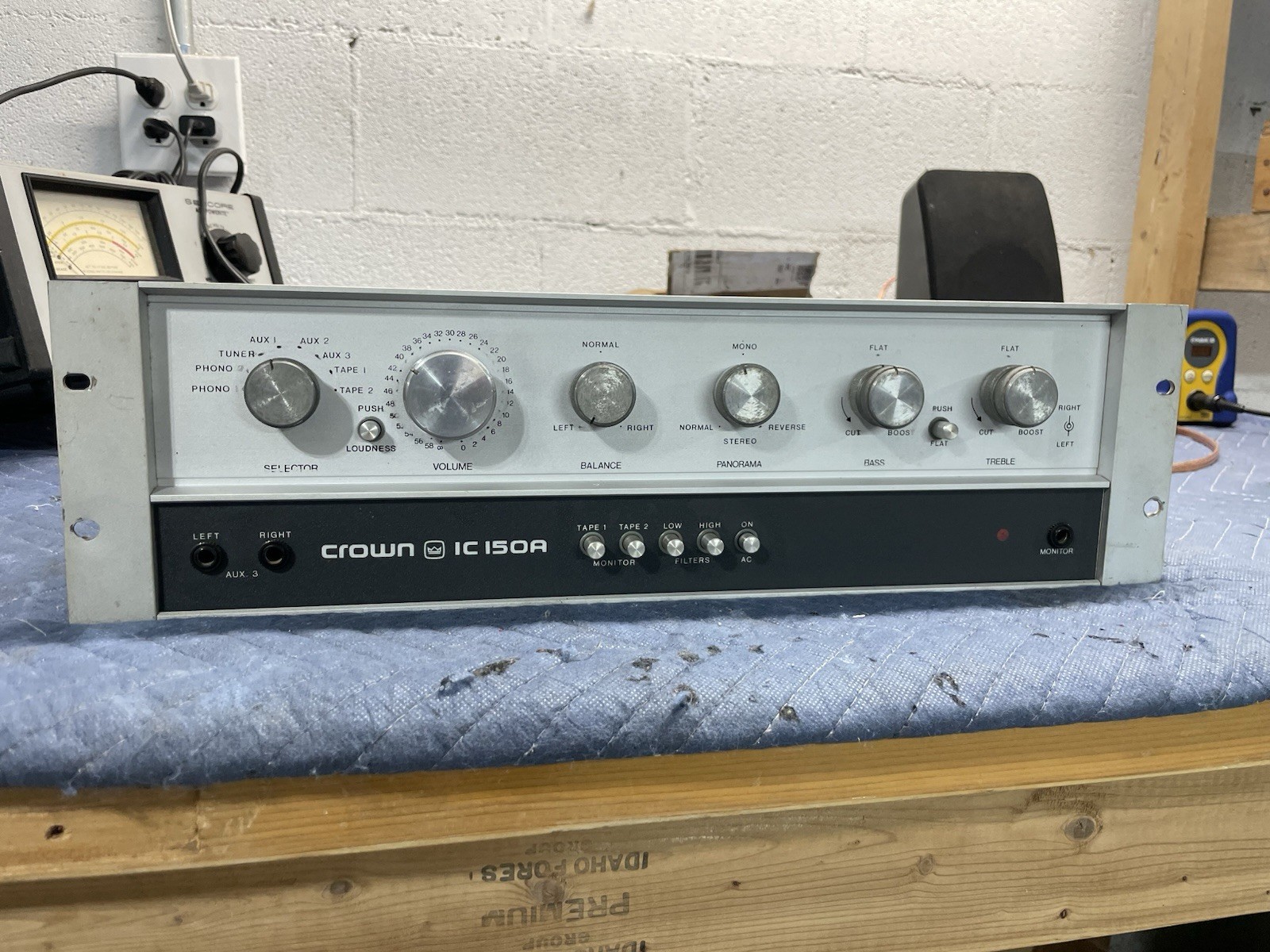
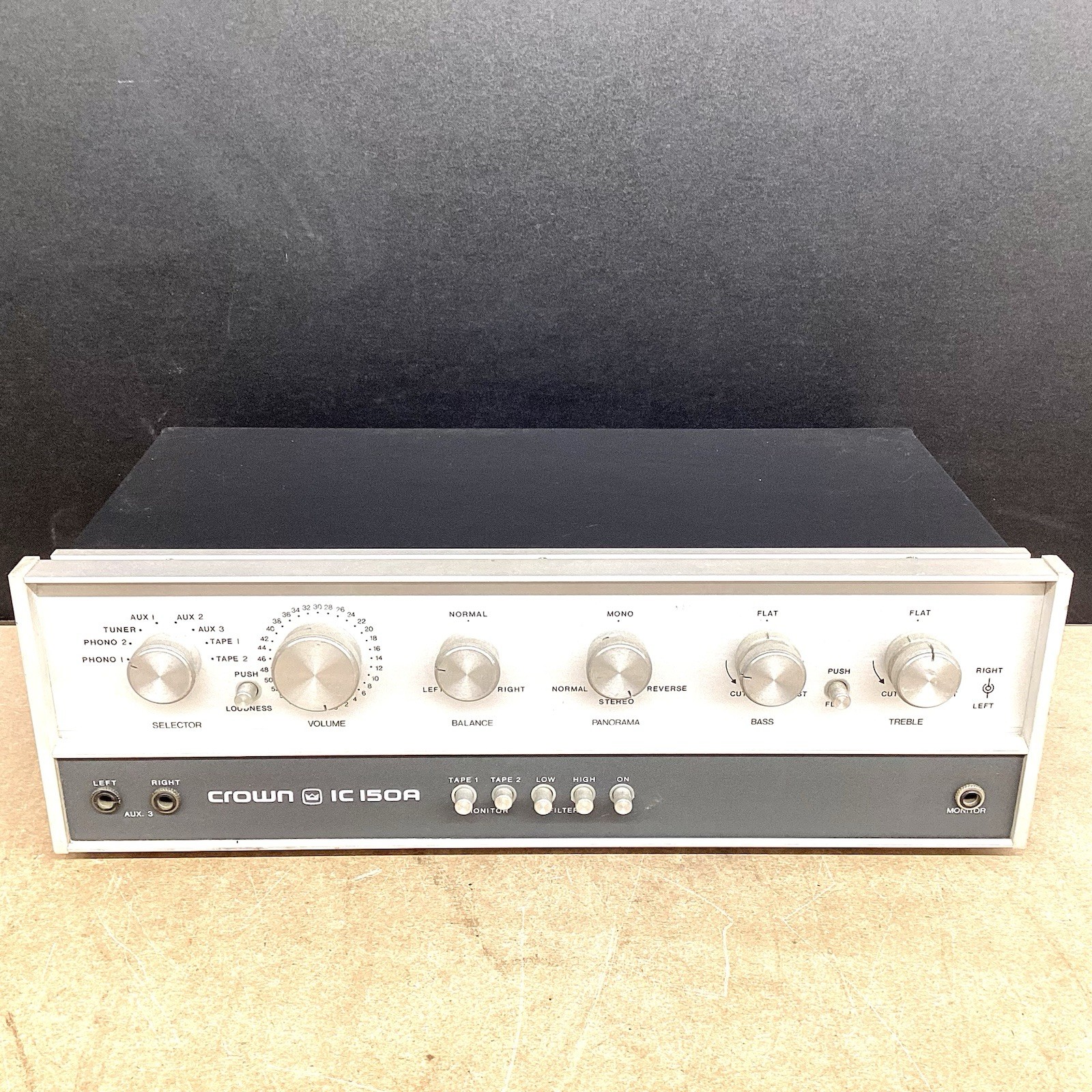
The IC-150A was not a standalone amplifier with front-panel controls or speaker terminals. Instead, it was a self-contained amplifier module built around a custom-designed integrated circuit, mounted on a small printed circuit board with external heat sinking. It required external power supplies and input signals but delivered a clean, robust audio output.
| Specification | Detail |
| Model | IC-150A |
| Manufacturer | Crown International |
| Year Introduced | 1972 |
| Type | Integrated circuit amplifier module |
| Configuration | Single-channel (monaural) |
| Output Power | Approximately 15W into 8Ω (estimated) |
| Frequency Response | 20Hz – 20kHz (±1dB) |
| Total Harmonic Distortion | <0.5% at rated power |
| Input Sensitivity | 0.5V RMS for full output |
| Input Impedance | 10kΩ (typical) |
| Power Supply | ±18V to ±24V DC (dual rail required) |
| Dimensions | Approx. 3" x 2" x 1" (without heatsink) |
| Cooling | External heatsink required |
| Primary Use | OEM, industrial, embedded applications |
The IC-150A utilized a complementary symmetry output stage built into a custom IC, which was quite advanced for its time. This allowed Crown to deliver consistent performance across units while reducing component count and improving reliability. The module included internal compensation and protection circuitry to guard against thermal runaway and short circuits, making it well-suited for unattended or embedded operation.
Sound Characteristics and Performance
Given its intended application, the IC-150A was not designed for audiophile listening or high-end sound reproduction. However, by the standards of early 1970s integrated amplifier technology, it delivered remarkably clean and transparent sound with low distortion and excellent transient response.
Engineers who worked with the module often praised its stability and low noise floor, which made it ideal for voice reinforcement and background music systems. While it lacked the raw power and dynamic headroom of Crown’s larger discrete amplifiers, the IC-150A provided more than enough fidelity for applications where clarity and reliability were paramount.
Its frequency response was flat across the audible spectrum, and the low distortion ensured minimal coloration. In modern terms, it would be considered a high-quality Class AB monoblock amplifier on a chip, optimized for consistent performance in mass-produced systems.
Notable Features and Innovations
The IC-150A stood out for several reasons:
- Early Use of Custom ICs in Audio: At a time when most audio amplifiers used discrete transistors or off-the-shelf op-amps, Crown’s development of a custom integrated circuit for audio amplification was forward-thinking. This allowed for tighter control over performance parameters and manufacturing consistency.
- OEM-Focused Design: The module was designed for easy integration—engineers could simply mount it on a chassis, connect power and signal wires, and attach a heatsink. This modularity was ahead of its time and foreshadowed modern “amp-in-a-box” solutions.
- Built-in Protection: Thermal shutdown and short-circuit protection were not common in small amplifier modules of the era. Crown’s inclusion of these features demonstrated a commitment to reliability, especially important in commercial installations.
- Industrial Durability: Built with high-quality components and robust packaging, the IC-150A was designed to operate continuously in demanding environments—from factory floors to airport terminals.
Common Issues and Maintenance
Today, the IC-150A is a rare find, and surviving units are often discovered in old industrial equipment or vintage test gear. Because it was not sold as a consumer product, documentation is scarce, and replacement parts are nearly impossible to source.
Common issues include:
- Degraded Solder Joints: Over time, thermal cycling can cause micro-cracks in solder joints, leading to intermittent operation.
- Failed Power Supplies: The IC-150A requires a clean, regulated dual-voltage supply. Many failures are actually due to poor external power rather than the module itself.
- Overheating: Without proper heatsinking, the module can overheat and fail. Original heatsinks are often missing or damaged.
- Obsolete IC: The custom amplifier IC is no longer manufactured. If it fails, repair is nearly impossible unless a donor unit is available.
For collectors or restorers, the best approach is to treat the IC-150A as a historical artifact or engineering curiosity. If functional, it should be operated with a properly regulated power supply and adequate cooling.
Current Market Value and Collectibility
The Crown IC-150A has no significant presence in the vintage audio collector market. It does not appear on auction sites with any regularity, and when it does, it’s often listed as a “vintage Crown amplifier module” without full understanding of its purpose.
Due to its obscurity and lack of consumer appeal, it is not valuable in monetary terms—typically selling for $25–$75 when found. However, for industrial audio historians, Crown enthusiasts, or engineers interested in vintage IC design, the IC-150A holds considerable historical value.
It represents a fascinating intersection of professional audio engineering and early integrated circuit technology—a prototype of the kind of modular, reliable audio solutions that would become standard in the 1980s and beyond.
Conclusion: A Hidden Gem of Audio Engineering
The Crown IC-150A may not have the fame of the DC-300 or the aesthetic appeal of a classic receiver, but it deserves recognition as an innovative and forward-looking product from one of America’s most respected audio companies. It embodies Crown’s engineering excellence and willingness to explore new technologies beyond the mainstream.
While it was never meant for the living room or recording studio, the IC-150A quietly powered countless audio systems behind the scenes—amplifying voices, music, and signals in places most of us never noticed. Today, it stands as a testament to the unsung heroes of audio design: compact, reliable, and built to last.
For the vintage audio enthusiast, the IC-150A is a reminder that innovation doesn’t always come in a polished chassis with glowing meters. Sometimes, it comes on a small circuit board, doing its job without fanfare—just as Crown intended.
eBay Listings


As an eBay Partner, we earn from qualifying purchases. This helps support our independent vintage technology research.
Related Models
- Crown 800 Series (Various Models) (1970)
- Crown C-4 (1965)
- Crown GOLD CROWN STEREO X (1975)
- Crown CX-844 (1985)
- Crown D-60 (1958)
- Luxman L-530 (1975)
- Luxman R-404 (1975)
- Luxman RV-371 (1975)
- Luxman SQ-38U (1975)
- Luxman T-14 (1972)