Crown EQ-2: The Precision Equalizer from the Golden Age of Pro Audio
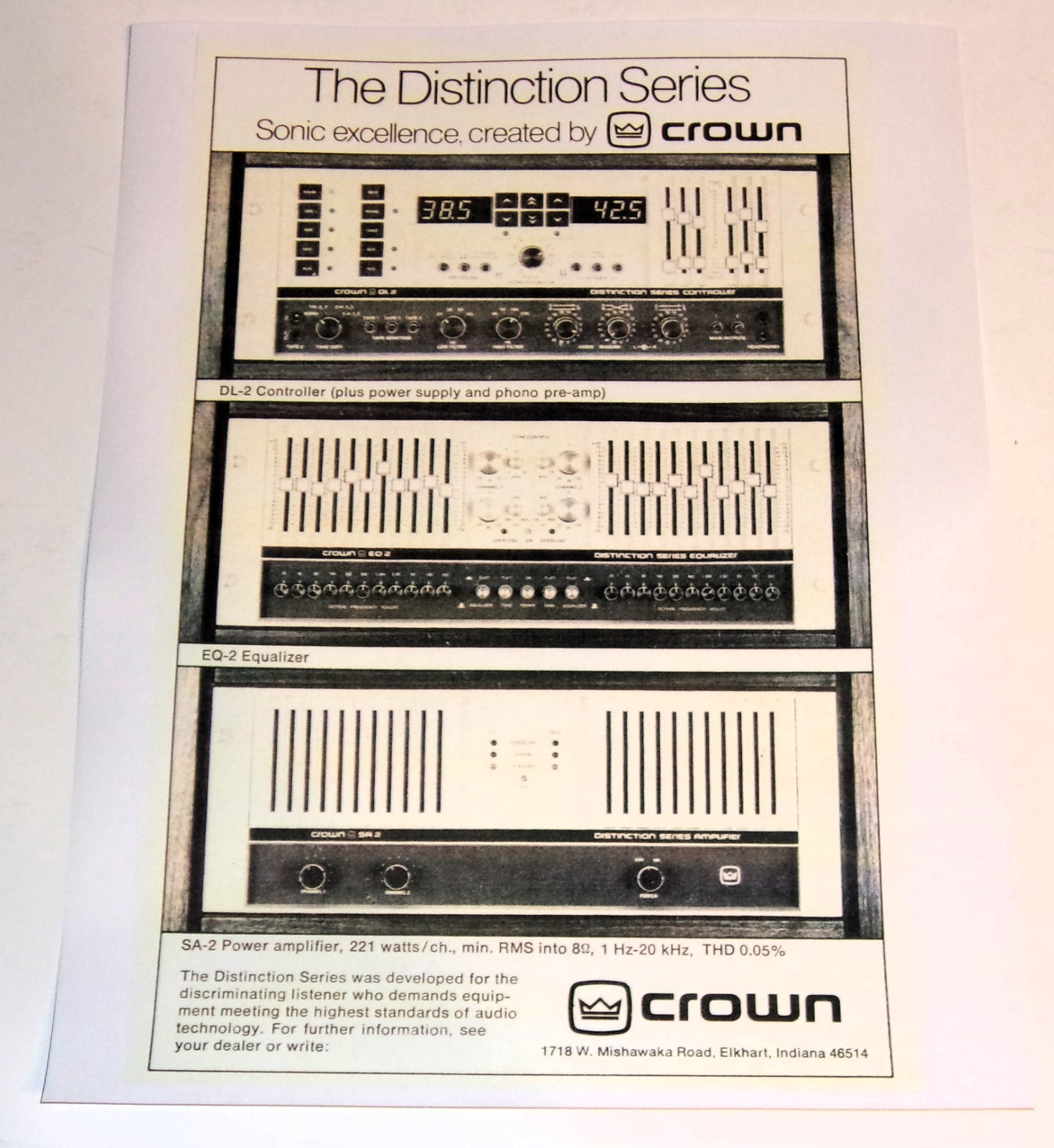
In the mid-1970s, as stereo systems evolved from simple hi-fi setups to more sophisticated audio environments, the demand for precise tone control grew—especially among recording engineers, audiophiles, and sound reinforcement professionals. Enter the Crown EQ-2, a stereo graphic equalizer that embodied the engineering rigor and no-nonsense design philosophy for which Crown International was renowned. While Crown is best known for its high-powered amplifiers, the EQ-2 stands as a testament to the company’s broader commitment to professional audio excellence.
Though not as widely recognized as some of its contemporaries from brands like Rane or dbx, the Crown EQ-2 carved out a niche in both studio and high-end home audio applications. Designed with clarity, reliability, and surgical control in mind, this analog equalizer offered users the ability to fine-tune their sound with a level of precision that was uncommon in consumer gear at the time.
Technical Specifications
The EQ-2 was engineered with professional use in mind, featuring balanced inputs and outputs, rugged construction, and a clean, modular signal path. While detailed service manuals are scarce today, surviving units and user reports confirm the following specifications:
| Specification | Detail |
| Model | EQ-2 |
| Manufacturer | Crown International |
| Year Introduced | 1975 |
| Type | Stereo 10-band graphic equalizer |
| Frequency Bands | 31 Hz, 63 Hz, 125 Hz, 250 Hz, 500 Hz, 1 kHz, 2 kHz, 4 kHz, 8 kHz, 16 kHz |
| Boost/Cut Range | ±12 dB per band |
| Input Impedance | 10 kΩ (balanced) |
| Output Impedance | 600 Ω (balanced) |
| Input/Output Connectors | XLR and 1/4" TRS (balanced) |
| Operating Level | +20 dBu maximum |
| Power Requirement | 115V AC, 50/60 Hz (internal transformer) |
| Dimensions (W×H×D) | 19" × 1.75" × 8" (standard 1U rack) |
| Weight | 7.5 lbs (3.4 kg) |
| Construction | Steel chassis, aluminum front panel |
The EQ-2 operated entirely in the analog domain, using passive filter networks combined with operational amplifiers to achieve its frequency shaping. Its 10-band design followed the ISO standard frequency spacing, making it compatible with common acoustic measurement tools and ideal for room correction and speaker matching.
Sound Characteristics and Performance
Unlike many consumer-grade tone controls of the era—which often colored or muddied the sound—the Crown EQ-2 was engineered for transparency. When all sliders were set to flat, the unit introduced minimal phase shift and negligible noise, preserving the integrity of the source signal. This made it a favorite among engineers who needed to correct room anomalies or speaker imbalances without adding sonic artifacts.
Each band offered smooth, predictable response curves, and the ±12 dB range provided ample headroom for both corrective and creative equalization. The use of high-quality potentiometers ensured consistent channel matching and long-term reliability. Users often praised the EQ-2 for its "invisible" presence when not in use and its surgical precision when needed.
In studio environments, the EQ-2 found use in monitor tuning, live sound reinforcement, and even as a mastering tool in smaller facilities. In high-end home audio systems, it allowed discerning listeners to tailor their listening rooms—especially helpful in spaces with problematic bass buildup or excessive high-frequency reflections.
Notable Features and Innovations
The Crown EQ-2 stood out for several reasons:
- Balanced I/O: Unlike many consumer equalizers of the time, the EQ-2 featured fully balanced XLR and 1/4" connections, allowing it to integrate seamlessly into professional signal chains and resist noise over long cable runs.
- Rack-Mount Design: Built as a 1U rackmount unit, it was designed for integration into studio racks and permanent installations.
- Dual-Mono Architecture: The EQ-2 treated each channel independently, avoiding crosstalk and ensuring true stereo correction.
- Durable Build Quality: Crown’s industrial-grade construction meant the EQ-2 could withstand the rigors of touring and daily studio use.
- LED Gain Reduction Metering: Some later units included simple LED indicators to show overall output level, helping prevent clipping in high-gain scenarios.
While not flashy, the EQ-2’s feature set was purpose-built for reliability and accuracy—hallmarks of Crown’s engineering ethos.
Common Issues and Maintenance
As with any vintage analog gear from the 1970s, the Crown EQ-2 can suffer from age-related wear, but it is generally considered robust. Common issues include:
- Noisy or scratchy sliders: The most frequent complaint. The slide potentiometers can accumulate dust or oxidize over time. Cleaning with contact cleaner (e.g., DeoxIT) often restores smooth operation.
- Power supply issues: The internal transformer and power cord may degrade. Replacement with a modern equivalent (while preserving original voltage specs) is recommended for safety.
- Capacitor aging: Electrolytic capacitors in the power supply or signal path may dry out. A recapping by a qualified technician can extend the unit’s life significantly.
- Loose connectors: XLR and 1/4" jacks may become loose due to repeated plugging. Solder joints should be inspected and reinforced if necessary.
Regular cleaning and occasional recalibration (if accessible) will keep the EQ-2 performing at its best. Due to its relatively simple circuit design, repairs are often straightforward for experienced technicians.
Current Market Value and Collectibility
The Crown EQ-2 is not a high-profile collector’s item like a vintage Neve or API unit, but it holds steady appeal among pro-audio enthusiasts, DIY audio builders, and vintage gear collectors who value functionality over fame.
On the secondhand market (eBay, Reverb, forums), working units typically sell for $150–$250, depending on condition and included accessories. Units with original packaging, manuals, or proven studio history may command slightly higher prices. Non-working units can be found for $50–$100, often snapped up by technicians for restoration.
While not rare, the EQ-2 is increasingly hard to find in good condition, especially with clean sliders and original finish. Its practicality ensures it remains in use rather than gathering dust on a shelf—always a sign of enduring value.
Conclusion and Legacy
The Crown EQ-2 may not have the legendary status of some boutique equalizers, but it represents the quiet backbone of professional audio during a transformative era. Built with integrity, designed for accuracy, and engineered to last, it exemplifies Crown’s commitment to solving real-world audio problems with solid, no-frills technology.
Today, the EQ-2 serves as a reminder that not all great gear needs to be flashy or expensive. For those restoring vintage systems, building a classic studio setup, or simply seeking precise analog tone control, the Crown EQ-2 remains a smart, functional choice. It’s a tool that was built to work—and decades later, many of them still do.
If you stumble upon a working EQ-2 in a rack at a garage sale or tucked away in a studio closet, don’t overlook it. You might just have found one of the most honest equalizers ever made.
eBay Listings



As an eBay Partner, we earn from qualifying purchases. This helps support our independent vintage technology research.
Related Models
- Crown C-8 (1960)
- Crown CX-724 (1995)
- Crown ES26 (1978)
- Heathkit AA-2010 (1975)
- Sony MDR-4 (1978)
- Sony MDR-80 (1975)
- Sony MDR-A60 (1975)
- Accuphase DG-28
- Accuphase G-18
- Altec 804A