Crown DC-150: The Solid-State Power Pioneer of the 1960s
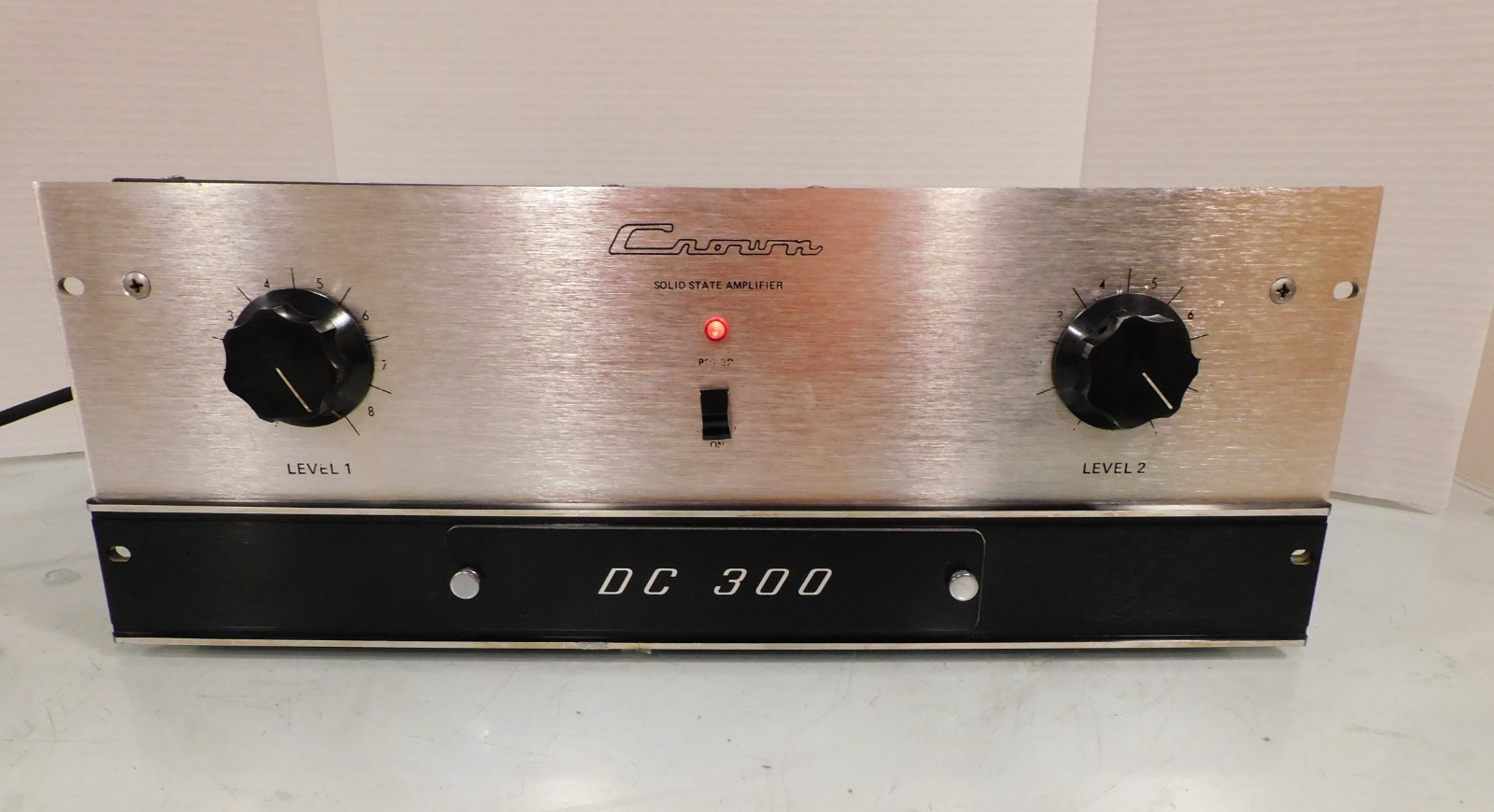
In the late 1960s, as the audio world transitioned from vacuum tubes to solid-state electronics, few amplifiers made as bold a statement as the Crown DC-150. Introduced in 1967, the DC-150 was not just another power amplifier—it was a technological milestone. As one of the first commercially available solid-state amplifiers capable of delivering 150 watts per channel in stereo (or a staggering 300 watts in mono bridged mode), the DC-150 redefined what was possible in high-fidelity and professional audio. Built by Crown International, a company already respected for its innovative engineering, the DC-150 became a favorite among audiophiles, sound reinforcement engineers, and recording studios alike.
At a time when most consumer amplifiers struggled to break 50 watts, the DC-150’s power output was nothing short of revolutionary. Its robust build, clean sound, and groundbreaking DC-coupled design (hence the "DC" in its name) eliminated the need for output coupling capacitors, reducing distortion and improving low-frequency response. This made it not only a powerhouse but also a high-fidelity leader in its era.
Technical Specifications
| Specification | Detail |
| Model | Crown DC-150 |
| Year Introduced | 1967 |
| Configuration | Stereo / Mono (bridged) |
| Power Output | 150W per channel (stereo, 8Ω) |
| 300W (mono bridged, 8Ω) | |
| Frequency Response | 20Hz – 20kHz (+0, -1 dB) |
| Total Harmonic Distortion | <0.1% (1kHz, full power) |
| Input Sensitivity | 1.4V for full output |
| Input Impedance | 50kΩ (balanced), 25kΩ (unbalanced) |
| Damping Factor | >200 (8Ω, 1kHz) |
| Signal-to-Noise Ratio | >90 dB (A-weighted) |
| Inputs | XLR (balanced), 1/4" phone (unbalanced) |
| Outputs | Screw terminals (binding posts) |
| Impedance Range | 2–8Ω |
| Weight | ~45 lbs (20.4 kg) |
| Dimensions (W×H×D) | 19" × 8.5" × 16" (48 × 22 × 41 cm) |
| Cooling | Convection (no fan) |
| Power Supply | Dual mono, transformer-coupled |
Sound Characteristics and Performance
The Crown DC-150 was engineered for clarity, control, and authority. Unlike many early solid-state amplifiers that suffered from harshness or "transistor glare," the DC-150 delivered a remarkably smooth and neutral sound. Its DC-coupled circuitry ensured excellent bass extension and tight control over speakers, making it ideal for both high-end home audio systems and demanding professional applications.
With a damping factor exceeding 200, the DC-150 could effectively control even the most difficult loudspeaker loads, minimizing resonance and enhancing transient response. Its wide frequency response and ultra-low distortion meant that music was reproduced with startling accuracy—details in orchestral passages, the attack of percussion, and the subtleties of vocal performances were rendered with precision.
In professional settings, the DC-150 became a staple in recording studios and live sound reinforcement. Its ability to drive large speaker arrays without strain made it a favorite for PA systems, while its clean headroom ensured that recordings captured the full dynamic range of performances. Even today, vintage audio enthusiasts praise the DC-150 for its "effortless" power delivery and natural tonal balance—qualities that remain impressive by modern standards.
Notable Features and Innovations
The DC-150 was packed with innovations that set it apart from its contemporaries:
- DC-Coupled Design: By eliminating output capacitors, Crown achieved a flatter frequency response, especially at the low end, and reduced phase shift and distortion.
- Dual-Mono Power Supply: Each channel had its own dedicated transformer winding and filtering, minimizing crosstalk and improving channel separation.
- Balanced Input Stage: The use of XLR and 1/4" TRS inputs allowed for noise-free signal transmission over long cable runs—essential in studio and live environments.
- Robust Build Quality: Housed in a heavy-gauge steel chassis with a large toroidal transformer and massive heat sinks, the DC-150 was built to last.
- Bridged-Mono Mode: A switch on the rear panel allowed users to combine both channels into a single 300-watt mono amplifier, ideal for subwoofers or high-power center channels.
Crown’s engineering philosophy emphasized reliability and serviceability, and the DC-150 reflected that. Its modular design made repairs straightforward, and many units from the 1960s and 70s are still operational today with basic maintenance.
Common Issues and Maintenance
While the DC-150 is legendary for its durability, age-related issues do arise:
- Capacitor Aging: The electrolytic capacitors in the power supply and signal path can dry out over time, leading to hum, reduced performance, or failure. A full recapping is often recommended for units that have been dormant.
- Resistor Drift: Carbon composition resistors may drift in value, affecting bias and balance. Replacing critical resistors with modern metal-film types can improve stability.
- Thermal Stress: Although the amplifier uses convection cooling, poor ventilation can cause heat buildup. Ensure the unit is placed in a well-ventilated area and keep vents clear.
- Input Jack Wear: The 1/4" jacks can become loose or oxidized. Cleaning with contact cleaner and checking solder joints can restore reliable connectivity.
- Bias Adjustment: Over time, the output transistor bias may drift. A qualified technician should check and adjust bias to ensure optimal performance and prevent thermal runaway.
Despite these considerations, the DC-150 is relatively straightforward to service. Replacement parts are still available, and its simple, discrete transistor design (no integrated circuits) makes troubleshooting accessible to experienced hobbyists.
Current Market Value and Collectibility
The Crown DC-150 has become a sought-after piece among vintage audio collectors and professional audio historians. While not as widely collected as some Japanese receivers or tube amplifiers, its historical significance and engineering excellence give it a special place in audio lore.
A fully functional DC-150 in good cosmetic condition typically sells for $400–$800, depending on provenance, originality, and whether it has been restored. Units with original packaging, manuals, or studio history can command higher prices. Fully recapped and serviced models are especially desirable.
Its appeal lies not just in nostalgia but in real-world performance. Many audiophiles still use the DC-150 as a power amplifier in high-end systems, often paired with modern preamps. Its ability to drive difficult speaker loads makes it a practical choice, not just a museum piece.
Conclusion and Legacy
The Crown DC-150 was more than an amplifier—it was a statement of intent from an American company determined to lead the solid-state revolution. At a time when high power and high fidelity were often seen as mutually exclusive, the DC-150 proved they could coexist. Its combination of brute strength, sonic clarity, and engineering integrity set a benchmark that influenced amplifier design for decades.
Today, the DC-150 stands as a monument to American audio innovation. It bridged the gap between professional and consumer audio, showing that reliability, power, and fidelity could be achieved in a single, well-engineered package. For vintage audio enthusiasts, restoring a DC-150 is not just about preserving history—it’s about experiencing a pivotal moment in audio evolution.
If you’re lucky enough to own or encounter a working DC-150, fire it up with care. Behind its unassuming rack-mount chassis lies the sound of the future—as imagined in 1967, and still impressive today.
eBay Listings


As an eBay Partner, we earn from qualifying purchases. This helps support our independent vintage technology research.
Service Manuals & Schematics
- Manual — archive.org
Related Models
- Crown 800 Series (Various Models) (1970)
- Crown C-4 (1965)
- Crown GOLD CROWN STEREO X (1975)
- Crown CX-844 (1985)
- Crown D-60 (1958)
- Luxman L-530 (1975)
- Luxman R-404 (1975)
- Luxman RV-371 (1975)
- Luxman SQ-38U (1975)
- Luxman T-14 (1972)