Crown D-75: The Solid-State Pioneer That Redefined Professional Audio
In the late 1950s, the world of audio amplification stood on the cusp of a technological revolution. Vacuum tubes had long dominated high-fidelity and professional sound systems, but their limitations—fragility, heat generation, and maintenance demands—were becoming increasingly apparent. Enter the Crown D-75, introduced in 1958, a groundbreaking solid-state stereo power amplifier that signaled Crown’s bold entry into the world of transistorized audio. Though modest by today’s standards, the D-75 was a landmark achievement: one of the first commercially successful solid-state amplifiers designed for both professional sound reinforcement and high-end home audio use.
Manufactured by Crown International, an Indiana-based company founded in 1947 by Raymond A. Mogilefsky, the D-75 embodied the company’s early commitment to reliability, innovation, and performance. Crown had already built a reputation for high-quality public address systems and tube amplifiers, but the D-75 represented a decisive leap into the future. It was engineered not just to compete with tube amplifiers, but to surpass them in consistency, durability, and sonic clarity—especially in demanding environments like recording studios, broadcast facilities, and live venues.
Technical Specifications
The Crown D-75 was a dual-channel (stereo) power amplifier designed for high-fidelity applications. Its solid-state design utilized germanium transistors, which were cutting-edge at the time but required careful thermal management and biasing. Despite the technological constraints of the era, the D-75 delivered impressive performance for its day.
| Specification | Detail |
| Model | D-75 |
| Manufacturer | Crown International |
| Year Introduced | 1958 |
| Type | Solid-state stereo power amplifier |
| Power Output | 75W RMS per channel (into 8Ω) |
| Total Harmonic Distortion | Less than 0.5% (typical) |
| Frequency Response | 20Hz – 20kHz (+/- 0.5dB) |
| Input Sensitivity | 1.4V for full output |
| Input Impedance | 100kΩ (balanced or unbalanced) |
| Damping Factor | >50 (at 1kHz, 8Ω) |
| Speaker Impedance | 2Ω to 16Ω (stable into complex loads) |
| Cooling | Convection (no internal fan) |
| Dimensions | 19" W × 8.5" H × 14" D |
| Weight | 42 lbs (19 kg) |
| Inputs | Terminal strip (screw-type) |
| Outputs | 4- and 8-ohm binding posts per channel |
Notably, the D-75 featured a modular internal layout—a rarity in the late 1950s—allowing for easier servicing and component replacement. Its robust steel chassis and front-panel-mounted heat sinks (integrated into the cast aluminum side panels) helped dissipate heat effectively, a critical consideration given the thermal sensitivity of early transistors.
Sound Characteristics and Performance
The Crown D-75 was not designed to be a “warm” or “tubey” amplifier. Instead, it aimed for accuracy, neutrality, and control—qualities that made it a favorite among engineers and audiophiles seeking transparency. Its solid-state design delivered a tight, well-defined bass response, a clean midrange, and extended highs without the soft roll-off typical of tube amps.
In professional settings, the D-75’s low distortion and high damping factor allowed it to drive difficult speaker loads with authority, making it ideal for studio monitors and early high-efficiency loudspeakers. Its ability to remain stable into low impedances (down to 2Ω) gave it a versatility that few amplifiers of the era could match.
While later solid-state designs would surpass it in power and refinement, the D-75 was praised at the time for its dynamic punch and clarity, especially when compared to the best tube amplifiers. It lacked the euphonic colorations of tubes, offering instead a more direct, “honest” presentation that revealed both the strengths and flaws of source material—a trait that endeared it to critical listeners.
Notable Features and Innovations
The Crown D-75 was packed with forward-thinking features that set it apart from its contemporaries:
- Early Solid-State Design: One of the first commercially available transistorized power amplifiers, predating even the famed Dynaco Stereo 70 (tube) and preceding the widespread adoption of solid-state tech by a decade.
- High Damping Factor: Unusually high for its time, allowing superior control over speaker cone movement and tighter bass.
- Wide Impedance Tolerance: Could safely drive loads from 2Ω to 16Ω, making it adaptable to a wide range of speaker systems.
- Balanced Input Capability: A rare feature in consumer-grade gear of the era, allowing noise rejection in long cable runs—ideal for studio and PA use.
- Reliability Focus: Built with serviceability in mind, using point-to-point wiring and accessible components, reflecting Crown’s professional audio roots.
Perhaps most importantly, the D-75 helped demystify solid-state audio. At a time when many doubted transistors could match the sonic quality of tubes, the D-75 proved that solid-state amplification could be not only reliable but musically satisfying.
Common Issues and Maintenance
As with any vintage electronics from the late 1950s, the Crown D-75 requires careful attention today. The most common issues stem from aging components:
- Capacitor Degradation: Electrolytic capacitors in the power supply and signal path often dry out or leak, leading to hum, reduced output, or complete failure. A full recapping is strongly recommended before powering up a long-dormant unit.
- Transistor Failure: Germanium output transistors (such as the 2N174 or similar) are prone to thermal stress and can fail or drift in bias. Many restorers opt to replace them with modern silicon equivalents or NOS (new old stock) parts.
- Bias Drift: The D-75 requires periodic bias adjustment to maintain optimal performance. Drifting bias can cause crossover distortion or thermal runaway.
- Corrosion and Dust: Units stored in damp or dirty environments may suffer from oxidized terminals or clogged ventilation paths.
Due to its professional build quality, however, many D-75 amplifiers have survived in working condition. Replacement parts are scarce but available through specialty vintage audio suppliers and Crown enthusiast communities.
Current Market Value and Collectibility
The Crown D-75 is a rare and increasingly collectible piece of audio history. Few units were produced compared to later Crown models, and even fewer have survived in original, unmodified condition. On the vintage market, working examples typically sell for $800 to $1,500, depending on condition, originality, and provenance.
Collectors value the D-75 not for its raw power, but for its historical significance—it represents the dawn of the solid-state era in audio. It’s particularly sought after by:
- Vintage pro-audio enthusiasts
- Audio historians
- Crown brand collectors
- Restorers of mid-century hi-fi systems
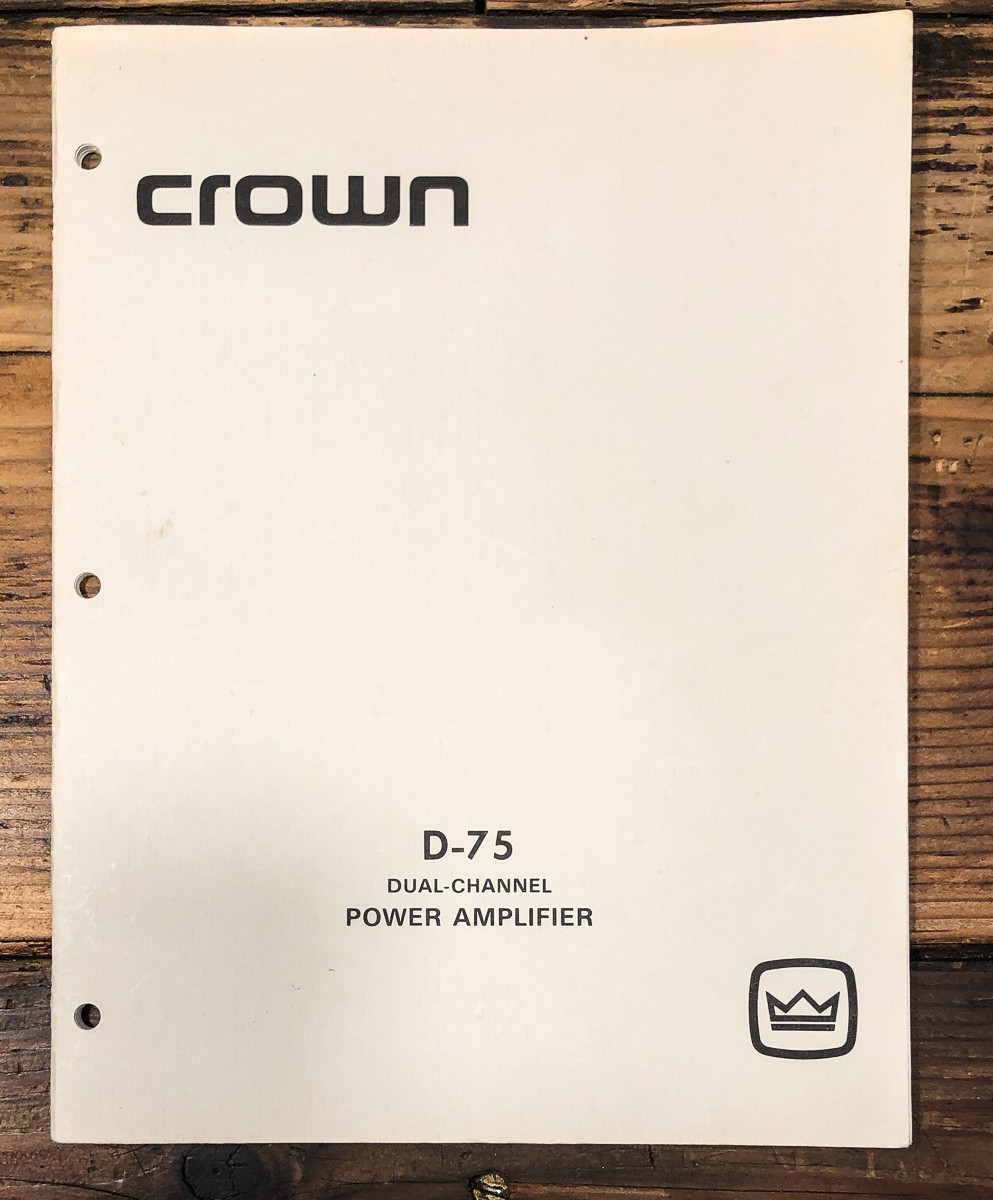
Units with original chassis labels, manuals, and matching-number components command premium prices. Cosmetic condition matters less than functionality, given the D-75’s utilitarian design.
Conclusion and Legacy
The Crown D-75 may not be as famous as the McIntosh MC240 or the Marantz 10B, but its place in audio history is secure. As one of the first successful solid-state power amplifiers, it helped pave the way for the transistor revolution that would dominate audio for the next 50 years. It embodied Crown’s philosophy of rugged, no-nonsense engineering—a trait that would define the brand’s future in professional sound.
More than just a technical curiosity, the D-75 was a vision of the future—a bold statement that solid-state audio could be reliable, powerful, and sonically compelling. For vintage audio enthusiasts, restoring a D-75 isn’t just about reviving old hardware; it’s about connecting with a pivotal moment when the sound of tomorrow first began to take shape.
Today, the Crown D-75 stands as a monument to innovation, a reminder that progress in audio isn’t just about louder or cleaner sound—but about reimagining what’s possible.
eBay Listings


As an eBay Partner, we earn from qualifying purchases. This helps support our independent vintage technology research.
Related Models
- Crown 800 Series (Various Models) (1970)
- Crown C-4 (1965)
- Crown GOLD CROWN STEREO X (1975)
- Crown CX-844 (1985)
- Crown D-60 (1958)
- Luxman L-530 (1975)
- Luxman R-404 (1975)
- Luxman RV-371 (1975)
- Luxman SQ-38U (1975)
- Luxman T-14 (1972)