Crown D-60: The Dawn of Solid-State Power in Professional Audio
In the late 1950s, the world of audio amplification stood on the brink of a revolution. Vacuum tubes, which had dominated amplifier design since the early 20th century, were beginning to show their limitations—bulky, fragile, power-hungry, and prone to heat and failure. Enter Crown International, a company that would become synonymous with innovation in professional audio. In 1958, Crown introduced the D-60, a landmark amplifier that represented one of the earliest commercially viable attempts to harness the potential of transistors in high-fidelity audio amplification.
The Crown D-60 wasn’t just another amplifier—it was a bold statement about the future of sound reinforcement. As one of the first transistorized amplifiers designed for professional use, the D-60 signaled the beginning of the end for tube dominance and laid the foundation for Crown’s reputation as a pioneer in solid-state audio engineering.
Historical Context: The Shift to Solid-State
The 1950s saw rapid advancements in semiconductor technology. Transistors, first developed at Bell Labs in 1947, began to replace vacuum tubes in radios, televisions, and eventually, audio equipment. However, early transistors struggled with power handling, heat dissipation, and linearity—critical factors for audio amplification.
Crown, founded in 1947 by Clarence Moore, had already built a reputation for high-quality tube amplifiers used in churches, schools, and public address systems. But Moore and his team recognized the long-term potential of solid-state technology. The D-60, released in 1958, was their answer: a compact, reliable, and efficient amplifier that could deliver consistent performance without the fragility of tubes.
Though modest by today’s standards, the D-60’s 60 watts of total RMS power was significant for its time—especially considering it was achieved without a single vacuum tube. It was primarily marketed to institutions needing dependable sound reinforcement: auditoriums, educational facilities, and small performance venues.
Technical Specifications
| Specification | Detail |
| Model | Crown D-60 |
| Year Introduced | 1958 |
| Power Output | 60W RMS total (likely 30W per channel) |
| Configuration | 2-channel (stereo or dual-mono) |
| Technology | All-transistor (early germanium types) |
| Frequency Response | Approx. 20Hz – 20kHz (±2dB) |
| Input Sensitivity | 0.3V for full output |
| Input Impedance | 100kΩ (high for the era) |
| Output Impedance | Multiple taps (4Ω, 8Ω, 16Ω) |
| Distortion (THD) | <1% at rated power |
| Damping Factor | Low (typical of early solid-state) |
| Cooling | Passive (no fan) |
| Dimensions | Approx. 19" W × 8" H × 12" D |
| Weight | ~25 lbs (11.3 kg) |
| Enclosure | Steel chassis, black wrinkle finish |
| Inputs | RCA and/or terminal block |
| Outputs | Screw-terminal speaker connections |
The D-60 used early germanium transistors, which were more sensitive to heat and less linear than the silicon transistors that would dominate the 1960s and beyond. Its circuit design was relatively simple by modern standards—direct-coupled, push-pull class AB operation—but groundbreaking for its era. The use of a toroidal transformer (a rarity at the time) contributed to lower hum and better efficiency.
Sound Characteristics and Performance
The Crown D-60 was not designed as a "hi-fi" component for home audiophiles, but rather as a workhorse for public address and institutional sound. As such, its sonic signature prioritized clarity, reliability, and headroom over warmth or musical coloration.
Listeners familiar with early solid-state gear will recognize the D-60’s sound: clean, somewhat clinical, with a fast transient response but limited dynamic punch compared to later designs. Bass response was tight but not particularly deep, while highs were extended but occasionally edgy—partly due to the limitations of germanium transistors and early capacitor technology.
Still, for its intended applications—speech reinforcement, background music, and small venue amplification—the D-60 delivered consistent, feedback-resistant performance. Its high input impedance made it easy to pair with a variety of preamplifiers and microphones, and its multiple output taps allowed flexible speaker matching.
Notable Features and Innovations
The Crown D-60’s most significant innovation was simply its existence. At a time when most manufacturers were still refining tube-based designs, Crown bet on transistors—and won. Key features included:
- All-transistor design: No tubes, no heaters, no warm-up time.
- High reliability: Fewer failure points than tube amps, ideal for institutional use.
- Compact size: Smaller and lighter than comparable tube amplifiers.
- Low maintenance: No need for tube replacements or bias adjustments.
- Built-in protection: Early forms of overload and thermal protection (rudimentary by today’s standards).
The D-60 also featured Crown’s signature attention to build quality—thick steel chassis, robust terminal blocks, and clear labeling. It was designed to be mounted in racks or placed on shelves, and its industrial aesthetic reflected its professional mission.
Common Issues and Maintenance
Today, surviving Crown D-60 units are rare and prized by collectors of early solid-state gear. However, they require careful attention due to their age:
- Germanium transistor failure: These early transistors degrade over time and are difficult to source. Replacements may require substitution with modern silicon types, which can alter performance.
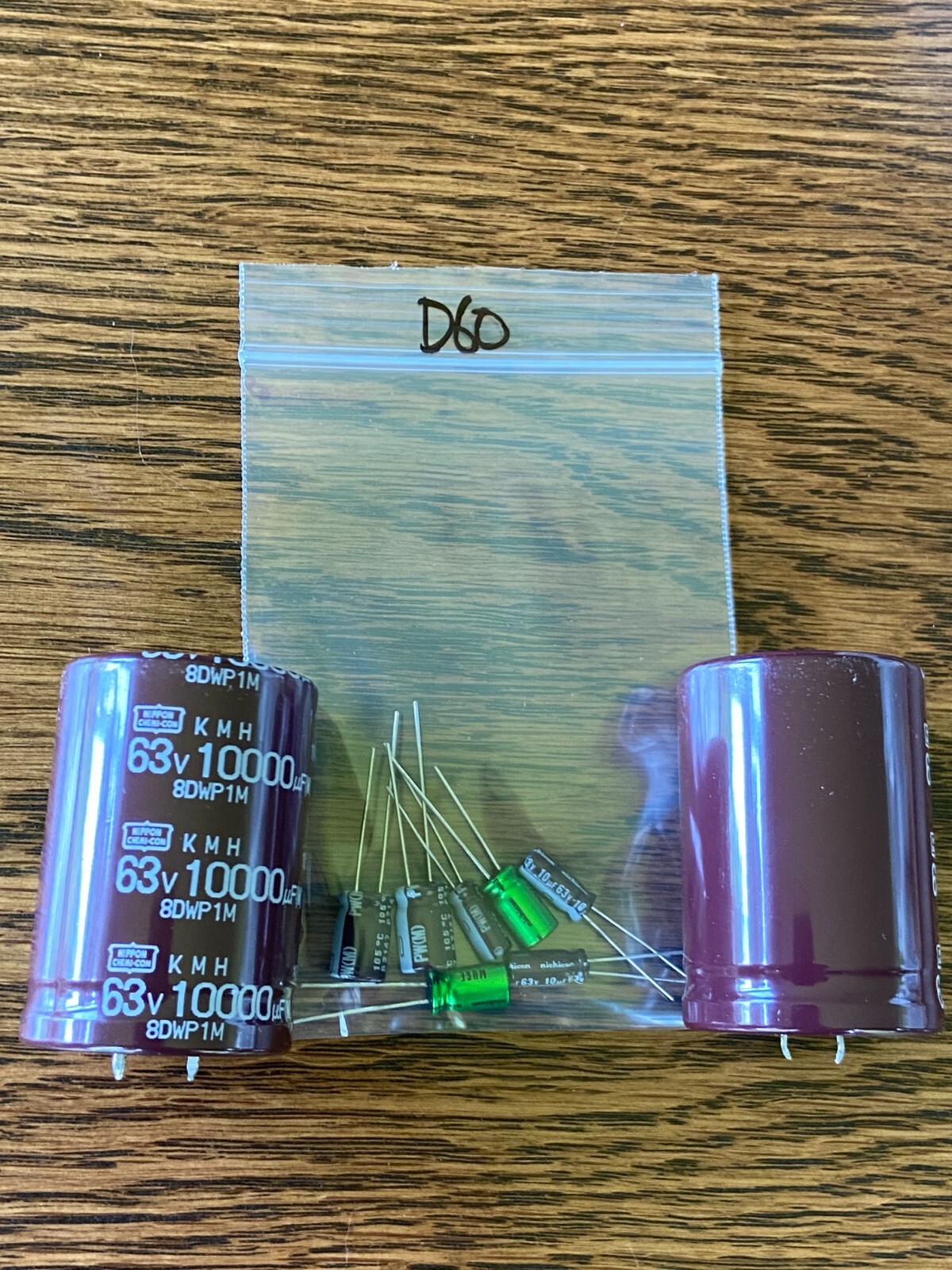
- Capacitor aging: Electrolytic capacitors in the power supply and signal path are likely dried out and should be replaced during restoration.
- Resistor drift: Carbon composition resistors can change value over decades, affecting bias and gain.
- Corrosion and oxidation: Terminal blocks and switches may need cleaning or replacement.
- Transformer issues: While robust, the power transformer can develop shorts or insulation breakdown after 60+ years.
Restoration should be undertaken by technicians experienced with vintage solid-state equipment. Due to the scarcity of original parts, some compromise is often necessary to return a D-60 to safe, functional condition.
Current Market Value and Collectibility
The Crown D-60 is a niche collectible. It doesn’t command the high prices of rare tube amplifiers or high-end hi-fi separates, but it holds significant historical value. In working condition, a restored D-60 might fetch $400–$700, depending on provenance and cosmetics. Non-working units in good shape may sell for $150–$300 to restorers.
Collectors of early transistor gear, pro audio historians, and Crown enthusiasts are the primary market. Its importance lies not in sonic perfection, but in its role as a technological trailblazer—the amplifier that helped usher in the solid-state era.
Conclusion: A Pioneer of Its Time
The Crown D-60 may not be the most powerful or refined amplifier ever made, but it is undeniably important. As one of the first successful all-transistor audio amplifiers for professional use, it represents a pivotal moment in audio history. It embodies the courage to innovate, the willingness to embrace new technology, and the vision to see beyond the limitations of the present.
For vintage audio enthusiasts, the D-60 is more than a relic—it’s a testament to the ingenuity that shaped modern sound reinforcement. While later Crown models like the DC-300 would achieve greater fame, it was the D-60 that laid the foundation. In the quiet hum of its chassis lives the sound of progress—a whisper of the future, heard for the first time in 1958.
eBay Listings


As an eBay Partner, we earn from qualifying purchases. This helps support our independent vintage technology research.
Related Models
- Crown 800 Series (Various Models) (1970)
- Crown C-4 (1965)
- Crown GOLD CROWN STEREO X (1975)
- Crown CX-844 (1985)
- Crown D-75 (1958)
- Luxman L-530 (1975)
- Luxman R-404 (1975)
- Luxman RV-371 (1975)
- Luxman SQ-38U (1975)
- Luxman T-14 (1972)