Crown C-4: The Unsung Pioneer of Solid-State Preamplification
In the mid-1960s, as high-fidelity audio systems were transitioning from vacuum tubes to solid-state electronics, Crown Audio—already renowned for its robust public address systems and professional amplifiers—stepped into the consumer and semi-professional hi-fi market with a quiet but significant innovation: the Crown C-4 stereo preamplifier. Though not as widely celebrated as contemporaries from Marantz, Fisher, or McIntosh, the C-4 represents an important milestone in American audio engineering. It was one of the earliest fully transistorized preamplifiers aimed at audiophiles and broadcast studios alike, offering a level of clarity, reliability, and low distortion that set it apart from its tube-driven peers.
While detailed documentation on the C-4 is scarce today, surviving units and period advertisements confirm its role as a forward-thinking design that bridged the gap between professional audio gear and high-end home systems. For collectors and vintage audio enthusiasts, the Crown C-4 is a rare find—a symbol of early solid-state innovation from a company that would later dominate power amplifier design.
Technical Specifications
The Crown C-4 was engineered during a time when solid-state technology was still proving itself in audio applications. Its circuitry relied on discrete germanium and early silicon transistors, avoiding integrated circuits, which were not yet reliable or widely available for audio use. The preamp was designed for versatility, with inputs tailored for turntables, tuners, tape decks, and even microphones—making it suitable for both home and studio environments.
| Specification | Detail |
| Model | C-4 |
| Manufacturer | Crown International |
| Year Introduced | 1965 |
| Type | Stereo Preamplifier |
| Technology | Fully transistorized (discrete components) |
| Inputs | 2x Line, 1x Phono (MM), 1x Microphone |
| Outputs | 1x Main Output, 1x Tape Output |
| Frequency Response | 20Hz – 20kHz (±1dB) |
| Total Harmonic Distortion | <0.1% at full output |
| Signal-to-Noise Ratio | >70dB |
| Power Supply | Internal linear transformer, 117V AC, 60Hz |
| Dimensions (H×W×D) | 6.5" × 17" × 10" |
| Weight | 14 lbs (6.4 kg) |
| Finish | Brushed aluminum front panel, black steel chassis |
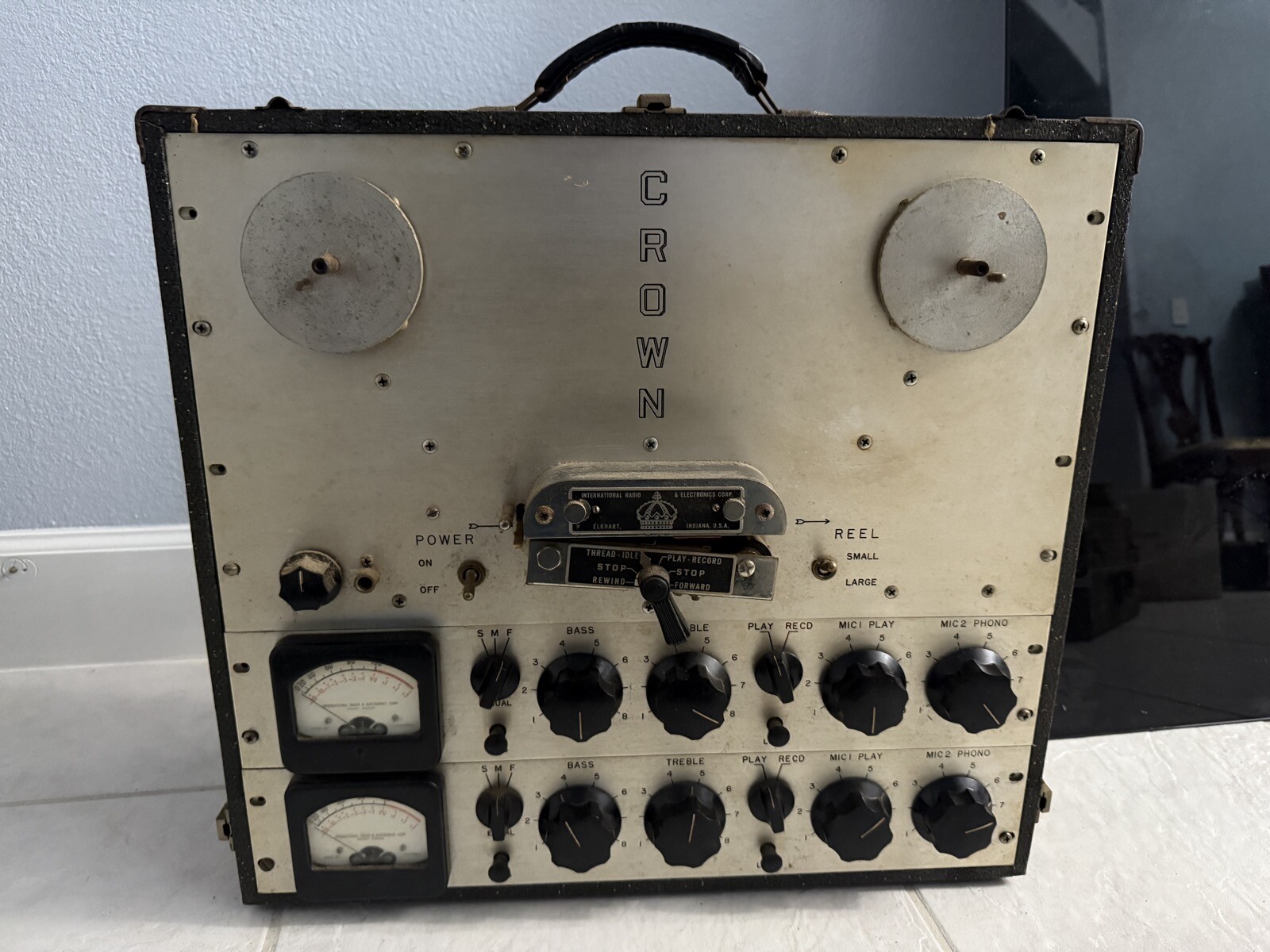
Unlike many consumer preamps of the era, the C-4 featured a minimalist, functional aesthetic—more akin to broadcast equipment than the ornate wood-clad receivers popular at the time. Its front panel included a large central VU meter, source selection knobs, bass and treble tone controls, and a prominent volume potentiometer. The rear panel offered high-quality screw-terminal connections, reflecting Crown’s professional heritage.
Sound Characteristics and Performance
The sonic signature of the Crown C-4 is best described as clean, neutral, and transparent—a stark contrast to the warm, slightly colored sound of tube-based preamplifiers. Early solid-state gear often suffered from harshness or “transistor glare,” but the C-4 avoided these pitfalls through careful circuit design and conservative gain staging. Its phono stage, designed for moving magnet cartridges, provided accurate RIAA equalization with low noise, making it well-suited for the vinyl playback of the era.
Users of surviving units report a wide soundstage, excellent channel separation, and a dynamic presentation that pairs well with both vintage and modern power amplifiers. The microphone input, often overlooked, adds a unique dimension, allowing the C-4 to function as a small mixing console—ideal for recording spoken word or acoustic performances directly to tape.
While it lacks the lush harmonic richness of tube gear, the C-4 excels in accuracy and detail retrieval. It was clearly designed for listeners who valued factual reproduction over euphonic coloration, a philosophy that would later define high-end audio in the 1970s and beyond.
Notable Features and Innovations
The Crown C-4 stood out for several reasons:
- Early Adoption of Solid-State Design: At a time when many audiophiles were skeptical of transistors, Crown demonstrated that solid-state electronics could deliver high fidelity without the maintenance and heat issues of tubes.
- Professional-Grade Build Quality: Built with heavy-gauge steel, military-spec connectors, and over-engineered power supplies, the C-4 was designed to last. This durability is evident in the number of units still operational today.
- Integrated VU Meter: The inclusion of a real-time VU meter was rare in consumer preamps and reflected Crown’s broadcast and studio roots. It allowed users to monitor output levels and avoid clipping.
- Modular Internal Layout: Service documentation (where available) suggests a modular design with easily replaceable circuit boards—a forward-thinking approach for the 1960s.
- Low Feedback Design: Unlike later high-feedback solid-state amplifiers, the C-4 used minimal negative feedback, contributing to its natural, uncolored sound.
Common Issues and Maintenance
As with any 50+ year-old electronics, the Crown C-4 requires careful attention before being powered up:
- Capacitor Aging: Electrolytic capacitors in the power supply and signal path are likely dried out. A full recap is strongly recommended to prevent damage and restore performance.
- Transistor Reliability: While generally robust, early germanium transistors can drift in value or fail. Testing and replacement with modern equivalents (where appropriate) may be necessary.
- Potentiometer Noise: The volume and tone controls often develop crackle over time. Cleaning with contact cleaner may help, but replacement with NOS (New Old Stock) or high-quality modern pots is often needed.
- Oxidation and Corrosion: Screw terminals and input jacks can corrode. Thorough cleaning with DeoxIT or similar products is advised.
- Power Supply Safety: Given its age, the power transformer and wiring should be inspected for insulation breakdown. A variac and current limiter are recommended during initial power-up.
Due to the rarity of the C-4, schematics and service manuals are hard to find, though some have surfaced in online vintage audio forums and Crown archives. Enthusiasts are encouraged to join communities like the Crown Vintage Audio Group or AudioKarma for technical support.
Current Market Value and Collectibility
The Crown C-4 is a rare and under-the-radar collectible. It does not command the high prices of a Marantz 7 or McIntosh C22, but its value is rising among niche collectors who appreciate early solid-state design and professional heritage.
- Working Condition: $300–$500
- Restored with Original Parts: $600–$800
- Non-Working/Project Units: $100–$200
Units with the original brushed aluminum faceplate, intact VU meter, and all knobs are the most desirable. Because the C-4 was not mass-produced for the consumer market, surviving examples are uncommon, especially outside the United States.
Its appeal lies not in nostalgia alone, but in its historical significance as a pioneer of solid-state preamplification—a machine that helped prove transistors could deliver true high fidelity.
Conclusion and Legacy
The Crown C-4 may not be a household name in vintage audio circles, but it deserves recognition as a bold and technically accomplished design from a pivotal moment in audio history. It represents Crown’s early commitment to innovation, reliability, and sonic accuracy—values that would later define their legendary power amplifiers like the DC-300 and K-series.
For the collector, restorer, or audiophile interested in the evolution of solid-state audio, the C-4 offers a fascinating window into the 1960s transition from tubes to transistors. It’s a machine built for engineers and purists—unflashy, overbuilt, and honest in its sound.
In an era where vintage audio often celebrates warmth and coloration, the Crown C-4 stands apart: a cool, precise, and enduring statement of functional excellence.
eBay Listings


As an eBay Partner, we earn from qualifying purchases. This helps support our independent vintage technology research.
Related Models
- Crown 800 Series (Various Models) (1970)
- Crown GOLD CROWN STEREO X (1975)
- Crown CX-844 (1985)
- Crown D-60 (1958)
- Crown D-75 (1958)
- Luxman L-530 (1975)
- Luxman R-404 (1975)
- Luxman RV-371 (1975)
- Luxman SQ-38U (1975)
- Luxman T-14 (1972)