Celestion SL700: The British Icon of Studio Monitoring
In the pantheon of vintage studio monitors, few speakers command the respect and reverence of the Celestion SL700. Introduced in the early 1980s by the British company Celestion—better known at the time for its guitar speaker drivers—the SL700 marked a bold departure into the world of professional audio monitoring. Designed as a compact nearfield monitor for recording studios, the SL700 quickly earned a reputation for its startling clarity, neutrality, and unflinching honesty. It wasn’t designed to flatter; it was engineered to reveal—every nuance, every flaw, every detail in a mix. That uncompromising transparency made it a favorite among engineers during the analog tape era and cemented its legacy as a true classic in the evolution of studio monitor design.
Historical Context and Design Philosophy
Prior to the SL700, Celestion had built its name on high-performance loudspeaker drivers for guitar amplifiers, most notably used by rock legends like The Who and Jimi Hendrix. But by the late 1970s, the company sought to expand into the professional studio market. The result was the SL700, launched in 1982 as a compact two-way active monitor aimed at the growing demand for accurate nearfield listening in control rooms.
The SL700 was developed in collaboration with audio engineer and designer John Bird, who brought a meticulous approach to crossover design and cabinet construction. The goal was simple: create a monitor that told the truth. No sonic coloration, no exaggerated bass, no hyped highs—just a flat, neutral frequency response that allowed engineers to make critical decisions with confidence.
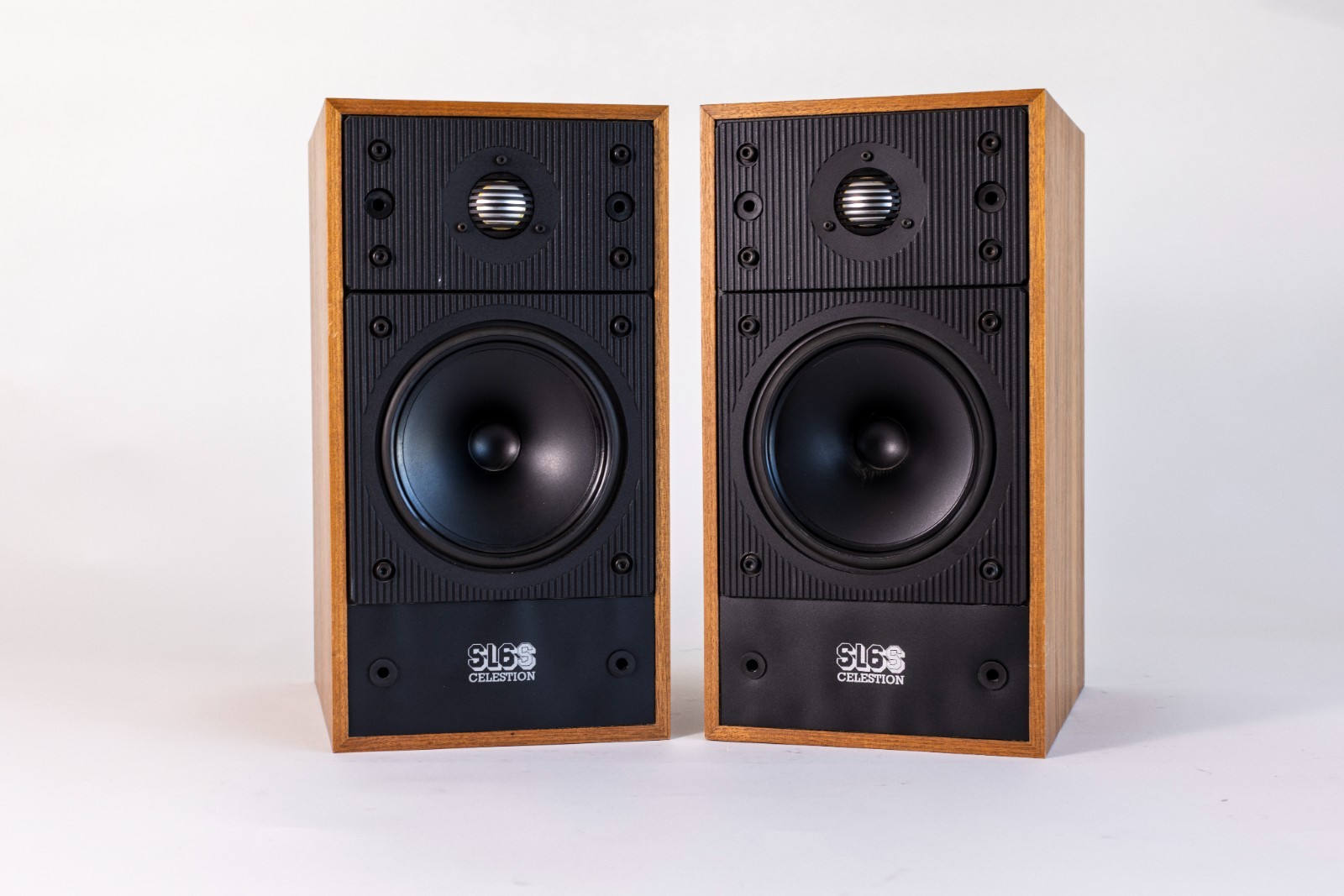
What set the SL700 apart wasn’t just its sound, but its striking appearance. Featuring a bright yellow Kevlar composite cone in its 7-inch bass/mid driver and a distinctive dished aluminum waveguide surrounding the 1-inch soft-dome tweeter, the SL700 was as visually arresting as it was sonically revealing. The waveguide, in particular, was a key innovation—designed to control dispersion and time-align the drivers for a coherent stereo image, even off-axis.
Technical Specifications
| Specification | Detail |
| Type | 2-way active studio monitor |
| Drivers | 7" yellow Kevlar cone (bass/mid), 1" soft-dome tweeter |
| Crossover Frequency | 2.8 kHz (24 dB/octave) |
| Frequency Response | 55 Hz – 20 kHz (±3 dB) |
| Amplification | Bi-amped (50W LF, 25W HF per cabinet) |
| Inputs | Balanced XLR and 1/4" TRS |
| Cabinet Material | Medium-density fiberboard (MDF) |
| Dispersion Control | Aluminum dished waveguide (patented) |
| Impedance | Not applicable (active design) |
| Dimensions (H×W×D) | 15.7" × 9.8" × 10.6" (400 × 250 × 270 mm) |
| Weight | 28 lbs (12.7 kg) per cabinet |
Note: While often mistaken for passive speakers, the original SL700 was fully active, with built-in amplification in each cabinet—a rarity for studio monitors of its era. This allowed for precise tuning of the drivers and minimized signal degradation from external amplifiers.
Sound Characteristics and Performance
The Celestion SL700 is renowned for its clinical precision and transparency. Its yellow Kevlar driver delivers tight, articulate midrange with minimal coloration, while the waveguide-controlled tweeter provides extended highs with exceptional detail. The result is a speaker that excels at revealing masking effects, phase issues, and subtle imbalances in a mix—qualities that made it a trusted tool in mastering and mixing environments.
Bass response, while not deep by modern standards (rolling off below 55 Hz), is remarkably tight and well-defined for a 7-inch driver. The bi-amped design ensures excellent transient response, making the SL700 particularly adept at reproducing percussive elements and vocal transients with startling realism.
Many engineers describe the SL700 as “unforgiving”—a trait that separates it from more forgiving consumer or home studio monitors. If a mix sounds good on the SL700, it’s likely to translate well across other systems. This earned them the nickname “the truth speakers” in British studios during the 1980s.
Notable Features and Innovations
- Dished Aluminum Waveguide: Perhaps the most iconic feature, this waveguide improved time coherence and off-axis response, reducing early reflections and enhancing stereo imaging.
- Integrated Bi-Amping: Each cabinet housed its own dedicated amplifier for the low and high-frequency drivers, eliminating the need for external power amps and ensuring optimal driver control.
- Kevlar Composite Driver: The yellow cone was not just for show—it offered high rigidity and low resonance, contributing to the speaker’s neutral midrange.
- Magnetic Shielding: Important for studio use near video monitors and tape machines, the SL700 was magnetically shielded to prevent interference.
- Balanced Connectivity: Offering both XLR and 1/4" inputs, the SL700 was ready for professional studio integration.
Common Issues and Maintenance
As with any vintage active monitor, the Celestion SL700 requires careful attention over time. Common issues include:
- Capacitor Aging: The internal power supplies and crossover networks use electrolytic capacitors that can dry out over decades, leading to hum, distortion, or complete failure.
- Amplifier Failures: The built-in amps, while robust, can suffer from thermal stress or component drift. Original service manuals are rare, making repairs challenging.
- Tweeter Damage: The soft-dome tweeters are delicate and can be damaged by overdriving or clipping.
- Cabinet Wear: The MDF cabinets are prone to chipping, especially around the edges. The yellow driver cones can fade or develop surface cracks if exposed to UV light.
Restoration is possible but often costly. Re-capping, amplifier servicing, and driver reconing are best handled by specialists in vintage pro audio. Some owners opt to convert the SL700 to passive use by removing the internal amps—a controversial but practical mod for those who want to preserve the speakers’ sonic character.
Current Market Value and Collectibility
The Celestion SL700 has become a sought-after collector’s item, especially in the UK and among vintage studio gear enthusiasts. Working pairs in good condition typically sell for $1,200 to $2,000, with pristine, fully serviced units commanding even higher prices. Non-working or project pairs can be found for $500–$800, but restoration costs can quickly add up.
Their collectibility stems not just from their sound, but from their historical significance. The SL700 was one of the first serious attempts by a British loudspeaker company to enter the high-end studio monitor market, and it did so with bold engineering and a distinctive aesthetic. They were used in iconic studios like Abbey Road, Townhouse, and Sarm West, further enhancing their legendary status.
Conclusion and Legacy
The Celestion SL700 stands as a landmark in the history of studio monitoring. It bridged the gap between the colored, character-driven speakers of the 1970s and the ultra-neutral reference monitors that dominate today’s studios. While later monitors like the Yamaha NS-10 and Genelec 8000 series achieved broader adoption, the SL700 carved out a niche as the engineer’s truth-teller—brutally honest, technically advanced, and sonically unforgettable.
Today, the SL700 is more than just a vintage speaker; it’s a symbol of a pivotal moment in audio engineering. Its blend of British craftsmanship, innovative design, and unflinching sonic integrity continues to inspire a loyal following. For those lucky enough to hear a well-maintained pair, the Celestion SL700 remains one of the most revealing windows into a mix ever created—a true classic of professional audio history.
eBay Listings



As an eBay Partner, we earn from qualifying purchases. This helps support our independent vintage technology research.
Related Models
- Celestion COUNTY (1978)
- Celestion SL12SI (1985)
- Celestion 5000 (1975)
- Celestion 7000 (1978)
- Celestion BC1 (1975)
- Akai AM-2850 (1975)
- Akai AP-206 (1975)
- Nakamichi BX-1 (1985)
- Acoustic Research research-ar-17 (1978)
- Acoustic Research AR-19 (1994)