Celestion DITTON-200: A British Icon of Precision Sound
In the early 1980s, British audio engineering reached a creative high point, and few speaker designs captured the spirit of innovation quite like the Celestion DITTON-200. As part of Celestion’s groundbreaking DITTON series—developed in collaboration with the acoustics research firm Ditton—the DITTON-200 stood out as a high-performance, two-way bookshelf or stand-mount loudspeaker aimed at discerning audiophiles who valued transparency, imaging precision, and neutral tonal balance.
Celestion, long respected for its professional monitor speakers and drive units, ventured into the high-fidelity consumer market with the DITTON line, and the DITTON-200 was one of its most celebrated offerings. Introduced in 1981, it represented a departure from traditional speaker design, embracing advanced crossover topologies and time-coherent engineering principles that were rare in mass-market loudspeakers at the time.
Technical Specifications
| Specification | Detail |
| Model | DITTON-200 |
| Manufacturer | Celestion Ltd. (UK) |
| Year Introduced | 1981 |
| Type | 2-way, passive, bass-reflex |
| Driver Complement | 1" soft-dome tweeter, 6.5" polypropylene cone woofer |
| Crossover Frequency | ~2.8 kHz |
| Crossover Type | 4th-order (24 dB/octave), time-aligned |
| Frequency Response | 55 Hz – 20 kHz (±3 dB) |
| Nominal Impedance | 8Ω (compatible with most amplifiers) |
| Sensitivity | 87 dB (2.83V/1m) |
| Recommended Amp Power | 25–100 watts |
| Enclosure Type | Bass-reflex with rear-firing port |
| Dimensions (H×W×D) | 370 × 220 × 290 mm (14.6 × 8.7 × 11.4 in) |
| Weight | 10.5 kg (23.1 lbs) per speaker |
| Finish Options | Rosewood, walnut, and black vinyl veneer |
The DITTON-200 employed a carefully engineered crossover network based on Ditton’s research into time and phase alignment, aiming to deliver a coherent acoustic center and superior stereo imaging. This was no ordinary crossover—it used a fourth-order Linkwitz-Riley alignment with precision components to ensure both drivers summed acoustically in-phase, minimizing lobing and off-axis coloration.
The 1-inch soft-dome tweeter provided smooth, extended high-frequency response without harshness, while the 6.5-inch polypropylene woofer offered tight, controlled bass for a speaker of its size. The bass-reflex port, located on the rear panel, enhanced low-frequency extension without sacrificing transient response—though the speakers benefited from careful placement away from rear walls to avoid bass boom.
Sound Characteristics and Performance
The DITTON-200 was never about raw power or deep sub-bass—it was engineered for clarity, precision, and realism. In a well-set-up system, these speakers delivered an astonishingly transparent midrange, making vocals and acoustic instruments sound lifelike and present. Their imaging was exceptional: pinpoint stereo focus, a wide and deep soundstage, and excellent instrument separation.
Treble response was detailed yet non-fatiguing, a rare balance in early 1980s designs that often leaned toward brightness. The polypropylene woofer provided a neutral, well-damped lower midrange, avoiding the "boxy" coloration that plagued many contemporaries. While bass extension reached down to 55 Hz, the speakers worked best with a modest room gain or, ideally, a small subwoofer for full-range listening.
What truly set the DITTON-200 apart was its time coherence. Because the crossover preserved phase alignment and the drivers were vertically aligned with the acoustic centers at ear level, the speaker behaved more like a point source. This resulted in a stable, three-dimensional soundstage that remained consistent even when listeners moved slightly off-axis—something few speakers of the era could match.
Notable Features and Innovations
The DITTON-200 wasn’t just another bookshelf speaker—it was a statement of engineering philosophy:
- Time- and Phase-Coherent Design: One of the first consumer speakers to prioritize time alignment, resulting in superior imaging and reduced phase distortion.
- Advanced Crossover Topology: The 4th-order Linkwitz-Riley network was sophisticated for its time, using high-quality capacitors and inductors to ensure smooth driver integration.
- Vertically Aligned Drivers: The tweeter and woofer were positioned to create a coherent wavefront, improving stereo focus.
- Neutral Voicing: Unlike many British speakers of the era that emphasized "warmth," the DITTON-200 aimed for accuracy, making it ideal for critical listening and studio-like monitoring.
- Hand-Built in the UK: Each pair was assembled with care in Celestion’s UK facilities, reflecting a commitment to quality.
These features made the DITTON-200 a favorite among recording engineers, broadcasters, and audiophiles who valued truth in sound reproduction over sonic embellishment.
Common Issues and Maintenance
Like all vintage speakers, the DITTON-200 requires some attention after four decades:
- Foam Surrounds Degradation: The polypropylene woofer used foam surrounds, which are prone to drying out and crumbling over time. Many surviving pairs have been re-foamed by specialist restoration services.
- Crossover Component Aging: Electrolytic capacitors in the crossover may have dried out, leading to loss of bass or tweeter failure. A capacitor refresh is often recommended for optimal performance.
- Tweeter Protection: The soft-dome tweeter is delicate. While robust for its era, it can be damaged by amplifier clipping or excessive volume. Some owners install protective grilles or limit high-frequency levels.
- Cabinet Integrity: The MDF cabinets were well-constructed, but veneer edges can chip, and internal bracing may loosen. Check for rattles or buzzing at high volumes.
Fortunately, there is an active community of vintage speaker enthusiasts who support DITTON-200 restoration. Replacement foam kits, crossover rebuild guides, and even upgraded tweeter domes are available from specialist suppliers.
Current Market Value and Collectibility
The Celestion DITTON-200 is highly collectible today, especially in good condition or professionally restored. Pairs in original, unmodified condition with clean cabinets and functioning drivers typically sell for £400–£700 (or $500–$900 USD), depending on region and restoration status. Fully restored pairs with re-foamed woofers and rebuilt crossovers may command even higher prices.
They are particularly sought after by:
- Vintage British audio collectors
- Studio monitor enthusiasts
- Listeners who appreciate neutral, detailed sound
While not as flashy as some contemporaries like the Linn Isobarik or B&W 801, the DITTON-200 has earned a quiet reputation as one of the most technically advanced and sonically honest speakers of its era.
Conclusion and Legacy
The Celestion DITTON-200 was more than just a loudspeaker—it was a bold experiment in scientific audio design. By applying rigorous acoustic research to a consumer product, Celestion and Ditton created a speaker that was ahead of its time in terms of phase coherence, imaging accuracy, and neutrality.
Though production was relatively limited and the model line was eventually discontinued as Celestion refocused on professional drivers, the DITTON-200 left a lasting legacy. It influenced later British designs and remains a benchmark for what a compact, two-way speaker can achieve when engineering takes precedence over marketing.
Today, in the hands of restorers and audiophiles, the DITTON-200 continues to deliver a listening experience that feels remarkably modern—proof that true innovation in audio design is timeless. For those who value precision, clarity, and a window into the recording studio, the Celestion DITTON-200 remains a hidden gem of British hi-fi history.
eBay Listings

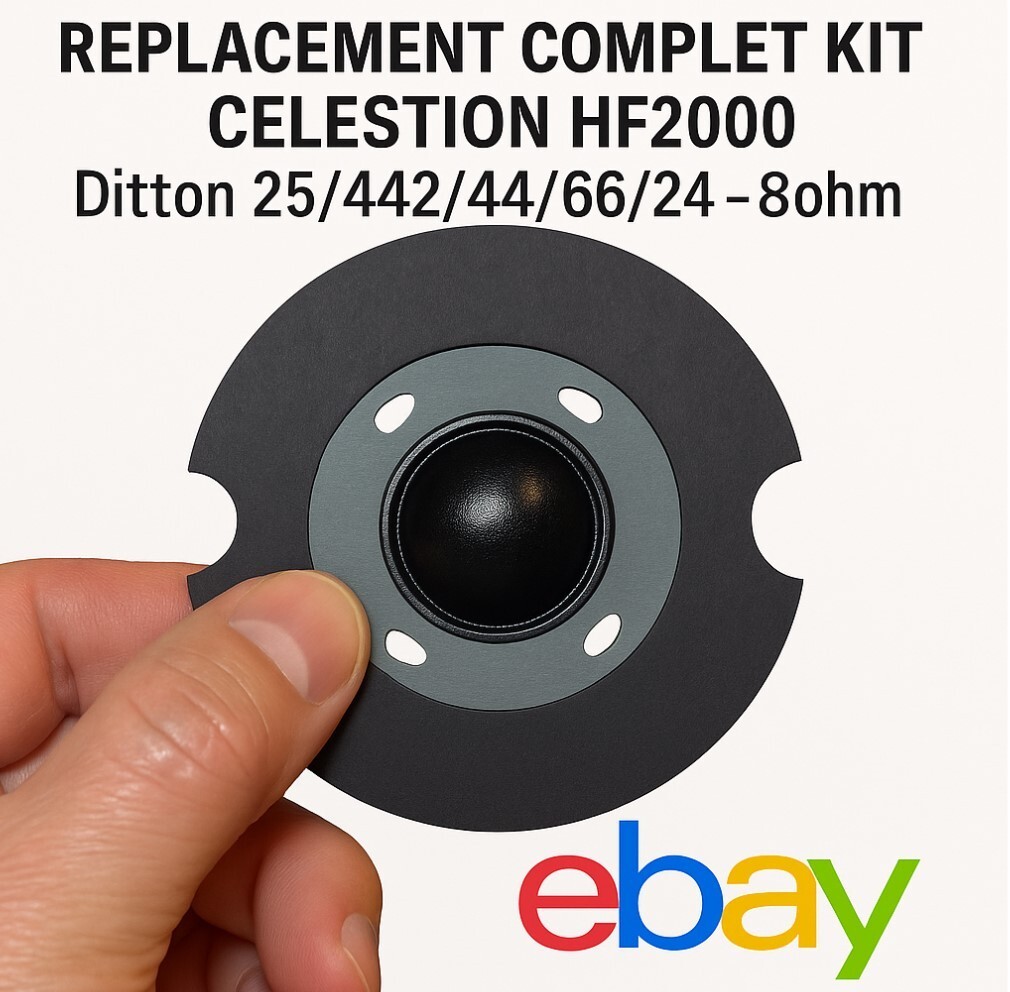


As an eBay Partner, we earn from qualifying purchases. This helps support our independent vintage technology research.
Related Models
- Celestion COUNTY (1978)
- Celestion SL12SI (1985)
- Celestion 5000 (1975)
- Celestion 7000 (1978)
- Celestion BC1 (1975)
- Akai AM-2850 (1975)
- Akai AP-206 (1975)
- Nakamichi BX-1 (1985)
- Acoustic Research research-ar-17 (1978)
- Acoustic Research AR-19 (1994)