Celestion DITTON-100: The British Engineering Marvel of the Early 1980s
In the early 1980s, British loudspeaker design was undergoing a quiet revolution. While companies like Bowers & Wilkins and Linn were pushing the boundaries of high-fidelity sound, a lesser-known but equally ambitious brand—Celestion—took a bold leap forward with the introduction of the DITTON-100. Though not as widely recognized as some of its contemporaries, the DITTON-100 stands today as a landmark achievement in speaker engineering, combining innovative driver alignment, transmission-line cabinet architecture, and a relentless pursuit of time coherence. It remains a cult favorite among vintage audio enthusiasts and a testament to British audiophile craftsmanship.
Historical Context: Celestion’s Transition from Pro to Hi-Fi
Celestion, originally renowned for its guitar speaker drivers used by rock legends like The Who and Jimi Hendrix, entered the high-fidelity market in the late 1970s with surprising ambition. The DITTON series—named after the Kent village where the company was based—was launched in the early 1980s as a premium line of domestic loudspeakers. The DITTON-100 was the flagship of this range, designed not just to compete with the likes of the BBC LS3/5A or the Spendor BC1, but to surpass them in technical sophistication.
At a time when most manufacturers were refining reflex-loaded or sealed-box designs, Celestion embraced the transmission-line (TL) principle—a complex but acoustically rewarding approach pioneered by John Wright and John Hayes at IMF (later TDL). The DITTON-100 took this further by integrating time-aligned driver arrays and asymmetric cabinet profiling, making it one of the first commercially available speakers to prioritize phase coherence and transient accuracy as much as frequency response.
Technical Specifications
| Specification | Detail |
| Model | DITTON-100 |
| Manufacturer | Celestion Ltd., DITTON, Kent, UK |
| Year Introduced | 1982 |
| Type | 3-way, transmission-line, floorstanding |
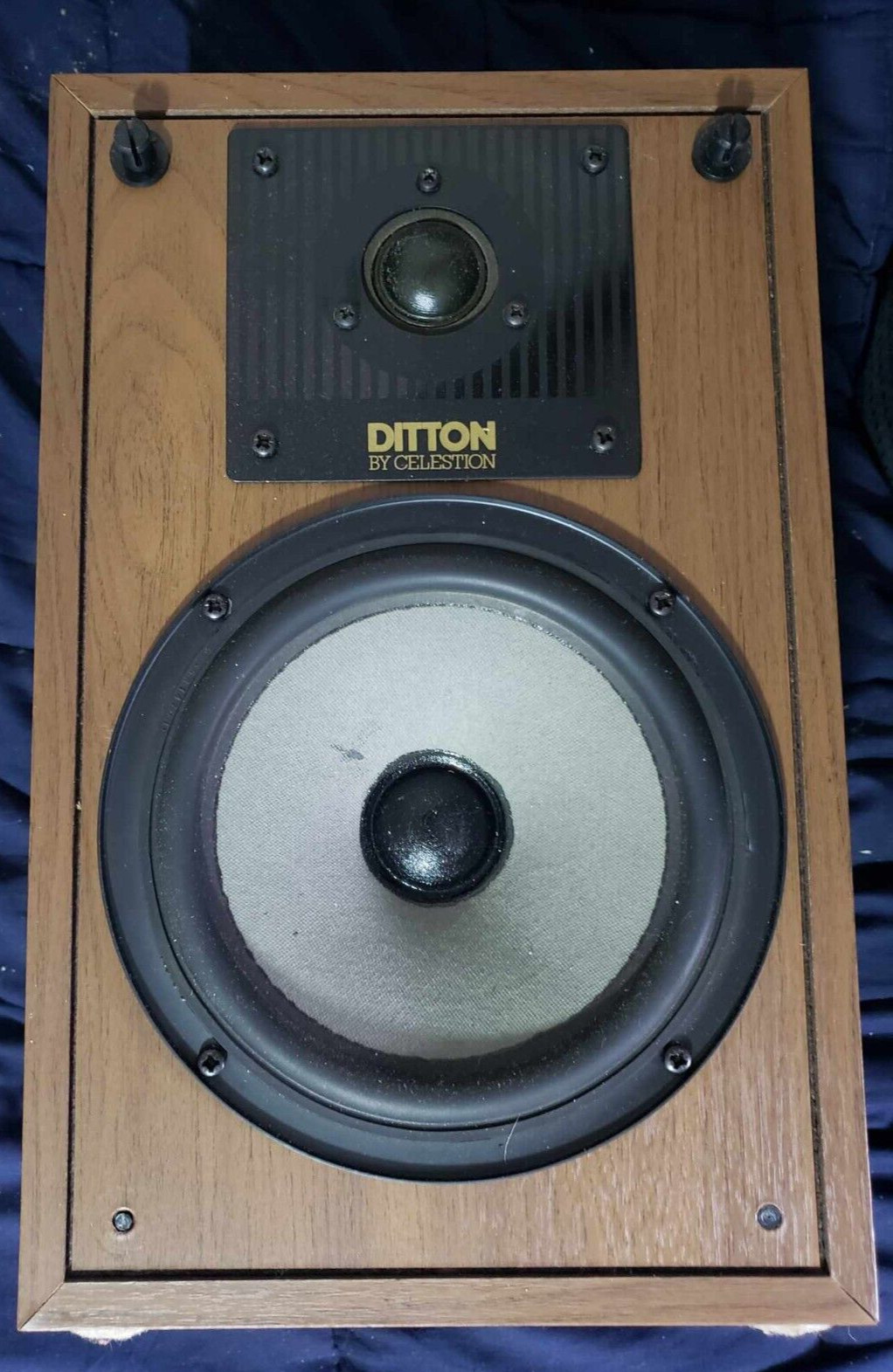
| Driver Complement | 1" soft-dome tweeter, 3.5" midrange, 8" bass |
| Crossover Frequency | 350 Hz, 3.5 kHz |
| Crossover Type | 2nd order (12 dB/octave) acoustic alignment |
| Sensitivity | 87 dB (2.83V/1m) |
| Nominal Impedance | 8Ω (compatible with most amplifiers) |
| Frequency Response | 35 Hz – 22 kHz (±3 dB) |
| Cabinet Design | Asymmetric transmission-line with front port |
| Dimensions (H×W×D) | 99 cm × 20 cm × 38 cm (approx.) |
| Weight | 28 kg per cabinet |
| Finish Options | Rosewood, walnut, black ash veneers |
Sound Characteristics and Performance
The DITTON-100’s sonic signature is nothing short of revelatory for its era. Thanks to its transmission-line cabinet—which uses a long, damped internal pathway to absorb and reinforce bass frequencies—the speaker delivers deep, articulate low end that belies its relatively modest 8" bass driver. The line extends down to 35 Hz, with a tautness and control unusual for non-ported designs of the time.
But the real magic lies in its midrange clarity and spatial precision. The 3.5" midrange driver, mounted on a sloped baffle and time-aligned with the tweeter, produces a lifelike vocal presence. Instruments are rendered with startling realism, and the soundstage is wide, deep, and remarkably stable. Listeners often describe the DITTON-100 as having a “you are there” quality—particularly with acoustic and chamber music.
The 1" soft-dome tweeter is smooth and detailed without being harsh, avoiding the sibilance that plagued many early dome tweeters. Its integration with the midrange is seamless, thanks to the carefully calculated crossover network and physical driver alignment.
Overall, the DITTON-100 excels in transparency and neutrality. It doesn’t “color” the sound the way vintage speakers sometimes do; instead, it reveals the recording as it was made. This makes it equally at home with classical, jazz, and well-produced rock—though it demands quality amplification to shine.
Notable Features and Innovations
Several design elements set the DITTON-100 apart from its contemporaries:
- Time-Aligned Driver Array: The tweeter and midrange are mounted on a stepped baffle so that their acoustic centers are equidistant from the listener, ensuring coherent phase response across frequencies.
- Asymmetric Transmission-Line Cabinet: Unlike symmetrical TL designs, the DITTON-100’s cabinet tapers and uses internal damping materials (long-fiber wool and foam) to minimize standing waves and resonance. The front-firing port enhances bass extension without the “one-note” boom of reflex designs.
- Point-to-Point Wiring and High-Quality Components: Inside, the crossover uses air-core inductors, polypropylene capacitors, and heavy-gauge wiring—uncommon in mass-market speakers of the era.
- Modular Driver Design: The drivers were engineered in-house with underhung voice coils and low-mass diaphragms for improved transient response.
Celestion even claimed that the DITTON-100 was designed to be “invisible” in the room—meaning the speaker itself should disappear, leaving only the music. While that’s a tall order, many owners report an uncanny sense of sonic transparency that supports the claim.
Common Issues and Maintenance
As with any vintage speaker, the DITTON-100 requires care and occasional restoration:
- Foam Surrounds: The original foam surrounds on the bass and midrange drivers can deteriorate over time, leading to flapping or distortion. Re-foaming or reconing is recommended for units over 30 years old.
- Crossover Components: While generally robust, electrolytic capacitors in the crossover may dry out. A full inspection and possible recapping can restore optimal performance.
- Cabinet Integrity: The transmission-line path relies on precise internal damping. If original damping material has settled or degraded, performance suffers. Replacing with modern acoustic wool can help.
- Grilles and Veneer: Original grilles are often missing, and wood veneers can show wear. Replacement grilles are occasionally available through enthusiast forums, and refinishing is possible with care.
Given their complexity, servicing DITTON-100s is best left to specialists familiar with transmission-line designs.
Current Market Value and Collectibility
The DITTON-100 is a sleeper classic in the vintage audio world. While not as widely collected as Linn or B&W models, it has a devoted following among engineers and audiophiles who appreciate its technical merits.
In good condition, a pair typically sells for $800–$1,500, depending on restoration status and originality. Fully restored pairs with reconed drivers and recapped crossovers can command higher prices, especially in Europe. Original boxes and documentation add value but are rare.
Its collectibility is growing, fueled by renewed interest in transmission-line speakers and British hi-fi heritage. The DITTON-100 is also sought after by studio engineers and mastering rooms for its flat response and low coloration.
Conclusion: A Hidden Gem of British Audio
The Celestion DITTON-100 may not have achieved the commercial success of its rivals, but it stands as a triumph of engineering ambition. It represents a moment when a rock-and-roll speaker company dared to reinvent itself as a high-end audio innovator—and succeeded.
With its time-aligned drivers, transmission-line cabinet, and uncolored sound, the DITTON-100 delivers a listening experience that feels startlingly modern. It’s a speaker that rewards careful setup, quality amplification, and well-recorded music.
For the vintage audio enthusiast, the DITTON-100 is more than just a relic—it’s a revelation. A quiet masterpiece from a golden era of British speaker design, it deserves a place on any shortlist of must-hear classics.
eBay Listings



As an eBay Partner, we earn from qualifying purchases. This helps support our independent vintage technology research.
Related Models
- Celestion COUNTY (1978)
- Celestion SL12SI (1985)
- Celestion 5000 (1975)
- Celestion 7000 (1978)
- Celestion BC1 (1975)
- Akai AM-2850 (1975)
- Akai AP-206 (1975)
- Nakamichi BX-1 (1985)
- Acoustic Research research-ar-17 (1978)
- Acoustic Research AR-19 (1994)