Celestion 5000: The British Icon of Studio Monitoring
In the pantheon of vintage studio monitors, few speakers command the respect and reverence of the Celestion 5000. Emerging from the fertile British audio engineering scene of the 1970s, the Celestion 5000 was not just another loudspeaker—it was a statement of intent. Designed to meet the rigorous demands of professional recording studios, this compact two-way monitor quickly gained a reputation for its revealing, uncolored sound and rugged build quality. Though Celestion is perhaps better known today for its guitar speaker drivers, the Celestion 5000 stands as a testament to the company’s broader legacy in high-fidelity audio reproduction.
Historical Context: A Monitor for the Modern Studio
Introduced in the mid-1970s, the Celestion 5000 arrived at a pivotal moment in music production. As multitrack recording became standard and studios sought greater accuracy in monitoring, engineers needed speakers that could reveal every nuance of a mix. The Celestion 5000 was developed in response to this demand, drawing on Celestion’s decades of experience in speaker design dating back to the 1920s.
Unlike many consumer-grade speakers of the era, the 5000 was engineered from the ground up for professional use. It found a natural home in UK recording studios during the golden age of rock, pop, and progressive music. Studios in London and beyond began adopting the 5000 as a nearfield or midfield monitor, appreciating its ability to expose flaws in recordings—making it an indispensable tool for critical listening.
Despite its professional pedigree, the Celestion 5000 also found favor among serious audiophiles and home studio enthusiasts. Its compact cabinet design and neutral tonal balance made it ideal for smaller control rooms, where precision mattered more than sheer volume.
Technical Specifications
The Celestion 5000 is a two-way, bass-reflex loudspeaker system, designed for accuracy rather than showy dynamics. It features a relatively modest driver configuration, but one that was carefully engineered for coherence and low coloration.
| Specification | Detail |
| Type | 2-way passive studio monitor |
| Driver Configuration | 8" bass/midrange, 1" dome tweeter |
| Crossover Frequency | ~3 kHz (estimated) |
| Frequency Response | 55 Hz – 20 kHz (±3 dB) |
| Sensitivity | 87 dB (1W/1m) |
| Nominal Impedance | 8 ohms |
| Cabinet Type | Bass-reflex with rear-firing port |
| Enclosure Material | Medium-density fiberboard (MDF) |
| Finish | Black textured vinyl wrap |
| Dimensions (H×W×D) | 16.5" × 10" × 11" (420 × 255 × 280 mm) |
| Weight | 22 lbs (10 kg) per speaker |
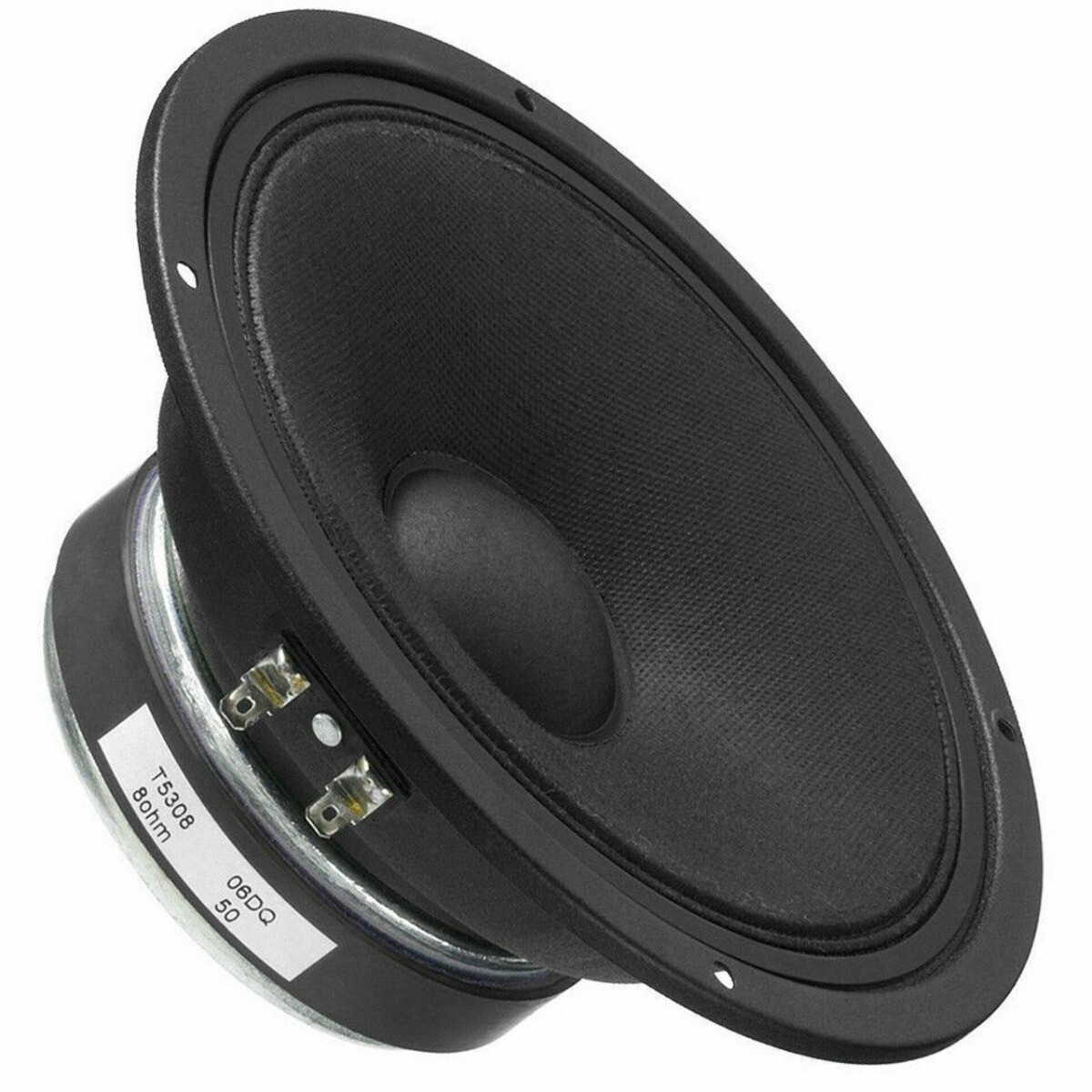
One of the most visually distinctive features of the Celestion 5000 is its yellow polypropylene cone, which became a signature of the brand’s professional drivers. This cone material was chosen for its stiffness and low resonance, contributing to the speaker’s clean midrange and tight bass response. The dome tweeter, typically made of soft fabric, offered smooth high-frequency extension without the harshness that plagued some contemporary designs.
The bass-reflex port, located on the rear panel, enhances low-frequency output and efficiency, allowing the 8-inch driver to deliver surprisingly deep bass for a cabinet of its size. However, this rear porting requires careful placement to avoid boundary reinforcement or bass cancellation.
Sound Characteristics and Performance
The Celestion 5000 is best described as transparent, neutral, and unforgiving—qualities that made it a favorite among engineers who needed to hear exactly what was on the tape. Its midrange is exceptionally clear, with vocals and acoustic instruments rendered with lifelike presence. The treble is detailed without being aggressive, and the bass, while not thunderous, is tight and well-controlled.
One of the hallmarks of the 5000’s sound is its coherence across the frequency spectrum. The crossover is well-executed for its era, resulting in a seamless transition between drivers. This makes the speaker excellent for identifying imbalances in a mix—whether a vocal is too forward, a guitar too bright, or a kick drum lacking punch.
In a professional setting, the Celestion 5000 was often used as a secondary or “reality check” monitor alongside more colored or hyped speakers. Its accuracy ensured that mixes translated well to other systems, from car stereos to home hi-fi setups.
Notable Features and Innovations
While not packed with flashy technology, the Celestion 5000 introduced several design philosophies that were ahead of their time:
- Yellow Polypropylene Cone: This became a hallmark of Celestion’s professional drivers, offering durability and sonic neutrality.
- Minimalist Crossover Design: Using high-quality components and a simple topology, the crossover preserves phase coherence and reduces signal degradation.
- Studio-Grade Cabinet Construction: The thick MDF enclosure minimizes panel resonance, reducing coloration.
- Neutral Voicing: Unlike many consumer speakers of the 1970s that emphasized bass or treble for “excitement,” the 5000 was voiced for accuracy—a rarity at the time.
The Celestion 5000 also helped establish the concept of the compact nearfield monitor in British studios, paving the way for later classics like the Yamaha NS-10 and the ATC SCM series.
Common Issues and Maintenance
As with any vintage speaker, the Celestion 5000 requires careful attention to remain in optimal condition. The most common issues include:
- Aging Foam Surrounds: The foam used to suspend the woofer cone often deteriorates after 30–40 years, leading to flaking and loss of bass response. Re-foaming is a common and recommended restoration.
- Tweeter Degradation: Older fabric dome tweeters may suffer from fatigue or damage, resulting in harshness or dropouts. Some owners opt for modern replacements or careful reconditioning.
- Crossover Component Drift: Capacitors and inductors in the crossover can degrade over time, altering the speaker’s tonal balance. Replacing these with modern equivalents can restore original performance.
- Cabinet Wear: The vinyl wrap may peel or discolor, and the MDF can be susceptible to moisture damage if stored improperly.
Fortunately, there is a dedicated community of vintage speaker enthusiasts who specialize in restoring Celestion monitors. Replacement parts, including reconed drivers and updated crossovers, are available from specialty audio restoration shops.
Current Market Value and Collectibility
Today, the Celestion 5000 is a sought-after piece of audio history. While not as ubiquitous as the NS-10, it holds a special place among vintage monitor collectors and analog studio aficionados. A pair in good working condition typically sells for $400–$800, depending on restoration status and originality.
Fully restored pairs with re-foamed drivers and updated crossovers can command higher prices, especially when sold with matching stands or original documentation. Their value is further enhanced by their association with classic British recordings from the 1970s and 1980s.
Though Celestion no longer produces the 5000, the company’s legacy lives on in modern studio monitors and high-end drivers. The 5000 remains a symbol of a time when British engineering met musical excellence.
Conclusion: A Legacy of Accuracy
The Celestion 5000 may not have the fame of some of its contemporaries, but among those in the know, it is revered as a benchmark of honest sound reproduction. It represents a philosophy of engineering integrity—where the goal was not to impress, but to reveal.
For vintage audio enthusiasts, restoring a pair of Celestion 5000s is more than a technical project; it’s a journey into the heart of analog recording history. Whether used in a modern project studio or displayed as a piece of audio heritage, the Celestion 5000 continues to inspire with its clarity, craftsmanship, and timeless design.
If you’re lucky enough to find a working pair, treat them with care—they’re not just speakers, they’re sonic time machines.
eBay Listings


As an eBay Partner, we earn from qualifying purchases. This helps support our independent vintage technology research.
Related Models
- Celestion COUNTY (1978)
- Celestion SL12SI (1985)
- Celestion 7000 (1978)
- Celestion BC1 (1975)
- Celestion BC3 (1970)
- Akai AM-2850 (1975)
- Akai AP-206 (1975)
- Nakamichi BX-1 (1985)
- Acoustic Research research-ar-17 (1978)
- Acoustic Research AR-19 (1994)