Carver TFM-45: The Compact Powerhouse of the 1980s
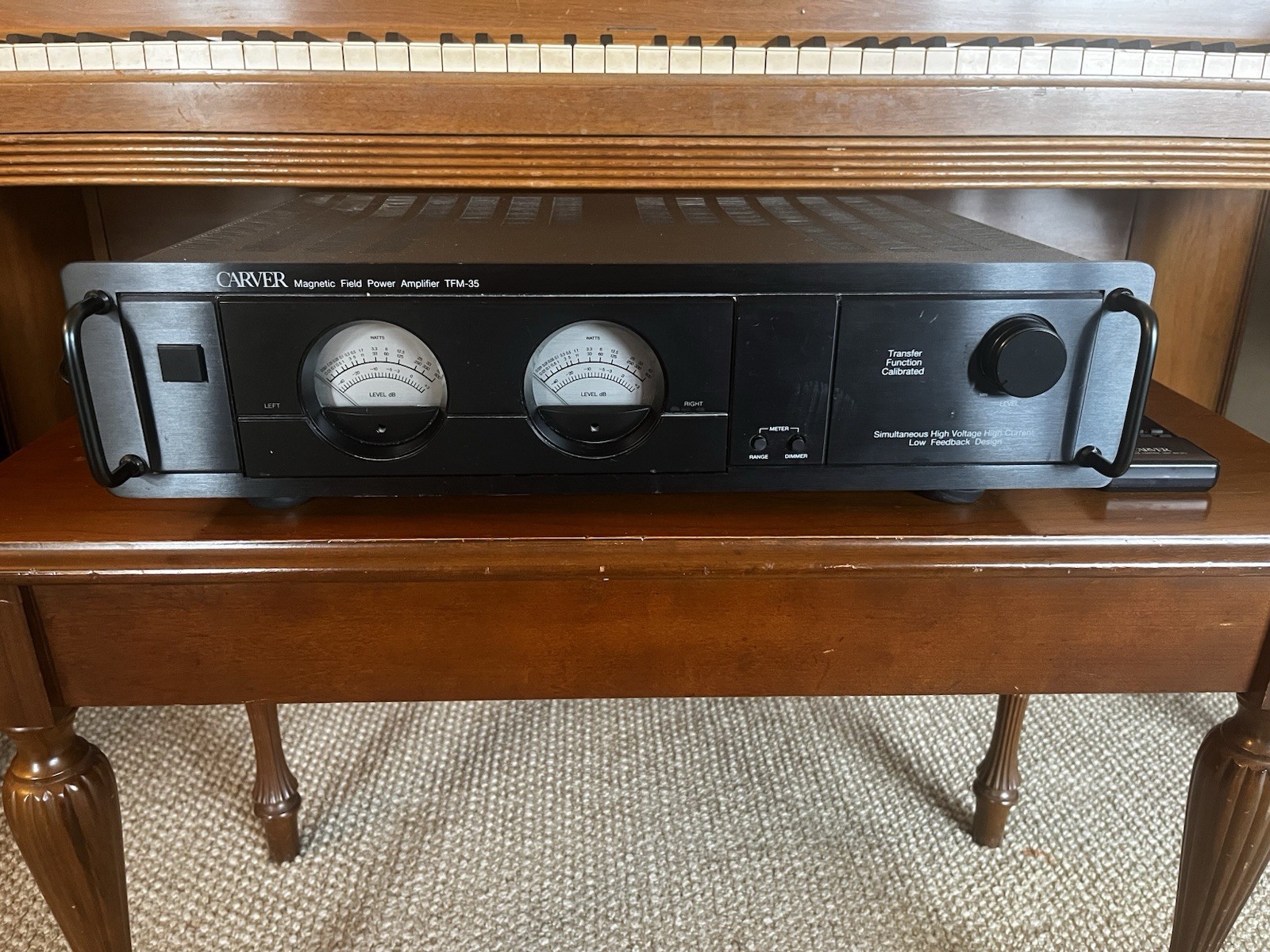
In the mid-1980s, when high-wattage amplifiers were battling for supremacy in audiophile living rooms, Bob Carver stood apart—not by chasing paper specs alone, but by engineering amplifiers that delivered real-world power, musicality, and innovation. The Carver TFM-45, introduced around 1985, is a shining example of Carver’s philosophy: intelligent design, high current delivery, and a compact, futuristic aesthetic. Though less famous than the towering TFM-25 or the legendary M-series, the TFM-45 carved out a loyal following among those who valued performance in a smaller footprint.
Housed in Carver’s iconic “Cube” chassis—compact, black, and minimalist—the TFM-45 was designed for those who wanted serious amplifier performance without dominating their equipment rack. It was part of Carver’s “TFM” (Theoretically Perfect Amplifier, later rebranded as “Musical Fidelity Amplifier”) series, which emphasized high damping factor, low distortion, and the ability to drive difficult speaker loads with authority. The TFM-45, while modest in size, packed a punch far beyond its dimensions, embodying Carver’s reputation for overachieving engineering.
Technical Specifications
| Specification | Detail |
| Model | TFM-45 |
| Manufacturer | Carver Corporation |
| Year Introduced | 1985 |
| Type | Solid-state stereo power amplifier |
| Power Output | 200W per channel (dynamic into 8Ω) |
| RMS Power (8Ω) | 100W per channel |
| RMS Power (4Ω) | 180W per channel |
| Total Harmonic Distortion | <0.05% (20Hz–20kHz) |
| Damping Factor | >200 (at 1kHz, 8Ω) |
| Frequency Response | 10Hz–60kHz (+/-0.5dB) |
| Input Sensitivity | 1V (for full output) |
| Input Impedance | 47kΩ (unbalanced), 94kΩ (balanced) |
| Gain | 29dB |
| Slew Rate | 35 V/µs |
| Protection | Thermal, over-current, DC offset |
| Inputs | 1 x RCA (unbalanced), 1 x XLR (balanced) |
| Outputs | Dual binding posts (A/B speaker switch) |
| Dimensions (W×H×D) | 17" × 5.5" × 14" |
| Weight | 32 lbs (14.5 kg) |
| Power Supply | Toroidal transformer, dual mono rails |
Sound Characteristics and Performance
The Carver TFM-45 delivers a sound signature that is both dynamic and refined—typical of Carver’s best work. It avoids the sterility sometimes associated with solid-state amplifiers of the era, instead offering a warm, engaging presentation with excellent bass control. The use of a high-current output stage allows it to remain stable even with complex, low-impedance speaker loads, making it a great match for demanding brands like AR, KEF, or Apogee.
Treble is detailed without being harsh, and the midrange is natural and forward enough to bring vocals and acoustic instruments to life. The amplifier’s wide bandwidth (extending to 60kHz) and high slew rate contribute to a sense of speed and transparency that belies its era. It doesn’t have the tube-like lushness of some contemporaries, but it excels in clarity, timing, and spatial imaging.
One of the TFM-45’s strengths is its ability to scale—whether driving efficient bookshelf speakers or power-hungry floorstanders, it adapts well. In modest setups, it offers clean headroom and effortless dynamics. In more ambitious systems, it reveals its high-current pedigree, maintaining composure during orchestral crescendos or complex rock passages.
Notable Features and Innovations
The TFM-45 stands out for several design choices that reflect Bob Carver’s engineering ingenuity:
- High-Current Design: Unlike many amplifiers of the time that advertised high wattage but struggled with real-world loads, the TFM-45 was built around a robust power supply with a toroidal transformer and substantial capacitance. This allowed it to deliver sustained current, critical for controlling speaker cones and maintaining dynamics.
- Dual-Mono Power Supply: Though compact, the amplifier uses a dual-mono rail design, minimizing crosstalk and improving channel separation. This contributes to a wider, more stable soundstage.
- Balanced XLR Input: Uncommon in mid-tier amplifiers of the 1980s, the inclusion of an XLR input suggests Carver’s intent for the TFM-45 to integrate into higher-end systems. It offers improved noise rejection and compatibility with preamps like the Carver C-4000 or C-1.
- A/B Speaker Switching: The front panel includes a convenient A/B speaker toggle, allowing users to switch between two pairs of speakers—ideal for comparing different models or using different speakers for different genres.
- Thermal Tracking Bias System: Carver implemented a bias circuit that adjusts with temperature, reducing crossover distortion and improving long-term reliability. This was a hallmark of Carver’s attention to both performance and durability.
- Compact “Cube” Chassis: The sleek black enclosure with blue power light became iconic. It wasn’t just aesthetic—its compact size made it ideal for space-constrained setups, while the internal layout maximized heat dissipation.
Common Issues and Maintenance
Like all vintage electronics, the Carver TFM-45 benefits from periodic maintenance. While generally reliable, aging components can lead to performance issues:
- Capacitor Aging: The electrolytic capacitors in the power supply and signal path may dry out over time, leading to hum, reduced bass, or channel imbalance. A full recapping by a qualified technician is recommended for units that haven’t been serviced in decades.
- Thermal Protection Cycling: If the amplifier shuts down under load, it may indicate failing bias transistors or clogged ventilation. The heatsinks should be cleaned, and thermal paste on output transistors refreshed.
- Binding Post Corrosion: The dual speaker terminals can corrode, especially in humid environments. Cleaning with contact cleaner and inspecting for tight connections is advised.
- Fan Failure (if equipped): Some later production units included a small cooling fan. If present, the fan should be checked for dust buildup or bearing noise.
- Input Jack Wear: RCA and XLR jacks can become loose. Solder joints should be inspected, and jacks replaced if wobbly.
Given its solid build quality and serviceable design, the TFM-45 is a worthwhile candidate for restoration. Replacement parts are generally available, and service manuals can be found online through vintage audio forums.
Current Market Value and Collectibility
The Carver TFM-45 is not as sought-after as the TFM-25 or the M-400, but it has a quiet cult following. In working condition, it typically sells for $200–$400, depending on cosmetic condition and whether it has been recently serviced. Fully restored units with recapped power supplies and clean cosmetics may command slightly higher prices, especially when paired with other Carver components.
Its compact size and high performance make it appealing to modern minimalist audiophiles and vintage gear enthusiasts alike. While not a “blue chip” collectible like a Mark Levinson or Krell, the TFM-45 represents excellent value for the money—offering 90% of the performance of Carver’s larger models at a fraction of the cost and space.
Conclusion and Legacy
The Carver TFM-45 may not have the wattage bragging rights of its bigger siblings, but it exemplifies Bob Carver’s design ethos: intelligent engineering, real-world performance, and accessibility. It proves that high fidelity doesn’t require massive heatsinks or towering chassis—just smart design and attention to detail.
Today, the TFM-45 stands as a testament to a golden era of American amplifier design. It’s a sleeper hit—overlooked by some, cherished by others—that continues to deliver thrilling, musical performance more than 35 years after its debut. For anyone exploring vintage solid-state amplifiers, the TFM-45 offers a compelling blend of power, refinement, and Carver’s unmistakable engineering flair. In the world of compact classics, it’s a true cube of sound.
eBay Listings


As an eBay Partner, we earn from qualifying purchases. This helps support our independent vintage technology research.
Related Models
- Carver M-4.0T (1985)
- Carver 4000T (1977)
- Carver C-4000 (1978)
- Carver C-9 (1985)
- Carver HR-895 (1985)
- Luxman L-530 (1975)
- Luxman R-404 (1975)
- Luxman RV-371 (1975)
- Luxman SQ-38U (1975)
- Luxman T-14 (1972)