Carver Sonic Holography Generator: Expanding the Dimensions of Stereo Sound
In the mid-1980s, when audiophiles were chasing ever-greater fidelity through higher power, lower distortion, and more precise component matching, Bob Carver took a different path. Instead of amplifying louder or cleaner, he asked: Can we make sound feel like it’s coming from beyond the speakers? The answer was the Carver Sonic Holography Generator, a bold and innovative audio processor designed to transform ordinary stereo recordings into immersive, three-dimensional soundscapes. Though not a traditional amplifier or receiver, this compact box became a cult favorite among experimental listeners and spatial audio pioneers—foreshadowing modern surround and binaural technologies by decades.
A Vision of Sonic Space
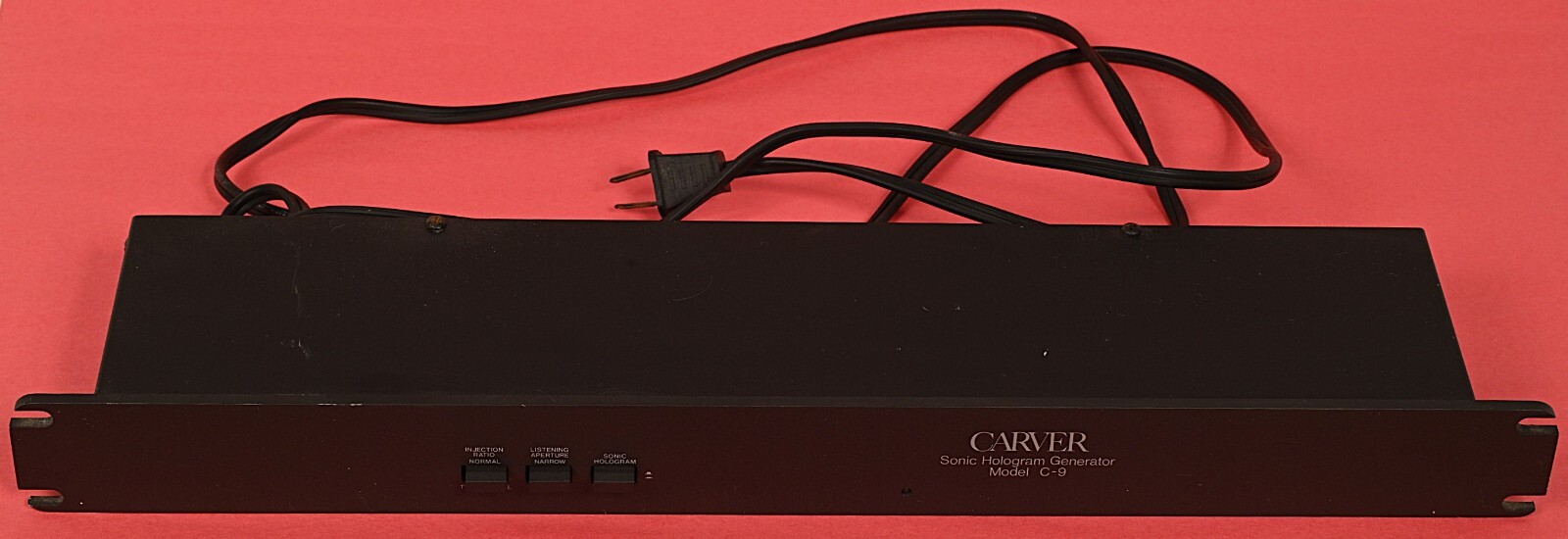
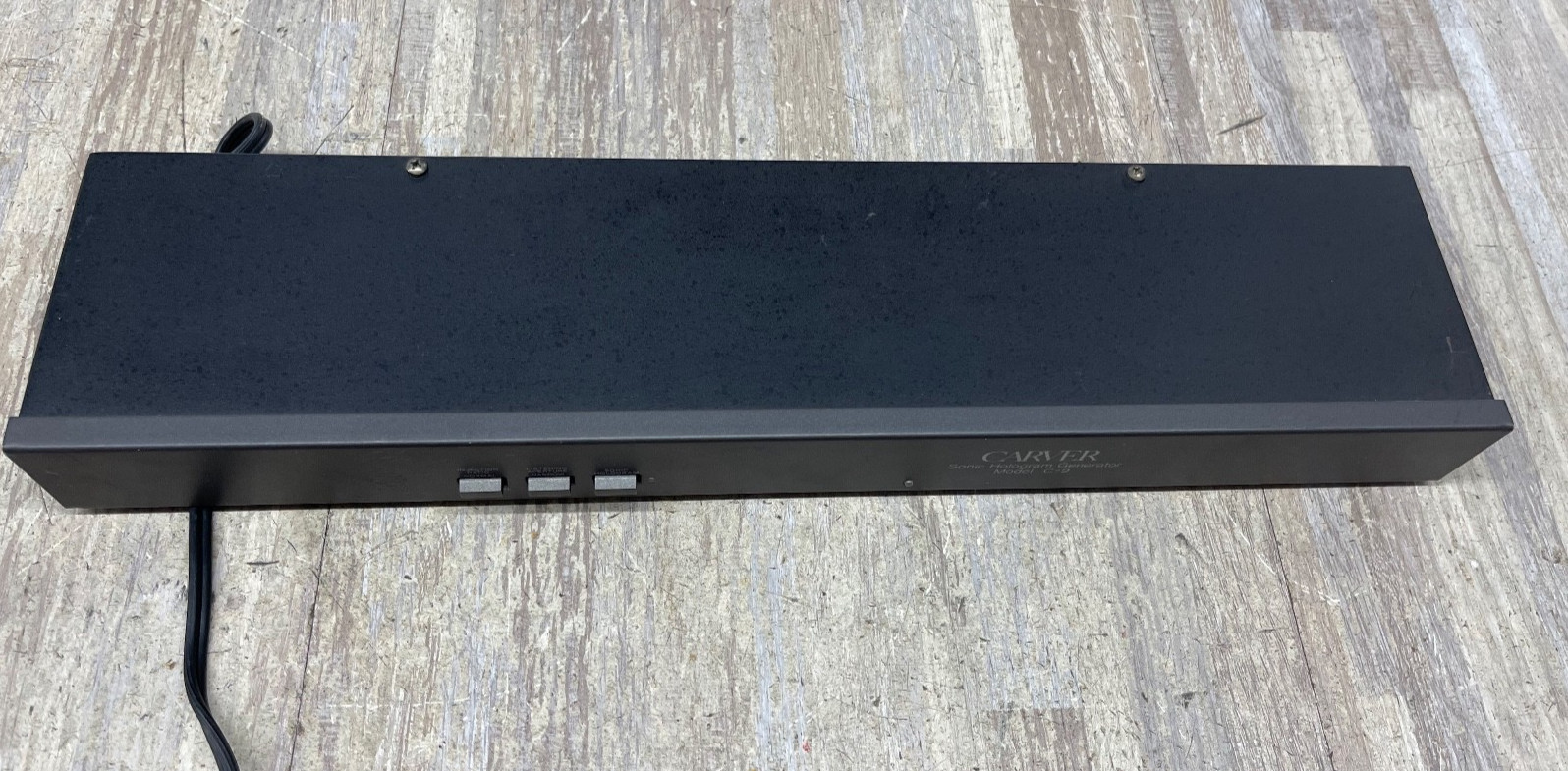
Introduced in 1986, the Carver Sonic Holography Generator was not intended to replace your amplifier but to enhance it. Placed between a preamplifier and power amplifier (or used with line-level inputs on integrated systems), the unit processed stereo audio signals in real time, manipulating phase, timing, and amplitude to create the illusion of sound sources located outside the physical boundaries of the speakers. The result? A dramatically widened and deepened soundstage, with instruments appearing to float in space, behind, between, or even behind the listener.
Bob Carver, already famous for his high-performance amplifiers and the controversial "Counterpoint" series, was known for pushing engineering boundaries. The Holography Generator was less about brute power and more about psychoacoustics—the science of how humans perceive sound. Drawing on research into interaural time differences (ITD) and head-related transfer functions (HRTF), Carver engineered a circuit that simulated the subtle cues our brains use to locate sounds in three-dimensional space.
Technical Specifications
| Specification | Detail |
| Model Name | Carver Sonic Holography Generator |
| Year Introduced | 1986 |
| Form Factor | 1U rack-mountable chassis |
| Inputs | 1 pair RCA (stereo line-level) |
| Outputs | 1 pair RCA (processed stereo line-level) |
| Power Supply | External AC wall adapter (12V DC) |
| Frequency Response | 20Hz – 20kHz (±0.5dB) |
| THD (Total Harmonic Distortion) | < 0.05% at 1kHz |
| Signal-to-Noise Ratio | > 90dB (A-weighted) |
| Controls | Holography Intensity (rotary knob) |
| Dimensions (W×H×D) | 17" × 1.75" × 7" |
| Weight | 5.5 lbs (2.5 kg) |
Despite its minimalist design—black faceplate, single silver knob, and Carver’s signature script logo—the unit packed sophisticated analog circuitry. Unlike digital surround processors that emerged later, the Holography Generator used entirely analog phase-shift networks and time-delay circuits to manipulate the stereo image. There were no presets, no digital chips, and no menus—just one knob to adjust the intensity of the holographic effect.
Sound Characteristics and Performance
The magic of the Carver Sonic Holography Generator lies in its ability to transform familiar recordings into something startlingly new. With the knob turned up, a standard stereo mix can suddenly feel expansive: pianos stretch across an imaginary stage, vocals appear centered in the middle of the room, and cymbals shimmer from above and behind. On well-recorded jazz or classical albums, the effect can be uncanny—like removing a veil from the music.
Critics at the time were divided. Some hailed it as a revelation, praising its ability to breathe new life into older recordings. Others dismissed it as a “gimmick,” arguing that it distorted the original artistic intent by altering the stereo image. Yet even skeptics acknowledged that the unit worked—it undeniably changed the spatial perception of sound.
Importantly, the Holography Generator does not add reverb or artificial echo. Instead, it uses precise phase manipulation to trick the auditory cortex into perceiving sounds as arriving from different angles and distances. When used subtly, the effect enhances realism; cranked to maximum, it can create a surreal, almost theatrical soundscape—ideal for headphone listening or small-room setups.
Notable Features and Innovations
- Analog Holographic Processing: Unlike later digital spatial processors, Carver’s design relied on passive and active analog components to create time and phase shifts, preserving the warmth and continuity of the original signal.
- Single-Knob Simplicity: The sole control adjusts the depth and width of the holographic field, making it accessible even to non-technical users.
- Transparent Signal Path: When bypassed or turned off, the unit passes audio with minimal coloration, thanks to high-quality op-amps and shielding.
- Headphone Enhancement: Though designed for speakers, the unit became a favorite among headphone listeners for eliminating the “in-the-head” stereo effect, creating a more natural, speaker-like experience.
Bob Carver himself described the technology as “sonic holography”—a way to reconstruct the spatial information lost in conventional stereo recording. While not a true hologram in the optical sense, the term captured the imagination of audiophiles seeking a more immersive experience.
Common Issues and Maintenance
As with any 1980s electronics, vintage units today may require attention:
- Power Supply Failure: The external 12V DC adapter is a common point of failure. Replacement units must match voltage and polarity exactly.
- Capacitor Aging: Electrolytic capacitors in the signal path may degrade over time, leading to hum or reduced performance. A recapping by a qualified technician can restore original fidelity.
- Potentiometer Noise: The holography intensity knob may develop crackling. Cleaning with contact cleaner often helps; replacement is recommended if worn.
- Circuit Board Corrosion: Units stored in humid environments may show signs of corrosion. Inspection and cleaning with isopropyl alcohol are advised.
Because the circuitry is relatively simple and well-documented, the Carver Holography Generator is one of the more repairable vintage audio processors. Schematics and service notes occasionally surface in enthusiast forums and Carver collector groups.
Current Market Value and Collectibility
The Carver Sonic Holography Generator never achieved mass-market success, making original units relatively rare today. On the secondary market, working examples typically sell for $150–$300, depending on condition and included accessories (especially the original power supply).
Collectibility is growing among:
- Carver enthusiasts who appreciate Bob Carver’s innovative spirit
- Spatial audio experimenters exploring pre-digital 3D sound
- Vintage synth and studio gear collectors, as the unit is sometimes used to widen electronic music mixes
Units with provenance (e.g., from Carver’s personal collection or original packaging) can fetch higher prices. While not yet a “blue-chip” vintage item like a Marantz 2270 or McIntosh MC275, the Holography Generator is increasingly recognized as a visionary footnote in audio history.
Conclusion: A Pioneer of Perceived Space
The Carver Sonic Holography Generator stands as a testament to Bob Carver’s fearless experimentation. At a time when high-end audio was fixated on measurements and specs, Carver dared to prioritize perception over precision. The result was a device that didn’t just play music—it reimagined how we experience it spatially.
While modern technologies like Dolby Atmos, DTS:X, and binaural rendering have surpassed it in sophistication, the Holography Generator remains a charming and effective analog solution for expanding stereo imaging. It’s not for purists who demand absolute fidelity, but for explorers who believe audio should be felt as much as heard.
If you stumble upon a working unit, don’t dismiss it as a curiosity. Plug it in, turn the knob, and let your speakers disappear. You might just hear your favorite records for the first time—again.
eBay Listings


As an eBay Partner, we earn from qualifying purchases. This helps support our independent vintage technology research.
Related Models
- Carver HR-752 (1985)
- Carver MXR-2000 (1983)
- Carver MXR-900 (1984)
- Akai AM-2850 (1975)
- Akai AP-206 (1975)
- Nakamichi BX-1 (1985)
- Acoustic Research research-ar-17 (1978)
- Acoustic Research AR-19 (1994)
- Acoustic Research AR-1W (1954)
- Acoustic Research AR-28S (1992)