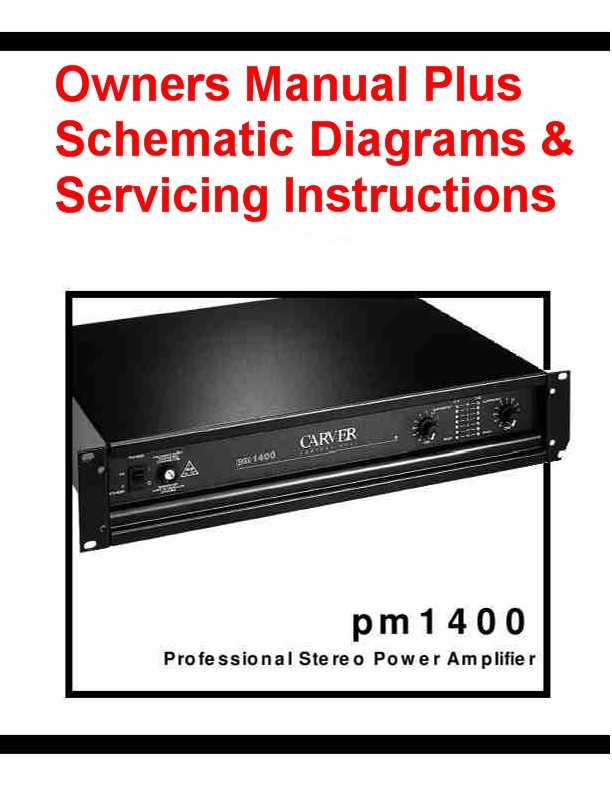
Carver PM-1400
Three and a half inches of rack space, thirty-four pounds, and enough current on tap to trip a household breaker. Carver built this pro-sound workhorse for the road, not the listening room.
Overview
The PM-1400 is a two-rack-unit professional power amplifier rated at 475 watts per channel into 8 ohms and 700 watts per channel into 4 ohms, both channels driven. In bridged-mono operation it is rated at 1400 watts into 8 ohms. Those numbers are quoted at no more than 0.2% THD, and the 8-ohm figure holds across the full 20 Hz-20 kHz band, not just at 1 kHz. The 4-ohm rating is specified at 1 kHz, with a 20 Hz-20 kHz figure of 675 watts noted alongside it. It's rare for a manufacturer to publish the less flattering number right next to the headline one. The manual's introduction states the design intent plainly: the amplifier is "specially designed for pro-sound applications," with rugged construction and a low profile aimed at surviving road use while saving rack space, and accurate sound and ample power for critical studio work as well.
The topology behind those numbers is a conventional class AB push-pull output stage fed by a commutated two-stage, dual-rail class H supply. Carver calls it the patented Magnetic Field Power Supply. The output stage swings between ±106V rails. The front end is a differential input stage with local and global negative feedback setting closed-loop gain at 36.7 dB. Removing jumper JP100 drops that to 30.7 dB. The bias network uses an NPN-PNP conjugate pair as a VBE multiplier, with one transistor thermally coupled to the output devices so bias stays stable as the amp heats up. A V-I limiter senses the drop across the emitter resistors and pulls back drive under overload.
Protection is unusually thorough for the era. Independent channel relays disconnect the speakers instantly on DC offset, over-temperature, or a shorted output. There's also a clipping eliminator circuit that drives an LED-LDR attenuator in the signal path, instead of just flashing a light at you. The balanced input uses a high common-mode rejection differential amplifier, with CMRR quoted at greater than 80 dB at 1 kHz. It's fed by XLR and 1/4-inch TRS connectors wired in parallel. The amp ships configured pin 2 hot, and JP3/JP4 flip the XLR polarity to pin 3 hot without touching the TRS jacks.
The published specs read like a serious touring amp, not a hi-fi showpiece. Damping factor is 200 nominal, channel separation exceeds 65 dB at 1 kHz, and signal-to-noise is greater than 100 dB A-weighted referenced to rated power into 4 ohms in high gain. Input impedance is 25 kilohms unbalanced per leg to ground and 50 kilohms balanced. Slew rate is 40 V/µs, bandwidth-limited. Power bandwidth runs 5 Hz to 40 kHz at +0/-3 dB, and the signal path includes a subsonic filter rolling off at 5 Hz and a low-pass filter at 45 kHz. Dynamic headroom is quoted at greater than 2.0 dB. Sensitivity is internally configurable: 0.775V or 1.5V rms for rated power into 4 ohms, with corresponding gains of 36.7 dB and 30.7 dB. Input overload is +18 dBu.
In practice this is an amp that drives difficult loads without complaint and behaves predictably when something goes wrong. Idle draw is a modest 40W, but the manual is blunt about what happens under load: 800W with musical program, 1500W continuous at full power into 8 ohms, and 2400W continuous into 4 ohms. Running rock program with both channels driven into 4 ohms just to the edge of clipping, the manual quotes an average draw of 6.7 amps on a 120V model. Try running a pair of these on a shared household circuit and you'll find out what that means. The 120V/60Hz version takes a 15-amp slo-blo fuse. Export 230V/50Hz units take an 8-amp slo-blo.
The feature list is where the pro-sound intent shows. Each channel gets eleven detented level-control positions and a level-defeat switch, so you can lock the amp at full gain and bypass the pots entirely. The manual notes this is the right move when the optional PowerLink module is installed, since computer control over levels assumes the attenuators are out of the circuit. Operating modes include normal stereo, Dual Mono (both channels fed from a single mono input), Bridged Mono, and Parallel Mono. Bridged mono is set with a switch on the input board behind the input panel. The manual warns that in this mode both output terminals carry voltage and neither may be grounded, and that any load below 8 ohms should be avoided because each channel sees half the connected impedance. Parallel Mono, for sustained high levels into a single low-impedance load, requires a field modification. Carver Technical Service had to supply Field Application Bulletin pm1400-1 with the procedure.
The 70-volt direct-drive capability is the sleeper feature. The PM-1400 has enough output voltage in stereo mode to drive a 70-volt distribution system without a step-up transformer at the amplifier, delivering up to 475 watts per channel depending on total system impedance. Transformers are still required at each loudspeaker, and the manual walks through the math. The amp's 8-ohm output is 61.6V line voltage, not 70.7V, so you compute a correction factor K = 61.6²/70.7² ≈ 0.7591 and multiply every transformer tap by it. A transformer marked 10W/5W/2.5W becomes 7.6W/3.8W/1.9W. The 3 dB relationship between taps holds, and maximum loading occurs when the sum of the new tap values equals 475W. This is the kind of detail you find in a manual written for installers.
Sequencing is the other feature that marks this as rack gear. The SEQUENCE RCV terminal accepts +7V to +15VDC at 50mA minimum. Daisy-chaining SND to RCV across a rack of amplifiers delays each unit's turn-on by 1.5 to 2 seconds, which prevents the in-rush current that pops breakers when an entire rack comes up at once. The design carries the control voltage through from RCV to SND even if an amplifier in the chain fails or blows a fuse, and once an amp is on, its own supply keeps it running if the RCV voltage is interrupted. A 9V battery will trigger the first amp in the chain. The optional PowerLink module is Carver's proprietary hardware and firmware talking to a MediaLink system. It allows real-time control and monitoring of nine operational parameters including input level, polarity, power up/down, and low-speed fan lock. The front panel carries a MediaLink indicator LED that illuminates green when the circuit is active and can be flagged by the host system to mark an amp needing attention.
Front-panel monitoring is per channel: a seven-LED display with one green READY, five yellow SIGNAL, and one red CLIP/PROTECT indicator per side. The READY LED glows red briefly at power-on while the supply stabilizes before the speaker relays engage, then turns green. A STANDBY LED stays lit whenever the amp is plugged into AC with the power switch off, confirming mains availability. Cooling is a two-speed fan. Physical dimensions are 3.5 inches (2U) by 19 inches by 13.25 inches, and net weight is 34.2 lbs, with a shipping weight of 40 lbs. The amp can be internally configured for 0.775V or 1.5V rms input sensitivity and for input polarity, and there are internal connection points for add-on accessories plus insert points P7 through P10 in the signal path for accessories.
Carver's professional PM Series drew attention in the trade press for its plug-in module ecosystem. EQ Magazine (February 1995, p.16) reported that Carver was promoting new plug-in electronic crossover, precision attenuator, and output transformer modules for the CA and PM Series of professional power amps. The CX-2 stereo electronic crossover incorporated Linkwitz-Riley networks per channel and separate second-order infrasonic filters, with plug-in components supplied for ten selectable frequencies. The amp was designed as a platform, and the manual's insert points and accessory connection points are the hardware side of that.
The PM-1400 sits in a lineage that includes Carver's other Magnetic Field Power Supply amplifiers, and the brand's professional line shared the sequencing and PowerLink infrastructure across models. The manual explicitly notes that the sequencer works with "any number of pm1400 amplifiers (or other Carver amplifiers equipped with sequencing capability)." Collectors chasing Carver's pro gear tend to group the PM series with the company's other touring-oriented designs. The PM-1400's specific place in the lineup and its production span are not documented in the available materials.
For anyone buying one today, the practical concerns are the ones the manual already flagged. These amps are heavy for their rack space, they draw serious current under load, and they're old enough that the electrolytics and the speaker relays are the usual suspects. The protection circuitry is genuinely protective, not decorative. A PM-1400 that's been abused will often shut itself down rather than cook its outputs. The level controls are detented and defeatable, which makes them less of a wear item than the continuously-variable pots on lesser amps. The two-speed fan is a serviceable part, and the class H supply means the amp isn't dissipating full rail voltage at idle, which is why 40W idle draw is even possible on a 1400-watt bridged amplifier. Bridged mono is where these things earn their keep: 1400 watts into 8 ohms from a 2U chassis is a serious number, and the manual's warning against running bridged loads below 8 ohms should be taken literally. Parallel mono requires the field modification bulletin, so a stock unit won't do it out of the box.
eBay Listings
As an eBay Partner, we earn from qualifying purchases. This helps support our independent vintage technology research.