Carver PM-1.5a (1989–1990)
A pro-rack workhorse. Carver's own service manual sums up the update plainly: two more output transistors per channel and two fans instead of one.
Overview
The PM-1.5a arrived in March 1989 as an update to the PM-1.5, a power amplifier that had already been in production for six years by that point. Carver's service documentation is blunt about what changed. The revision added two more power output transistors per channel and a second cooling fan. That's it. No cosmetic overhaul, no reworked circuit topology - just more output devices and more airflow. The original design was sound, and the update was about headroom and thermal margin rather than correction.
Under the hood, the PM-1.5a runs Carver's patented Magnetic Field power amplifier circuitry - a smart power supply paired with a highly linear, triple-rail output stage. This is how Carver got serious continuous power out of a chassis that weighs just 21 lbs (9.5 kg) and stands 3.5 inches tall in a standard 19-inch rack. Plenty of contemporary pro amps with similar wattage weighed two or three times that. The trade-off is that the Magnetic Field supply is a complex circuit, and anyone servicing one needs to understand that the power supply does as much work as the output stage.
The rated output is 450 watts per channel into 8 ohms, both channels driven, 20 Hz to 20 kHz, with no more than 0.5% THD. Into 4 ohms it's rated at 600 watts per channel under the same conditions. Bridged to mono, it delivers 1200 watts into 8 ohms. Carver's documentation notes that at clipping, both channels driven into 8 ohms at 1 kHz, the amp reaches 500 watts per channel, so the continuous ratings are honest, not optimistic. Dynamic headroom is specified at 1.6 dB into 8 ohms and 2.0 dB into 4 ohms, which leaves a little extra in reserve for transient peaks beyond the steady-state rating.
The input stage accepts both XLR and tip-ring-sleeve phone jacks, and the left-channel input circuit includes a phase-reverse switch for mono-bridge operation. Input impedance is 15k ohms unbalanced and 30k ohms balanced, with input overload at +15 dBu and sensitivity of 1.5V RMS for rated power into 8 ohms at 1 kHz. Gain is 32 dB. A front-panel LED ladder provides seven indicators per channel, with a 1 ms attack time and 500 ms decay time.
Frequency response is specified as 20 Hz to 20 kHz (+0, -0.5 dB), crosstalk is -50 dB from 100 Hz to 10 kHz, and damping factor exceeds 200 at 1 kHz. IM distortion is under 0.1%, and THD is under 0.5%. Noise is rated at -110 dB A-weighted referenced to rated power, nominal, with a limit figure of -107 dB. Referenced to 1W output, that's -83 dBW nominal and -80 dBW at the limit. Slew rate is 25V/μS. Power consumption runs 1500W at full output and 120W at idle. A rack full of these pulls real current even when nothing's playing.
The amp was available in 120VAC/60Hz for the US and Canadian markets and 230VAC/50Hz for Europe. Carver published a detailed voltage-conversion procedure for technicians, involving component changes on the regulator and power supply boards, a different fuse rating, and rewiring the power transformer primary windings. An alternative was simply buying a tested regulator board in the desired voltage. This isn't a flip-a-switch conversion. It's a bench job.
The display board, input board, and other assemblies are documented with full parts lists in the service manual, down to individual resistor values and Carver part numbers.
Service History and Known Issues
Carver issued several service bulletins for the PM-1.5a. Bulletin PM-1.5a-1 addresses units with serial numbers below 21176: if the second fan runs too slowly at idle, the fix is changing R-2 from an 18-ohm, 5-watt, 5% resistor to a 12-ohm, 5-watt, 5% unit.
Bulletin PM-1.5a-2, for serial numbers before 20850, describes a more serious condition. Driving the output level to maximum at high frequencies with no load can cause the outputs to fail if sustained. The remedy is changing the resistor at location R-86 from 43 ohms to 27 ohms. This is a real failure mode, and it's the kind of thing that happens in live-sound use when someone runs the amp with nothing connected and the level cranked.
Bulletin PM-1200-2, dated January 28, 1991, applies to PM-1200, PM-1.5a, and PM-1.5 units with PM-1200 serial numbers below 03445. It calls for adding a shield plate (Carver P/N 531-00004-00) to reduce noise in the outputs.
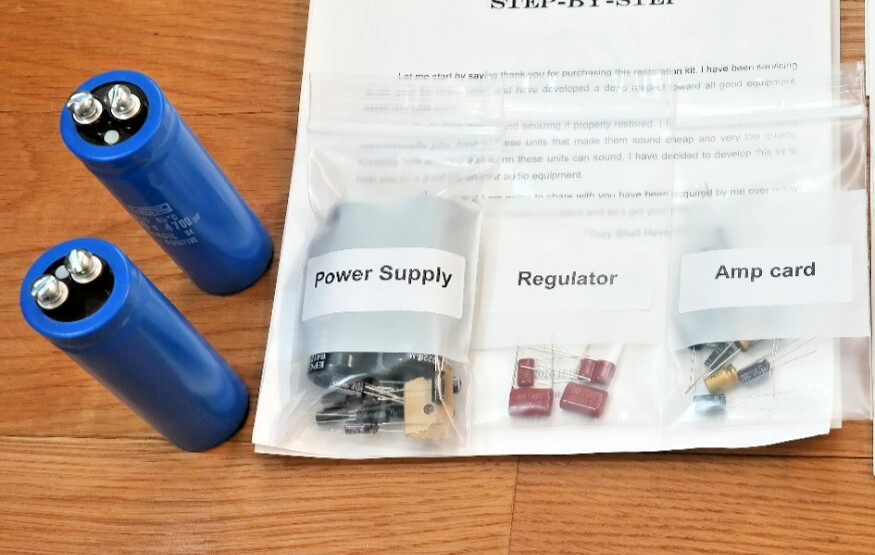
Bulletin PM-1200-5, dated January 20, 1992, notes that the original dual 2200µF/50V/80V capacitors (C13, C14) were no longer available. The replacement is a capacitor card assembly (Carver P/N 602-00500-01) that covers C13, C14, C22, and C23.
Carver's own service manual includes a note that accurate measurement of the amp's performance depends on a sufficiently stiff AC supply. The 60 Hz AC line distortion must be below IHF specifications. If bench measurements look off, check the AC line before blaming the amp.
What Happened Next
In March 1990, Carver renamed its professional power amplifier line to indicate total power output into 4 ohms. The PM-1.5a became the PM-1200. The two models are electrically identical. Carver's own service manual states this explicitly and covers both in the same documentation. The PM-1200 is rated at 450W per channel into 8 ohms, 600W per channel into 4 ohms, and 1200W bridged-mono into 8 ohms, which matches the PM-1.5a's specs exactly. A PM-1200 is the same amplifier with a different badge, and the service literature treats them as a single platform.
eBay Listings

As an eBay Partner, we earn from qualifying purchases. This helps support our independent vintage technology research.