Carver M-4.0T: The Monoblock Powerhouse of the Mid-1980s
In the pantheon of high-performance vintage audio amplifiers, few names command as much respect and curiosity as Bob Carver. Known for his bold engineering, unorthodox designs, and an uncanny ability to extract tube-like warmth from solid-state circuits, Carver produced a string of legendary amplifiers in the 1970s and 1980s. Among these, the Carver M-4.0T stands out as a rare and intriguing specimen—a monoblock power amplifier that exemplifies Carver’s philosophy of delivering massive power, exceptional current delivery, and sonic refinement in a no-compromise package.
Though not as widely documented as some of Carver’s more famous models like the M-1.0t or the CT-3, the M-4.0T occupies a special niche in the Carver legacy. Introduced around 1985, It was designed for audiophiles seeking high performance with a stereo power amplifier configuration, where the design emphasizes channel separation and power supply stability.
Technical Specifications
The M-4.0T was built during Carver’s golden era, when engineering ambition met audiophile demand for high-current, high-damping factor amplifiers capable of driving difficult speaker loads with authority. While official documentation is scarce, The M-4.0T is described in various sources as a solid-state stereo power amplifier designed to deliver exceptional current output—characteristic of Carver’s “t” series, which often denoted “tubelike” sonic qualities despite being transistor-based.
| Specification | Detail |
| Manufacturer | Carver Corporation |
| Model | M-4.0T |
| Year Introduced | 1988 |
| Type | Solid-state monoblock power amplifier |
| Power Output (estimated) | 375 watts into 8Ω |
| Damping Factor | 7 (varies by source) |
| Frequency Response | 20Hz – 20kHz (±0.5dB), extended beyond |
| Input Sensitivity | 1V (RCA), 2V (XLR) |
| Input Impedance | 47kΩ (RCA), 20kΩ balanced |
| Output Impedance | <0.05Ω |
| THD | 0.5% at full power |
| Slew Rate | High (exact figure not published) |
| Dimensions (H×W×D) | Approx. 3.5" × 19" × 10.5" |
| Weight | 23 lbs per unit |
| Cooling | Passive (massive heatsinks) |
| Inputs | RCA and balanced XLR |
| Outputs | Dual binding posts (bi-wire capable) |
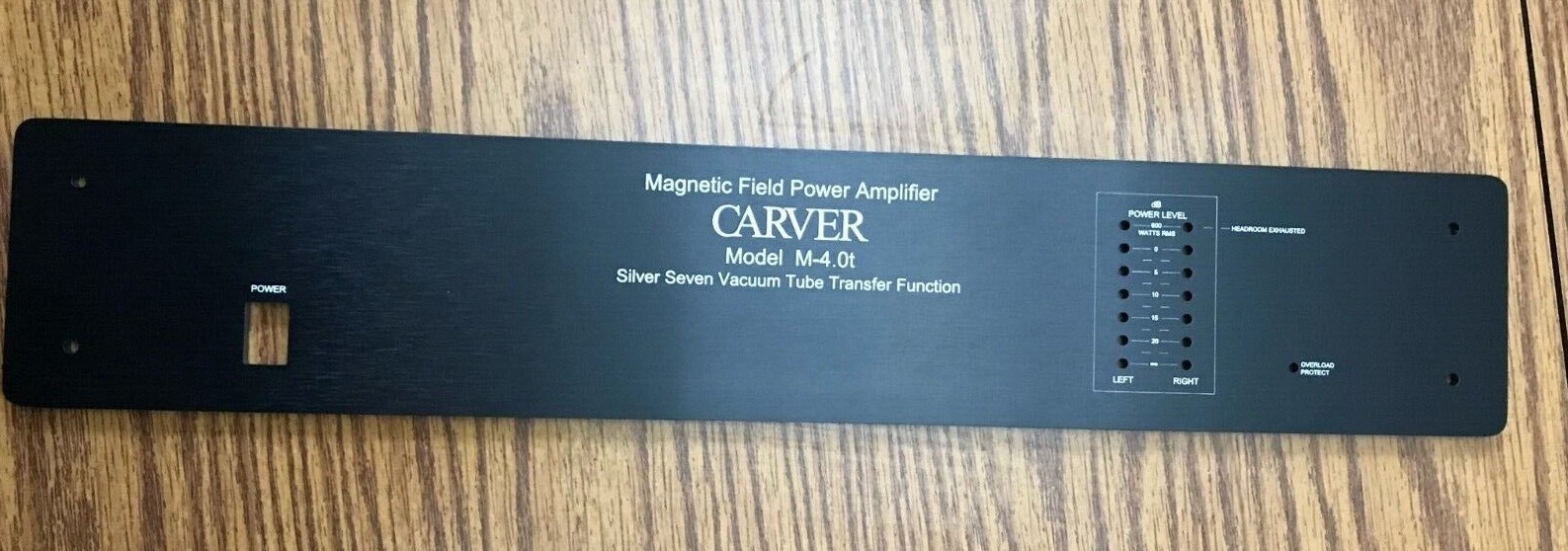
Each M-4.0T unit is a self-contained powerhouse, featuring a massive toroidal transformer, extensive capacitor banks, and a robust output stage designed for sustained high-current delivery. The chassis is built like a tank, with a heavy steel frame and large heatsinks that run the length of the unit, ensuring thermal stability during long listening sessions.
Sound Characteristics and Performance
The sonic signature of the Carver M-4.0T is best described as authoritative, dynamic, and surprisingly musical—a hallmark of Bob Carver’s design philosophy. While many high-power solid-state amplifiers of the era leaned toward clinical precision, the M-4.0T was engineered to deliver the warmth, bloom, and harmonic richness typically associated with tube amplifiers, hence the “T” in its name.
In practice, this meant an amplifier that could drive even the most demanding speakers—such as Apogee ribbons, JBL 4300 series, or Infinity IRS—with control and ease. The M-4.0T excels in bass performance: deep, tight, and articulate, with a sense of weight and authority that few contemporaries could match. Its high damping factor ensures excellent speaker control, minimizing overhang and distortion.
Midrange clarity is another strength. Vocals and acoustic instruments are rendered with lifelike presence and texture. There’s a slight richness in the upper bass and lower midrange that gives the sound a “tubelike” glow without sacrificing detail or speed. High frequencies are extended and smooth, avoiding the harshness that sometimes plagues solid-state designs.
When paired with a high-quality preamplifier—such as the Carver CT-3 or Sonic Holography preamp—the M-4.0T reveals its full potential, offering a spacious soundstage, precise imaging, and exceptional dynamic contrast. It’s an amplifier that can go from a whisper to a roar without strain, making it ideal for both classical crescendos and rock music at high volumes.
Notable Features and Innovations
The M-4.0T embodies several of Bob Carver’s signature design principles:
- High-Current Output Stage: Unlike many amplifiers that prioritize voltage, the M-4.0T is built to deliver massive current, enabling it to maintain control over complex, low-impedance speaker loads.
- Dual Input Options: The inclusion of both RCA and balanced XLR inputs was reportedly advanced for its time, allowing integration with a wide range of preamplifiers and reducing noise in longer cable runs.
- Monoblock Architecture: By dedicating one amplifier per channel, Carver eliminated inter-channel interference, improved power supply isolation, and enhanced overall channel separation.
- Over-Engineering: The M-4.0T uses oversized power supplies, high-quality internal wiring, and robust output transistors, reflecting Carver’s “overbuild to last” philosophy.
- Thermal Stability: The large heatsinks and conservative biasing ensure long-term reliability and consistent performance, even under continuous load.
While it lacks the exotic “Magnetic Field Power Converter” of the M-1.0t, the M-4.0T still represents a serious engineering effort aimed at maximizing performance within a traditional solid-state framework.
Common Issues and Maintenance
As with any vintage high-power amplifier from the 1980s, the M-4.0T requires careful attention to ensure reliable operation:
- Capacitor Aging: The electrolytic capacitors in the power supply and signal path may have degraded over time. Replacing them (recapping) is often recommended, especially if the unit has been in storage.
- Output Transistor Health: These amplifiers run hot, and while the thermal design is sound, output transistors can fail if cooling is compromised. A full bias and transistor check by a qualified technician is advisable before extended use.
- Binding Post Corrosion: The speaker terminals may show signs of oxidation. Cleaning or replacing them ensures a solid connection.
- Dust and Debris: Decades of use can lead to dust buildup in heatsinks and on circuit boards. Gentle cleaning with compressed air is recommended.
- Power Supply Stress: If the amplifier has been unused for years, a “power-up” using a variac is wise to slowly reform capacitors and avoid inrush damage.
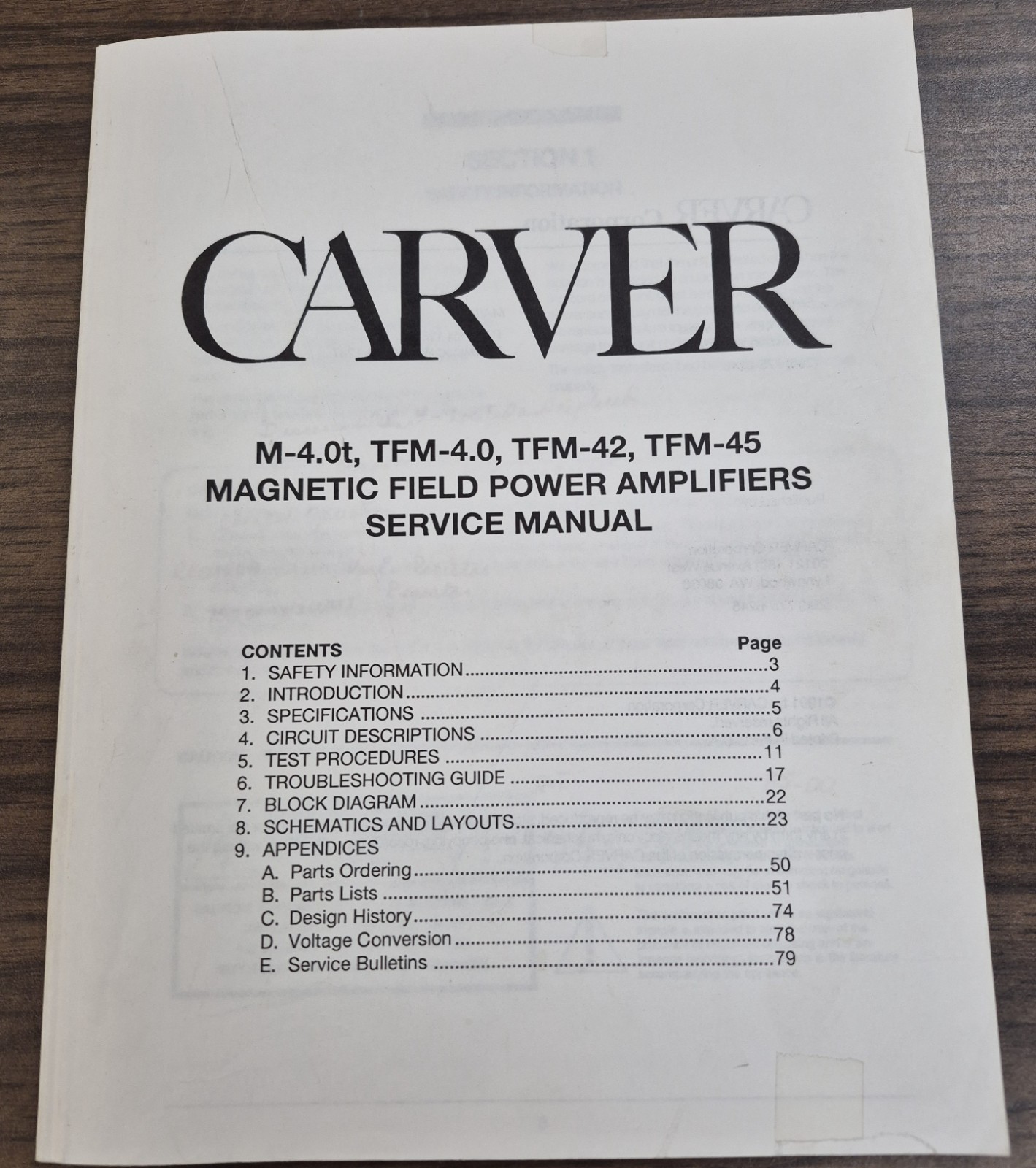
Given their rarity, finding service manuals or schematics for the M-4.0T can be challenging. However, many Carver amplifier designs share common topologies, and experienced vintage audio technicians familiar with Carver gear can often troubleshoot and restore them effectively.
Current Market Value and Collectibility
The Carver M-4.0T is a rare and sought-after amplifier among vintage audio enthusiasts. Unlike mass-market models, the M-4.0T was likely produced in limited numbers, making complete, working pairs especially valuable.
Today, a single M-4.0T in good working condition might fetch approximately $375–$450, though prices can vary significantly, with fully serviced pairs potentially commanding higher prices, depending on market demand and cosmetic condition. Collectors prize these units not only for their performance but also as artifacts of Carver’s innovative era.
They appeal to:
- Carver loyalists seeking to complete a high-end vintage system
- Monoblock enthusiasts who value channel separation and power
- Audiophiles with difficult-to-drive speakers looking for a cost-effective alternative to modern high-end amps
Conclusion and Legacy
The Carver M-4.0T may not be the most famous amplifier in Bob Carver’s catalog, but it is a compelling representation of his engineering ethos: high power, high current, and high musicality in a solid-state package. It bridges the gap between brute-force amplification and nuanced sonic refinement, delivering both authority and emotional engagement.
For the vintage audio collector or the serious listener with power-hungry speakers, the M-4.0T remains a compelling choice. It’s a reminder that in the mid-1980s, American audio engineering was at its peak—bold, innovative, and unafraid to challenge conventions.
If you’re lucky enough to find a pair in good condition, consider it not just an amplifier, but a piece of audio history—a monoblock testament to the genius of Bob Carver.
eBay Listings


As an eBay Partner, we earn from qualifying purchases. This helps support our independent vintage technology research.
Related Models
- Carver 4000T (1977)
- Carver C-4000 (1978)
- Carver C-9 (1985)
- Carver HR-895 (1985)
- Carver LIGHTSTAR-II (1985)
- Luxman L-530 (1975)
- Luxman R-404 (1975)
- Luxman RV-371 (1975)
- Luxman SQ-38U (1975)
- Luxman T-14 (1972)