Carver C-9 Preamplifier: The Quiet Master of American Hi-Fi
In the pantheon of vintage high-fidelity audio equipment, few names evoke as much reverence and curiosity as Carver. Founded by the maverick engineer Bob Carver in the late 1970s, the company became synonymous with bold innovation, high performance at accessible prices, and a distinctly American approach to audio design. While Carver is perhaps best known for its powerful amplifiers and the legendary "magnetic field" amplification technology, the Carver C-9 Preamplifier stands as a refined, understated masterpiece that showcases the company's commitment to sonic purity and engineering excellence.
Introduced in 1985, the C-9 was positioned as Carver’s flagship solid-state preamplifier during a golden era of analog audio. At a time when many competitors were embracing complex circuitry and feature-laden front panels, the C-9 took a different path—one of minimalism, precision, and transparency. It was designed not to impress with flash, but to disappear sonically, allowing the music to take center stage.
Technical Specifications
The C-9 was built around a discrete, fully balanced circuit topology—a rarity even among high-end preamplifiers of its time. This design choice contributed significantly to its low noise floor, wide bandwidth, and excellent channel separation. Power was supplied via a high-current toroidal transformer, ensuring stable operation even under dynamic load conditions.
| Specification | Detail |
| Model | Carver C-9 |
| Type | Solid-State Preamplifier |
| Year Introduced | 1985 |
| Gain | Approximately 12 dB |
| Frequency Response | 10 Hz – 100 kHz (+/- 0.5 dB) |
| Total Harmonic Distortion (THD) | < 0.01% (1 kHz, rated output) |
| Signal-to-Noise Ratio | > 100 dB (A-weighted) |
| Input Impedance | 47 kΩ |
| Output Impedance | 100 Ω |
| Inputs | 5 line-level (RCA), 1 tape loop |
| Outputs | Main out (RCA), tape out (RCA) |
| Power Supply | Dual mono regulated supplies |
| Construction | Point-to-point wiring, high-quality components |
| Dimensions | 17" W × 5" H × 14" D |
| Weight | 22 lbs (10 kg) |
| Finish | Black anodized aluminum, brushed faceplate |
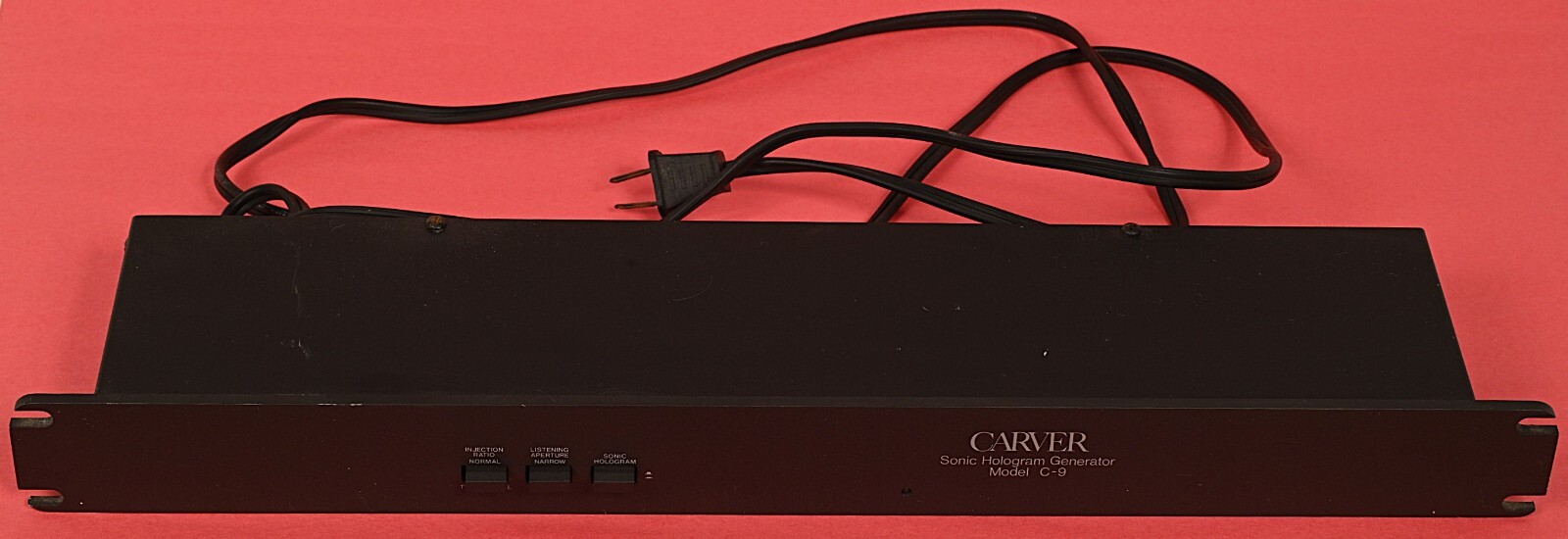
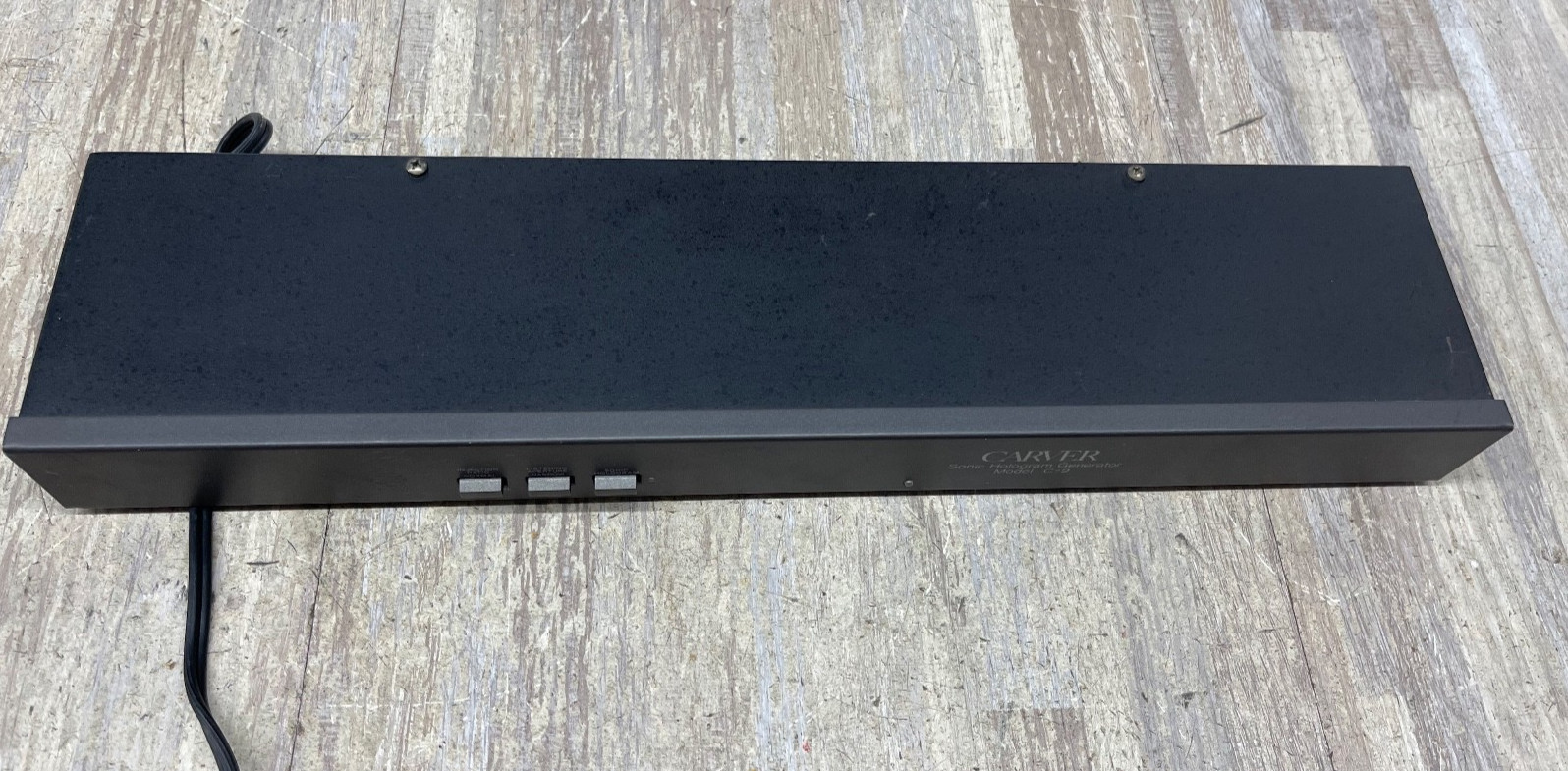
The C-9 featured a motorized Alps potentiometer for volume control—a premium component known for its smooth operation and long-term reliability. The front panel was minimalist: a large central knob for volume, a smaller one for balance, and a series of recessed buttons for source selection, mute, and power. The lack of a display or digital controls was intentional, reflecting Carver’s philosophy that the preamp should be an invisible conduit for music.
Sound Characteristics and Performance
The sonic signature of the Carver C-9 is best described as neutral, transparent, and dynamically expressive. It doesn’t add coloration or warmth the way some tube preamps do, nor does it emphasize brightness like certain early solid-state designs. Instead, it presents music with remarkable clarity, precision, and three-dimensionality.
Listeners often praise the C-9 for its excellent spatial imaging—instruments are precisely placed within a wide and deep soundstage. Bass is tight and well-controlled, mids are clear and natural, and highs are extended without being harsh. This neutrality makes the C-9 an ideal partner for a wide range of power amplifiers and speakers, especially those that benefit from a clean, uncolored signal source.
One of the C-9’s most impressive qualities is its dynamic contrast. It handles sudden shifts in volume and intensity with ease, making it particularly well-suited for classical, jazz, and acoustic recordings where subtle nuances matter. Whether it’s the delicate pluck of a guitar string or the thunderous roll of a timpani, the C-9 renders it with authority and finesse.
Notable Features and Innovations
While the C-9 may appear simple at first glance, it incorporates several advanced design elements:
- Fully Balanced Circuitry: Unlike many preamps that use unbalanced internal paths, the C-9 maintains a balanced signal from input to output, reducing noise and interference—especially beneficial in longer cable runs or electrically noisy environments.
- Discrete Design: The C-9 avoids integrated circuits (ICs) in its audio path, relying instead on discrete transistors and high-quality passive components. This approach was favored by audiophiles for its perceived sonic superiority and lower distortion.
- Regulated Power Supplies: Dual regulated power supplies ensure consistent voltage to critical circuit stages, minimizing power-related noise and improving stability.
- High-Quality Build: Hand-assembled in the USA with point-to-point wiring and premium components, the C-9 reflects Carver’s commitment to durability and performance. The heavy chassis and thick faceplate also help reduce microphonics and vibration.
- Tape Loop with Defeat: The inclusion of a tape monitor loop with a defeat function allows users to bypass it entirely when not in use, preserving signal integrity.
Common Issues and Maintenance
Despite its robust construction, the Carver C-9 is not immune to age-related issues. Over 35+ years, certain components may degrade:
- Capacitor Aging: Electrolytic capacitors in the power supply and signal path can dry out, leading to hum, reduced performance, or channel imbalance. A recap by a qualified technician is often recommended for units that haven’t been serviced.
- Potentiometer Wear: While the Alps volume pot is durable, it can develop crackling or channel imbalance over time. Cleaning with contact cleaner may help, but replacement is sometimes necessary.
- Relay Contacts: The C-9 uses relays for input switching. These can accumulate oxidation, causing intermittent connections. Cleaning or replacing relays can restore reliable operation.
- Binding Posts: If the unit includes optional speaker-level inputs (rare), the binding posts may corrode. Regular inspection and cleaning are advised.
Given its solid-state design and lack of tubes or complex digital circuitry, the C-9 is generally reliable. Regular use and a clean, dry environment go a long way in preserving its performance.
Current Market Value and Collectibility
The Carver C-9 is not as widely collected as some of Carver’s more flamboyant amplifiers (like the M-400 or the "Cube" models), but it holds a special place among audiophiles who value transparency and engineering integrity. In today’s vintage audio market, a fully functional C-9 typically sells for $400 to $700, depending on condition, provenance, and whether it has been professionally serviced.
Units that have been recapped and tested often command higher prices, especially when paired with matching Carver amplifiers like the M-1.0 or M-1.5t. While not a "holy grail" item, the C-9 is increasingly recognized as a sleeper classic—a preamp that delivers performance rivaling far more expensive contemporaries from brands like Mark Levinson or Audio Research.
Conclusion and Legacy
The Carver C-9 Preamplifier represents the quieter, more refined side of Bob Carver’s engineering genius. While he was famous for pushing the limits of power and efficiency, the C-9 demonstrates his equal mastery of subtlety, balance, and transparency. It’s a preamp that doesn’t shout for attention but earns deep respect through its faithful reproduction of music.
In an era when high-end audio often leaned toward complexity and opulence, the C-9 stood apart with its American minimalism and technical rigor. It remains a compelling choice for vintage system builders, especially those seeking a neutral, high-resolution front end that lets their speakers and sources shine.
For those who appreciate the art of audio engineering without the hype, the Carver C-9 is not just a preamplifier—it’s a statement. A quiet, confident declaration that sometimes, the best electronics are the ones you never notice.
eBay Listings


As an eBay Partner, we earn from qualifying purchases. This helps support our independent vintage technology research.
Related Models
- Carver M-4.0T (1985)
- Carver 4000T (1977)
- Carver C-4000 (1978)
- Carver HR-895 (1985)
- Carver LIGHTSTAR-II (1985)
- Luxman L-530 (1975)
- Luxman R-404 (1975)
- Luxman RV-371 (1975)
- Luxman SQ-38U (1975)
- Luxman T-14 (1972)