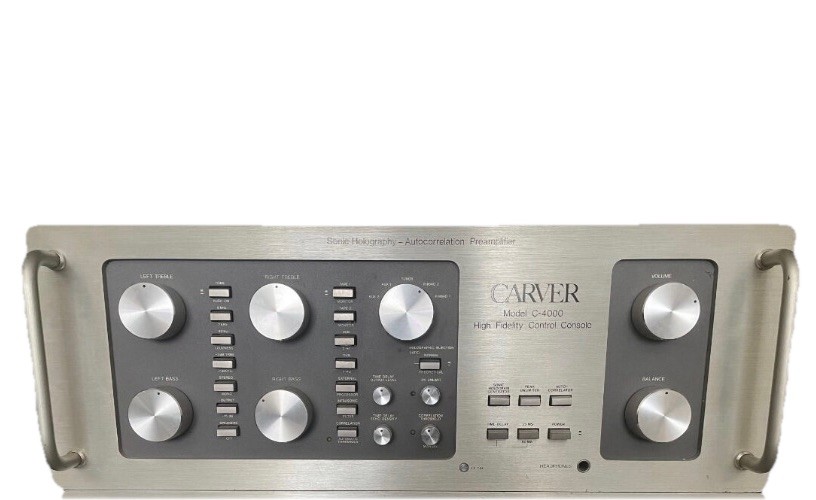
Carver C-4000: The Powerhouse of 1970s Solid-State Amplification
In the late 1970s, when high-fidelity audio was undergoing a dramatic transformation from tube-based warmth to solid-state precision, few names stood out as boldly as Bob Carver. A maverick engineer with a flair for innovation and a penchant for challenging the audiophile status quo, Carver introduced a series of amplifiers that redefined what was possible in affordable, high-performance audio. Among these, the Carver C-4000, released in 1978, stands as a landmark achievement — a powerful, feature-rich stereo amplifier that combined brute force with sonic refinement, all wrapped in a sleek, minimalist design that screamed modernity.
Though often overshadowed by its more famous sibling, the M-400 "Cube" amplifier, the C-4000 was no mere supporting act. It was a full-featured, dual-mono design stereo amplifier that delivered 300 watts per channel into 8 ohms — a staggering figure for its time — and did so without the need for exotic (and expensive) power supplies or massive heat sinks. This combination of high power, compact design, and accessible pricing made the C-4000 a favorite among both audiophiles and home theater pioneers in the early days of surround sound.
Technical Specifications
| Specification | Detail |
| Model | Carver C-4000 |
| Year Introduced | 1978 |
| Type | Solid-state stereo power amplifier |
| Power Output | 300W per channel (8Ω), 500W (4Ω) |
| Frequency Response | 20Hz – 20kHz (+/- 0.5dB) |
| Total Harmonic Distortion | < 0.01% (at full power) |
| Signal-to-Noise Ratio | 110 dB (A-weighted) |
| Input Sensitivity | 1.2V for full output |
| Input Impedance | 47kΩ |
| Damping Factor | > 200 |
| Protection Circuitry | Thermal, short-circuit, over-current |
| Dimensions (W×H×D) | 19" × 6.5" × 16" |
| Weight | 48 lbs (21.8 kg) |
| Finish | Black anodized aluminum, brushed faceplate |
The C-4000 employed Carver’s proprietary "Magnetic Field Power Supply" (MFPS) — a revolutionary approach that used magnetic saturation principles to deliver high current on demand without the bulk of traditional linear power supplies. This allowed the amplifier to remain compact while still delivering concert-hall levels of dynamics. The dual-mono layout ensured channel separation and minimized crosstalk, while the robust output stage used multiple parallel bipolar transistors to handle difficult speaker loads with ease.
Sound Characteristics and Performance
The Carver C-4000 was never about clinical neutrality — it was about authority, control, and musicality. Its sound signature leaned toward the dynamic and engaging, with a powerful bass response that could drive even the most demanding floor-standing speakers. Midrange clarity was excellent, with vocals and instruments rendered with lifelike presence. Highs were extended but never harsh, avoiding the "solid-state glare" that plagued many competitors.
One of the C-4000’s most praised attributes was its ability to remain composed under load. Thanks to its high damping factor and robust power supply, it could maintain tight control over speaker cones, even during complex orchestral crescendos or high-volume rock passages. This made it a favorite among owners of inefficient or reactive speakers like the Quad ESL-57, JBL L100, or Acoustic Research AR-3a.
Despite its high power, the C-4000 never sounded aggressive. Bob Carver was known for tuning his amplifiers to sound "musical" rather than just technically perfect, and the C-4000 exemplified this philosophy. It delivered the precision of solid-state with a hint of tube-like warmth — a rare balance that earned it respect in both technical and emotional listening circles.
Notable Features and Innovations
The Carver C-4000 wasn’t just powerful — it was smart. Among its standout features:
- Sonic Holography (later implemented in other Carver models): While not standard on the original C-4000, early prototypes and later revisions experimented with Carver’s groundbreaking Sonic Holography circuitry, which used time-delay and phase manipulation to expand the stereo image beyond the physical placement of speakers. This feature would later become a hallmark of Carver’s upper-tier models.
- Magnetic Field Power Supply (MFPS): This was the heart of the C-4000’s innovation. By using a magnetic amplifier to regulate power delivery, Carver achieved high current output without the need for massive transformers or capacitors. It was a clever workaround that delivered performance rivaling much larger and more expensive amplifiers.
- Auto-Engage Protection: The C-4000 featured a sophisticated protection circuit that monitored temperature, DC offset, and output current. If a fault was detected, the amplifier would mute the output and engage a red LED warning. Once the issue cleared, it would automatically reset — a rare feature at the time.
- Dual Input Selection: With both RCA and XLR inputs (on later production runs), the C-4000 catered to both consumer and semi-professional users. The balanced inputs helped reduce noise in longer cable runs, making it suitable for larger listening environments.
Common Issues and Maintenance
Like any vintage high-power amplifier, the Carver C-4000 requires attention to ensure reliable operation. Common issues include:
- Capacitor Aging: The electrolytic capacitors in the power supply and signal path are now over 40 years old. Many units benefit from a capacitor reformation or replacement to restore optimal performance and prevent failure.
- Thermal Stress: The high power output generates significant heat. Over time, this can cause solder joints to crack, particularly around the output transistors and power supply. A thorough inspection and reflow of critical joints is recommended.
- Bias Drift: The output stage bias can drift over time, leading to crossover distortion or thermal runaway. Adjusting the bias to factory specifications (typically 100–150mA per channel) is a standard maintenance task.
- Fan and Ventilation: While the C-4000 doesn’t have a fan, its ventilation slots can become clogged with dust. Regular cleaning and ensuring adequate airflow around the unit are essential for longevity.
Owners are advised to have the amplifier serviced by a technician familiar with vintage Carver gear, especially when dealing with the MFPS system, which operates at high voltages.
Current Market Value and Collectibility
The Carver C-4000 is not as widely collected as some of Carver’s later models (like the C-1 preamp or M-1.5t), but it holds a cult following among vintage audio enthusiasts. Well-maintained units in good cosmetic condition typically sell for $400–$700 on the secondary market, with fully restored examples commanding higher prices.
Its collectibility is driven by several factors:
- Historical significance as one of the first affordable 300WPC amplifiers
- Innovative engineering that challenged conventional amplifier design
- Strong performance with modern high-efficiency speakers
- Nostalgia for the golden era of American high-end audio
Units with original packaging, manuals, or rare revisions (such as those with early Sonic Holography circuitry) are particularly sought after.
Conclusion and Legacy
The Carver C-4000 was more than just a powerful amplifier — it was a statement. In an era when high power meant high cost and high bulk, Bob Carver proved that innovation could deliver performance without compromise. The C-4000 combined brute strength with elegance, technical prowess with musicality, and affordability with ambition.
Today, it stands as a testament to a time when American audio engineering was bold, unapologetic, and unafraid to challenge the establishment. For vintage audio collectors, the C-4000 offers not just impressive specs, but a piece of audio history — a powerful reminder that sometimes, more is more, and that with the right design, even the impossible can be achieved.
If you’re looking for an amplifier that commands respect, fills a room with sound, and carries the legacy of one of audio’s true innovators, the Carver C-4000 remains a compelling choice — over four decades after its debut.
eBay Listings



As an eBay Partner, we earn from qualifying purchases. This helps support our independent vintage technology research.
Service Manuals & Schematics
- Manual — archive.org
Related Models
- Carver M-4.0T (1985)
- Carver 4000T (1977)
- Carver C-9 (1985)
- Carver HR-895 (1985)
- Carver LIGHTSTAR-II (1985)
- Luxman L-530 (1975)
- Luxman R-404 (1975)
- Luxman RV-371 (1975)
- Luxman SQ-38U (1975)
- Luxman T-14 (1972)