Braun SK-61: The Epitome of Minimalist Audio Control
In the mid-1960s, German design house Braun redefined what audio equipment could look and feel like—not through raw power or sonic dominance, but through clarity, precision, and restraint. At the heart of this design revolution stood Dieter Rams, whose philosophy of “less, but better” found one of its purest expressions in the Braun SK-61, a modular control unit introduced in 1965 as part of the SK (Stereophonie-Kombination) system.
Unlike traditional amplifiers or receivers, the SK-61 was not a standalone audio source or power amplifier. Instead, it functioned as a centralized control hub—a sleek, minimalist interface designed to coordinate multiple components within Braun’s modular audio ecosystem. It was never about brute force; it was about intelligent design, intuitive operation, and aesthetic harmony.
A Design Landmark in Audio History
The SK-61 emerged during a golden era of industrial design, when consumer electronics began to transition from bulky, wood-cased machines into sleek, modernist appliances. Braun, under Rams’ leadership, became a pioneer in this shift. The SK-61, with its clean white enamel finish, aluminum trim, and monochromatic labeling, embodied the principles of functionalism and visual calm.
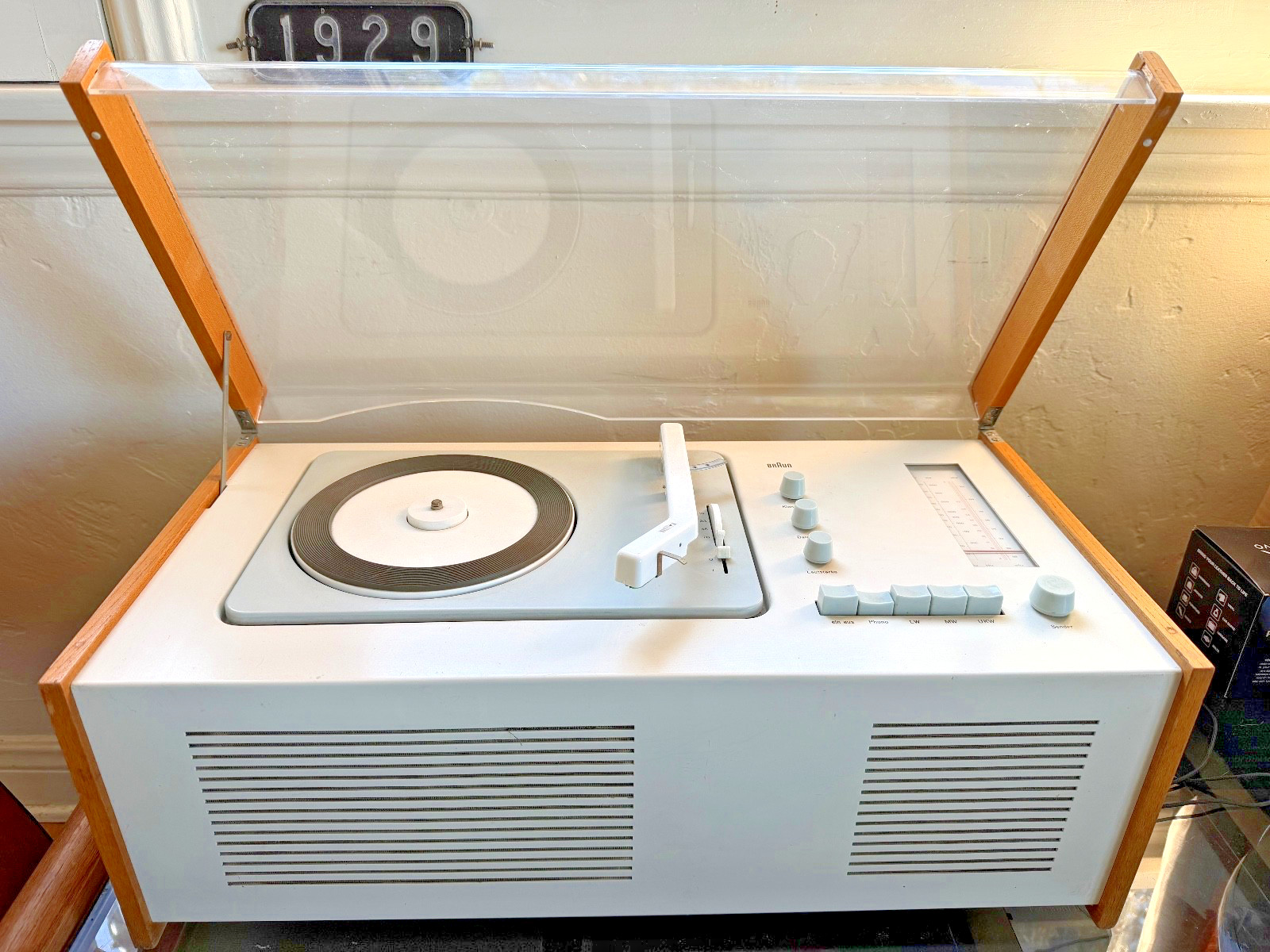
Housed in a compact rectangular chassis measuring approximately 43 x 8 x 26 cm, the SK-61 was meant to sit at the center of a custom-built audio wall unit—often paired with the TS 45 tuner, LE 1 speaker modules, and L 450 speakers. Its layout was sparse: a row of small rotary knobs for volume, balance, tone control (bass and treble), and input selection, all aligned with precision beneath a continuous aluminum fascia. The front panel featured no branding—only subtle engraved labels in Rams’ signature sans-serif typeface.
This was not just audio equipment; it was industrial art.
Technical Specifications
| Feature | Specification |
| Model | SK-61 |
| Year Introduced | 1965 |
| Manufacturer | Braun AG, Germany |
| Category | Modular Audio Control Unit |
| Function | Preamp / Control Center |
| Inputs | 2–3 line-level (via SK system bus or DIN connectors) |
| Tone Controls | Bass, Treble (±12 dB) |
| Balance Control | Yes |
| Power Output | Not applicable (no built-in amplifier) |
| Impedance Matching | Not applicable |
| Dimensions (W×H×D) | 430 × 80 × 260 mm (16.9 × 3.1 × 10.2 in) |
| Weight | ~3.2 kg (7 lbs) |
| Finish | White high-gloss lacquer, aluminum front panel |
| Compatible Components | TS 45 tuner, LE 1 tape recorder, L 450 speakers |
The SK-61 operated as a passive preamplifier, routing signals from connected sources (typically the TS 45 FM/AM tuner and optionally the LE 1 reel-to-reel unit) to an external power amplifier—often the companion Audio 300 or Audio 400 models. It used a proprietary DIN-based backplane connection system that allowed daisy-chaining of components, reducing cable clutter and enabling a flush, integrated wall-mounted installation.
This modular philosophy was revolutionary for its time. Instead of a single all-in-one console, Braun offered a customizable audio wall—a system where each component slotted together like parts of a larger design puzzle. The SK-61 was the brain of this operation: the only unit with user controls, ensuring a clean, uncluttered aesthetic across the entire setup.
Sound Characteristics and Performance
Given its role as a preamp and control unit, the SK-61 did not amplify sound but shaped it through tone and balance adjustments. Its circuitry was designed for neutrality and transparency, staying true to Rams’ belief that technology should be invisible in service of function.
Users report a clean, uncolored signal path with smooth, precise controls. The tone circuits offer gentle shelving filters—ideal for subtle room correction or personal preference, not for dramatic EQ sculpting. The balance control is linear and accurate, allowing for fine stereo image adjustment.
While not a high-gain or feature-rich preamp by modern standards, the SK-61 excelled in its intended context: delivering clear, unobtrusive signal management within a thoughtfully engineered system. When paired with the L 450 speakers and TS 45 tuner, the result was a balanced, detailed soundstage—modest in volume but rich in clarity.
Notable Features and Design Innovations
- Modular Integration: The SK-61 was designed to work within Braun’s SK wall system, using a backplane connection method that eliminated visible wiring.
- Minimalist Interface: No logos, no chrome, no distractions—only essential controls with tactile feedback.
- Precision Engineering: Knobs feature detented adjustments with smooth resistance, reflecting Rams’ obsession with usability.
- Aesthetic Unity: Every component in the SK system shared the same design language, creating a cohesive visual experience.
- Wall-Mount Capability: Designed to be installed in custom wall units, often with matching furniture by Dietrich Lubs or solid teak frames.
The SK-61 also exemplified Rams’ Ten Principles of Good Design, particularly "Good design is unobtrusive" and "Good design is as little design as possible." It didn’t shout for attention; it simply worked—elegantly, quietly, effectively.
Common Issues and Maintenance
Due to its age and passive nature, the SK-61 is generally reliable, but several issues may arise in vintage units:
- Oxidized Controls: Decades of use can cause potentiometers to become scratchy. Cleaning with contact cleaner (e.g., DeoxIT) often restores smooth operation.
- Faded Labels: While rare due to the engraved panel, some units show wear on the rear DIN connectors or rubber feet.
- Capacitor Aging: Though it has no power supply, passive coupling capacitors in the signal path may degrade, leading to muffled sound or channel dropouts.
- DIN Connector Wear: The proprietary backplane connectors can loosen over time; careful inspection and reseating are recommended.
Restoration should prioritize preservation over modification. Given its status as a design icon, replacing original parts with non-Braun equivalents diminishes its value. Enthusiasts recommend professional servicing for internal work, especially if integrating the SK-61 into a modern system.
Current Market Value and Collectibility
The Braun SK-61 is highly collectible, not primarily for its audio performance, but for its historical and design significance. Original, fully functional units in good condition regularly sell for €1,200–€2,500 at auction or through design specialty dealers. Complete SK systems—including tuner, tape deck, and speakers—can exceed €10,000, especially when paired with original wall units or teak cabinetry.
Factors affecting value:
- Original finish (gloss white should be crack-free)
- Presence of all knobs and labels
- Working condition of controls
- Provenance (original packaging, manuals, or matching serial numbers)
The SK-61 is often featured in design museums, including the Museum of Modern Art (MoMA) in New York, and is cited as a benchmark in minimalist industrial design.
Conclusion: A Legacy Beyond Sound
The Braun SK-61 is not just a piece of vintage audio gear—it’s a manifesto in metal and plastic. It represents a moment when design, engineering, and philosophy converged to create something timeless. While it lacks the wattage of a receiver or the warmth of tube amplification, it offers something rarer: clarity of purpose.
Today, the SK-61 stands as a symbol of restraint in an age of excess. It appeals not only to audiophiles but to designers, collectors, and anyone who believes that beauty lies in simplicity. In the world of vintage audio, where power and specs often dominate the conversation, the SK-61 reminds us that sometimes, the most powerful statement is silence—broken only by the soft click of a perfectly engineered knob.
eBay Listings


As an eBay Partner, we earn from qualifying purchases. This helps support our independent vintage technology research.
Related Models
- Braun L-810 (1965)
- Braun ATELIER-1-81 (1965)
- Braun ATELIER-1 (1965)
- Braun ATELIER-3 (1965)
- Braun AUDIO-1 (1965)
- Akai AM-2850 (1975)
- Akai AP-206 (1975)
- Nakamichi BX-1 (1985)
- Acoustic Research research-ar-17 (1978)
- Acoustic Research AR-19 (1994)