Braun REGIE-510: A Masterpiece of Minimalist Design in Vintage Audio
In the late 1960s, German design house Braun redefined what consumer electronics could look like—not just as tools for listening, but as objects of aesthetic integrity. The Braun REGIE-510, introduced around 1968, stands as a compelling example of this philosophy. Though not as widely documented as some of Dieter Rams’ more iconic hi-fi systems, the REGIE-510 captures the essence of Braun’s design ethos: clarity, functionality, and timeless elegance. More than just a radio or cassette player, it is a statement piece—a fusion of industrial design and audio utility that continues to captivate collectors and design enthusiasts alike.
Historical Context: Braun and the Design Revolution
By the 1960s, Braun had firmly established itself as a leader in merging form and function. Under the creative direction of Dieter Rams, the company produced a series of audio products that would become benchmarks in industrial design. While the REGIE-510 may not have been designed directly by Rams himself, it was developed within his design framework and reflects the principles he championed: “Less, but better.”
The REGIE series—of which the 510 is a part—was aimed at the mid-tier market, offering accessible yet beautifully crafted audio units. These devices were not high-power amplifiers or complex receivers, but rather compact, integrated systems designed for everyday use in homes, offices, or even modernist bachelor pads. The REGIE-510, in particular, combined an AM/FM radio with a built-in cassette recorder, a relatively novel feature at the time, especially in such a sleek enclosure.
Technical Specifications
| Feature | Specification |
| Model | REGIE-510 |
| Manufacturer | Braun (Germany) |
| Year of Introduction | 1968 |
| Type | Radio-Cassette Combination Unit |
| Tuning Bands | AM (Medium Wave), FM |
| Cassette Function | Playback and Recording |
| Inputs/Outputs | Internal microphone, headphone jack (likely 3.5mm) |
| Power Supply | AC mains (220V, European standard) |
| Dimensions | Approx. 38 cm (W) × 14 cm (H) × 20 cm (D) |
| Weight | Approx. 4.5 kg |
| Finish | White or light gray ABS plastic, aluminum tuning dial and control accents |
| Power Output | Not applicable (integrated speaker system) |
| Impedance | Not applicable |
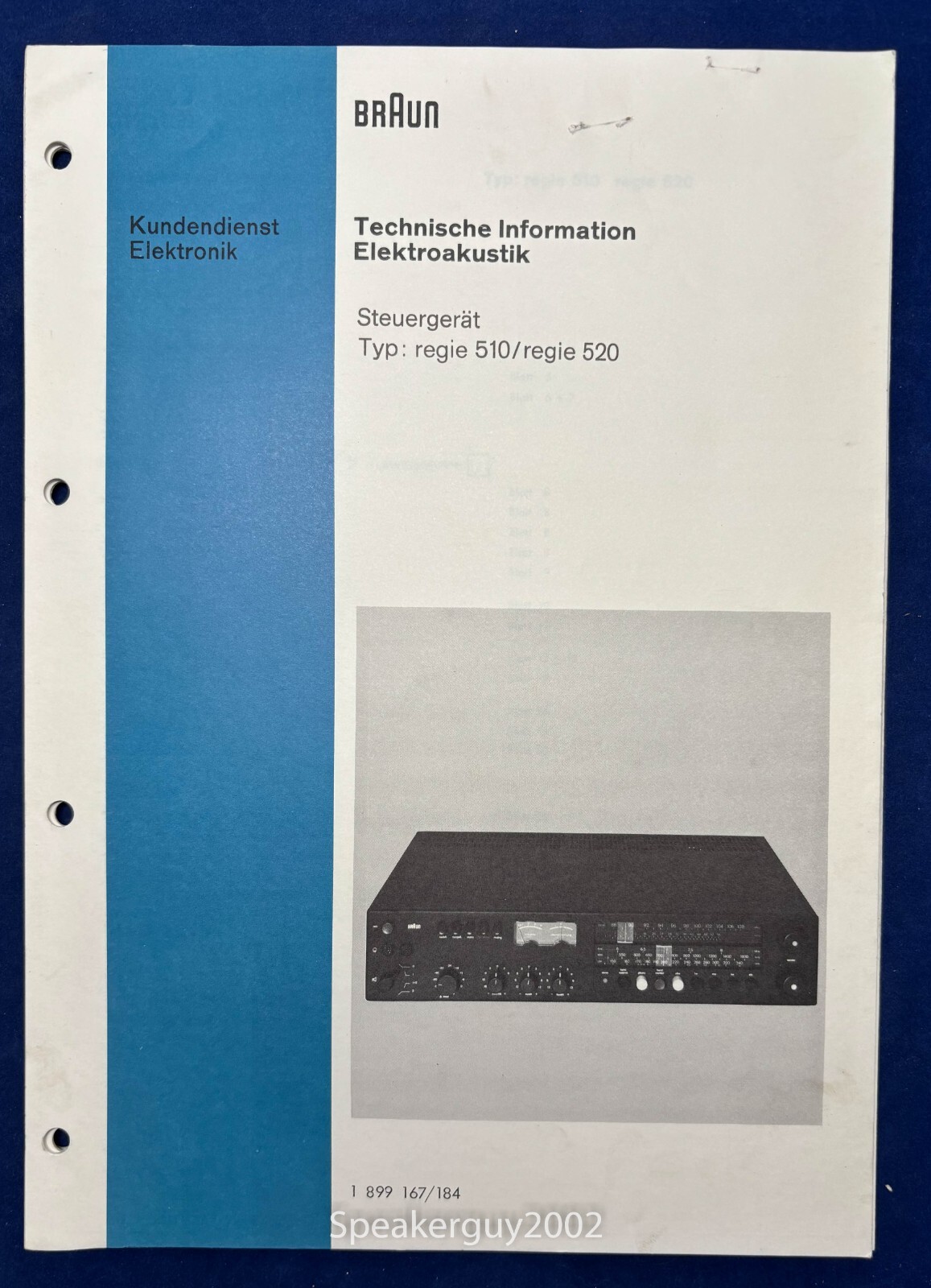
The REGIE-510 features a clean, horizontal layout with a fabric-covered speaker grille spanning the lower third of the front panel. The top section houses the FM/AM tuner with a large, centrally located analog dial, flanked by minimalist control knobs—typically for volume, tone (bass/treble), and power. The cassette deck sits just below, with basic transport controls (play, record, stop, rewind, fast forward) arranged in a logical, uncluttered fashion.
Unlike high-fidelity separates, the REGIE-510 was not built for audiophiles seeking deep bass or wide frequency response. Instead, it prioritized clarity, usability, and visual harmony. Its internal speaker system delivers modest but clear sound suitable for background listening or speech-based content like news and radio dramas.
Sound Characteristics and Performance
The audio performance of the REGIE-510 is best described as honest and unembellished. The built-in speaker—likely a single full-range driver—produces a warm midrange with limited bass extension and restrained highs. This is typical of compact systems of the era, especially those housed in small enclosures with minimal acoustic damping.
FM reception is generally solid for its time, with clear stereo separation when available (though some variants may be mono). The AM band performs adequately, with acceptable selectivity and sensitivity, though susceptible to interference in urban environments.
The cassette recorder uses a basic single-head system, meaning the same head handles both playback and recording. This limits fidelity compared to three-head decks, but for voice recording or casual music duplication, it was perfectly serviceable. Tape speed is standard 4.76 cm/s, and bias/frequency response aligns with consumer-grade expectations of the late 1960s.
Notable Features and Design Innovations
What truly sets the REGIE-510 apart is its design language:
- Monochromatic Palette: Typically finished in matte white or light gray, with subtle aluminum accents on knobs and tuning dial.
- Minimalist Interface: No cluttered labels or excessive buttons. Controls are intuitive, with tactile feedback.
- Integrated Form: The unit appears as a single, cohesive object—no visible seams or disjointed modules.
- Human-Centered Layout: The cassette deck is positioned for easy access, and the large tuning dial allows for precise station selection.
The REGIE-510 also reflects Braun’s commitment to user experience. The cassette compartment opens smoothly, often with a soft-click mechanism. The tuning dial features a clear luminous pointer and frequency scale, legible even in low light. These small details underscore Braun’s belief that good design is unobtrusive yet deeply considered.
Common Issues and Maintenance
As with any vintage electronics from the 1960s, the REGIE-510 requires careful attention to ensure reliable operation:
- Capacitor Aging: Electrolytic capacitors in the power supply and audio circuitry may have dried out, leading to hum, distortion, or failure to power on. Replacing these is often the first step in restoration.
- Tape Head Wear: The cassette head may be worn or clogged with oxide residue. Cleaning with isopropyl alcohol and demagnetizing can restore performance.
- Rubber Components: Drive belts (if used in the tape transport) and idler wheels may have hardened or cracked. These should be replaced with period-correct or modern equivalents.
- Tuner Alignment: Over time, the FM/AM tuner may drift out of alignment, requiring calibration with a signal generator.
- Plastic Integrity: While Braun used high-quality ABS plastic, prolonged UV exposure can cause yellowing or brittleness. Avoid direct sunlight and consider gentle cleaning with non-abrasive solutions.
Due to its relative rarity, sourcing replacement parts can be challenging. However, many components (such as potentiometers or switches) are standard and may be cross-referenced with other Braun or European electronics of the era.
Current Market Value and Collectibility
The Braun REGIE-510 is a rare find on the vintage market. Unlike the more famous SK series or T1000, the REGIE line has not achieved widespread fame—yet this obscurity adds to its appeal among design collectors.
In excellent, fully functional condition, a REGIE-510 can fetch between €400 and €800 at auction or through specialty vintage audio dealers. Units with original packaging, manuals, or accessories command premium prices. Cosmetic condition is critical—scratches, yellowing, or missing knobs significantly reduce value.
Its collectibility stems not from sonic performance, but from its design pedigree. As interest in mid-century modern design grows, Braun products—especially those embodying Rams’ principles—continue to appreciate. The REGIE-510, while not a flagship model, is a genuine artifact of that golden era.
Conclusion: A Quiet Icon of German Design
The Braun REGIE-510 may not thunder with power or dazzle with technical specs, but it speaks volumes through its restraint. It is a product of a time when electronics were beginning to enter the living room not as utilitarian boxes, but as design objects—meant to coexist with furniture, art, and daily life.
For the vintage audio enthusiast, it offers a glimpse into a different philosophy of sound: one where clarity of form mirrors clarity of function. For the design lover, it’s a wearable piece of history—a quiet testament to the idea that even the most ordinary devices can be extraordinary.
Today, the REGIE-510 stands not as a high-performance machine, but as a cultural artifact—a reminder that good design never dates, even when the technology within slows to a stop.
eBay Listings

As an eBay Partner, we earn from qualifying purchases. This helps support our independent vintage technology research.
Service Manuals & Schematics
- Manual — archive.org
- Service Manual — archive.org
Related Models
- Sony TC-2050SD (1978)
- Aiwa AD-F990 (1993)
- Kenwood KX-3060 (1982)
- Sony TC-2130A (1974)
- Sony TC-2220 (1972)
- Sony TC-FX6 (1982)
- Sony TC-K96R (1986)
- Stromberg-Carlson RS-404 (1975)
- Akai CS-F33R (1985)
- Akai DX-59 (1983)