Braun L-310: The Quiet Masterpiece of Modernist Audio Design
In the world of vintage audio, where tube glow, rotary knobs, and warm tonality often dominate the conversation, the Braun L-310 stands apart—not for its sound alone, but for its revolutionary design philosophy. Released in 1960 by the German company Braun, the L-310 is not a receiver, amplifier, or turntable, but a passive loudspeaker system conceived as part of a holistic high-fidelity audio vision. Designed under the direction of Dieter Rams, the L-310 exemplifies the principles of functionalism, minimalism, and enduring aesthetic clarity that would come to define mid-century modern design.
Though it never achieved mass-market popularity like its Japanese or American counterparts, the L-310 has since become a coveted artifact among design collectors and audiophiles who appreciate the marriage of form and function. It is less a component of a stereo system and more a sculptural statement—an embodiment of the idea that audio equipment should disappear into the background, both acoustically and visually, allowing the music to take center stage.
Historical Context: Braun and the Rise of German Design
By the late 1950s, Braun—originally a manufacturer of electrical shavers and household appliances—had begun expanding into audio electronics. Under the leadership of Rams, who joined the company in 1955 and became chief design officer in 1961, Braun embraced a design ethos rooted in "less but better" (weniger aber besser). This philosophy rejected decorative excess in favor of clean lines, honest materials, and intuitive usability.
The L-310 was introduced as part of a broader ecosystem of audio components, including the PS 500 turntable, TS 45 amplifier, and T 1000 radio tuner—all unified by a shared design language. The speaker was not intended to be flashy or dominant in a room; instead, it was designed to complement modern interiors with restraint and precision.
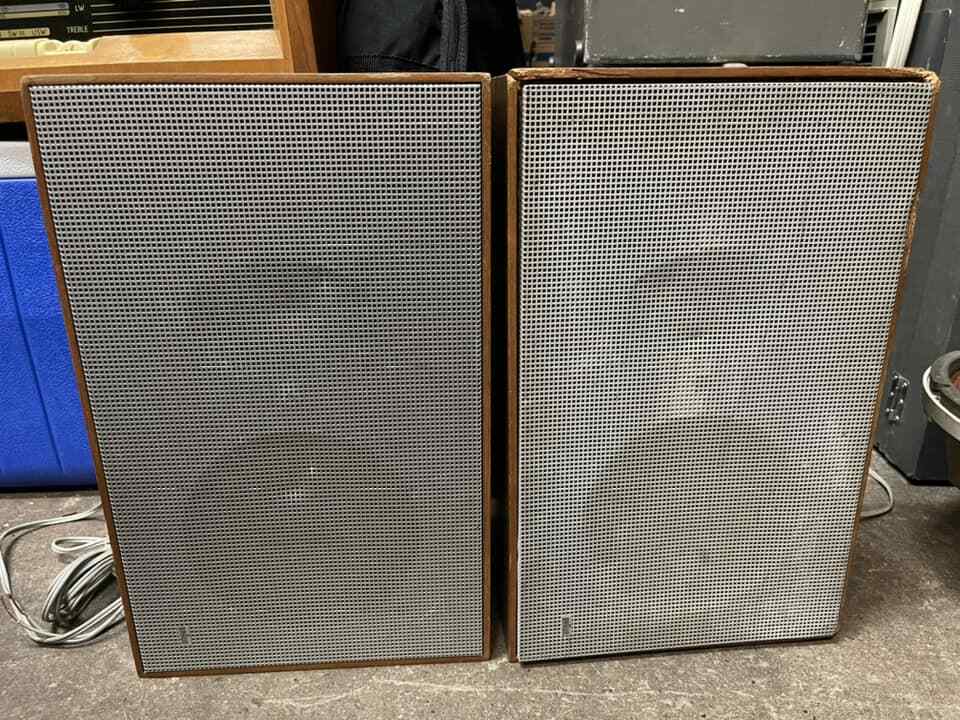
Unlike many speakers of the era, which often featured ornate wood cabinets or faux-leather grilles, the L-310 presented a stark, almost clinical appearance: a rectangular enclosure clad in light gray or white textured plastic (Braun’s signature "Braun tone"), with a simple fabric grille and minimal branding. It was available in both floor-standing and wall-mountable configurations, reflecting its adaptability to modern living spaces.
Technical Specifications
| Specification | Detail |
| Model | Braun L-310 |
| Manufacturer | Braun (Germany) |
| Year Introduced | 1960 |
| Type | Passive 2-way loudspeaker |
| Driver Configuration | 1 x 20 cm (8") woofer, 1 x tweeter |
| Crossover | Passive crossover network |
| Enclosure | Sealed (acoustic suspension) |
| Impedance | Not applicable (passive speaker) |
| Power Handling | Designed for low-to-moderate power amps |
| Dimensions (H×W×D) | Approx. 75 × 25 × 20 cm (floor model) |
| Weight | ~8 kg per unit |
| Finish | Light gray or white textured ABS plastic |
| Mounting Options | Floor-standing or wall-mounted |
The L-310 utilized a two-way driver configuration, with a paper-cone 8-inch woofer handling mid-bass frequencies and a small dome or horn tweeter for high frequencies. The sealed enclosure design contributed to tight, controlled bass response—uncommon for the era, when many manufacturers favored ported designs for increased loudness.
Internally, the crossover network was modest but well-constructed, using basic inductors and capacitors to direct frequencies appropriately. While not designed for high-efficiency output, the L-310 was engineered to work optimally with Braun’s own low-to-mid-powered amplifiers, such as the TS 45, which delivered around 20 watts per channel.
Sound Characteristics and Performance
The L-310 was never intended to be a "hi-fi powerhouse" in the conventional sense. Instead, it prioritized clarity, neutrality, and tonal balance over sheer volume or bass impact. Listeners familiar with the speaker often describe its sound as clean, articulate, and uncolored—a direct reflection of Rams’ design principles.
- Midrange: Exceptionally clear and natural, ideal for vocal and acoustic recordings.
- Treble: Smooth and detailed without harshness, though not as extended as modern tweeters.
- Bass: Tight and well-damped due to the sealed cabinet, but limited in depth—typical of 1960s compact designs.
- Soundstage: Modest in width but coherent, with good imaging for its time.
It shines with classical, jazz, and vocal music—genres where precision and timbral accuracy matter more than dynamic punch. When paired with Braun’s matching electronics, the L-310 delivers a cohesive, balanced listening experience that feels remarkably modern in its honesty.
Notable Features and Design Innovations
What makes the L-310 truly special is not its technical prowess, but its design integrity:
- Minimalist Aesthetic: No visible screws, logos, or decorative elements. The speaker blends into its environment rather than dominating it.
- Material Honesty: The use of industrial plastics was radical at the time, signaling a break from traditional wood cabinet norms.
- Modular Integration: Designed to work as part of a unified audio system, with matching finishes and proportions across components.
- Wall-Mount Capability: Ahead of its time, allowing for space-saving installation in modern apartments.
The L-310 also reflects Rams’ belief that "good design is as little design as possible." Every element serves a purpose; nothing is added for ornamentation. The fabric grille, for example, is taut and frameless, maintaining a flat plane with the cabinet. Even the speaker terminals, though basic by today’s standards, are neatly recessed and functional.
Common Issues and Maintenance
As with any vintage speaker from the 1960s, the L-310 requires careful attention to maintain performance:
- Aging Drivers: The original woofers and tweeters may suffer from surround disintegration or voice coil degradation. Re-coning or replacement with period-correct drivers is often necessary.
- Crossover Components: Capacitors can dry out over time, leading to imbalanced frequency response. Upgrading with modern film capacitors can restore clarity.
- Cabinet Integrity: While the plastic casing is durable, it can develop hairline cracks or discoloration, especially in sunlight. Cleaning should be done with mild soap and water—no abrasive chemicals.
- Grille Fabric: Original fabric may be brittle or stained. Replacement with neutral-tone acoustic fabric preserves aesthetics without affecting sound.
Due to the speaker’s status as a design icon, many owners prefer conservative restoration—preserving original materials whenever possible rather than modernizing.
Current Market Value and Collectibility
The Braun L-310 is rare and highly collectible, particularly in original, unrestored condition. While not as widely known as the L-450 or L-700 models, the L-310 holds a special place among Rams enthusiasts and mid-century modern collectors.
- Market Value: Pairs in good condition typically sell for $800–$1,500, with fully restored or museum-quality examples reaching $2,000+.
- Collector Appeal: Strong among design-focused buyers; often displayed in modernist interiors even when not used for audio.
- Authenticity Matters: Original finishes, grilles, and matching serial numbers significantly increase value.
Its presence in design museums and inclusion in retrospectives on Dieter Rams’ work have cemented its legacy beyond audio performance.
Conclusion: A Legacy of Quiet Influence
The Braun L-310 is more than a speaker—it is a manifesto in plastic and wood. It represents a moment when industrial design began to take audio equipment seriously as part of the domestic environment. While it may not deliver the bass slam of a modern floorstander or the wattage of a 1970s behemoth, its commitment to clarity, simplicity, and honesty remains profoundly influential.
Today, the L-310 stands as a quiet icon—a reminder that great design doesn’t shout. It listens. And in doing so, it allows the music, and the space around it, to speak for itself.
For collectors, designers, and audiophiles alike, the Braun L-310 is not just a relic of the past, but a timeless statement on how technology should serve both function and beauty.
eBay Listings


As an eBay Partner, we earn from qualifying purchases. This helps support our independent vintage technology research.
Service Manuals & Schematics
- Manual — archive.org
Related Models
- Braun L-810 (1965)
- Braun ATELIER-1-81 (1965)
- Braun ATELIER-1 (1965)
- Braun ATELIER-3 (1965)
- Braun AUDIO-1 (1965)
- Akai AM-2850 (1975)
- Akai AP-206 (1975)
- Nakamichi BX-1 (1985)
- Acoustic Research research-ar-17 (1978)
- Acoustic Research AR-19 (1994)