Braun AUDIO-3: The Essence of Minimalist Audio Design
In the mid-1960s, as stereo audio systems were rapidly evolving and consumer electronics became increasingly feature-laden, German design house Braun took a radically different approach. Instead of chasing complexity, they pursued clarity—both sonically and visually. The result was the Braun AUDIO-3, a high-fidelity control unit that stands today not just as a piece of vintage audio equipment, but as a landmark in industrial design history.
Designed by Dieter Rams and his team at Braun’s design studio, the AUDIO-3 was introduced in 1965 as the central component of a modular hi-fi system. Unlike traditional receivers or amplifiers, the AUDIO-3 was a pre-amplifier and control unit intended to be paired with separate power amplifiers and source components—most notably the Braun LE1 turntable and TS47 tuner—to form a complete, elegantly coordinated system. Its purpose was not to impress with raw power or flashy features, but to deliver clean signal management with unmatched precision and aesthetic purity.
Technical Specifications
The Braun AUDIO-3 was engineered with a focus on signal integrity, minimal interference, and user clarity. It featured discrete transistor circuitry—a cutting-edge approach at the time—avoiding the integrated circuits that were just beginning to emerge. This allowed for greater control over audio signal paths and contributed to the unit’s clean, neutral sound.
| Specification | Detail |
| Model | AUDIO-3 |
| Year Introduced | 1965 |
| Manufacturer | Braun (Germany) |
| Type | Pre-amplifier / Control Unit |
| Circuitry | Discrete transistor (no ICs) |
| Inputs | 2x Line (Tuner, Tape), 1x Phono (MM) |
| Outputs | 1x Main Out, 1x Tape Out |
| Tone Controls | Bass and Treble (±12dB at 100Hz/10kHz) |
| Power Supply | External 12V AC adapter (separate unit) |
| Dimensions | 380 × 75 × 200 mm (W×H×D) |
| Weight | 4.2 kg |
| Finish | Aluminum front panel, white lacquered steel casing |
| Notable Pairings | LE1 turntable, TS47 tuner, PA3 amp |
The use of an external power supply was a deliberate design choice to minimize electromagnetic interference within the audio circuitry—a practice now common in high-end audio but rare in the 1960s. This separation helped preserve signal purity and contributed to the unit’s low noise floor.
Sound Characteristics and Performance
The AUDIO-3 was never intended to color the sound. Its sonic signature is best described as transparent, neutral, and highly detailed. With a frequency response of 20Hz–20kHz (±1dB), it delivered a flat, uncolored signal path that let source components and speakers shine without interference.
Users of restored systems often praise the AUDIO-3 for its exceptional clarity in the midrange, tight bass control, and smooth, non-fatiguing highs. The tone controls, while present, are subtle and surgical—designed more for room or recording compensation than for dramatic sound shaping. When paired with the matching Braun PA3 power amplifier, the system achieves a balanced, cohesive sound that emphasizes musical timing and spatial accuracy.
Though not high-powered (as it’s a preamp), the AUDIO-3’s low output impedance ensures excellent drive capability, making it compatible with a wide range of power amplifiers beyond the original Braun ecosystem.
Notable Features and Design Innovations
The AUDIO-3 is a masterclass in functional minimalism. Every element serves a purpose, and every aesthetic choice reinforces usability.
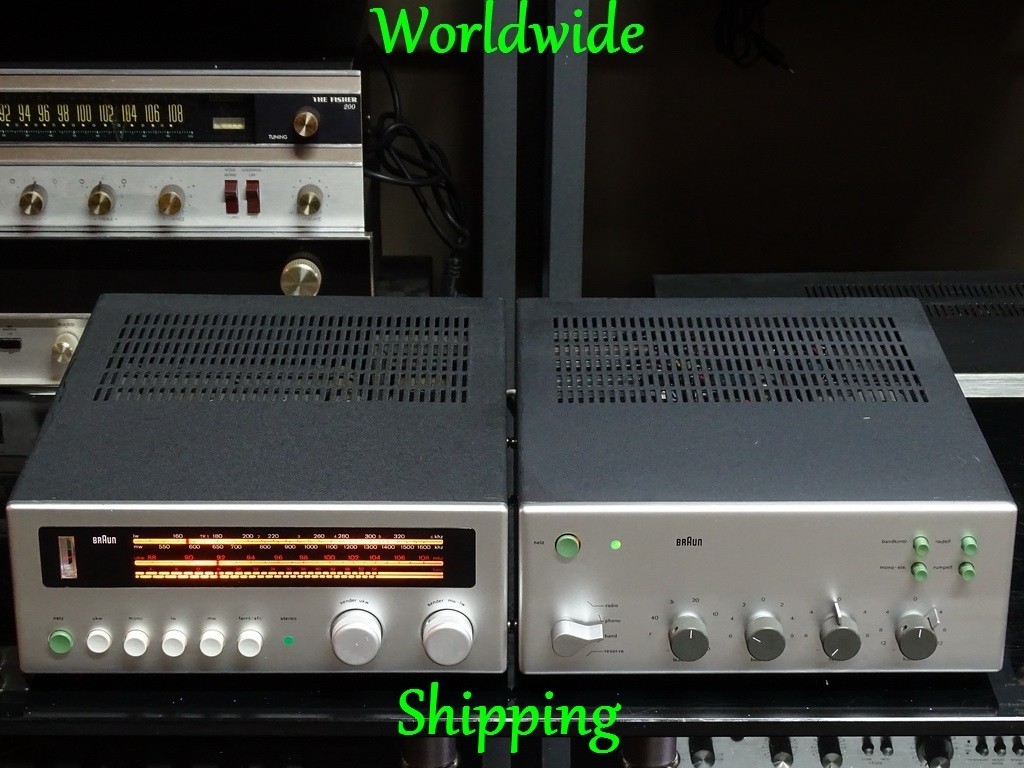
- Monolithic Aluminum Front Panel: The thick, brushed aluminum faceplate features only essential controls—input selector, volume, balance, and tone adjustments—each with precise detents and smooth operation. No branding, no decorative flourishes.
- Hidden Functionality: The power switch is located on the rear panel, maintaining the clean front aesthetic. The only indicator is a small pilot light, discreetly placed near the volume knob.
- Modular Ecosystem: The AUDIO-3 was part of Braun’s larger vision for modular audio. Components shared the same design language and could be stacked or mounted on custom racks, creating a unified, clutter-free system.
- User-Centered Layout: Knobs are spaced for easy access, labeling is clear and understated, and the layout follows a logical signal flow from left to right.
This design philosophy—later summarized by Dieter Rams as “Less, but better”—would go on to influence generations of product designers, most notably at companies like Apple. The AUDIO-3 is often cited as a prime example of Rams’ Ten Principles of Good Design, particularly in its emphasis on innovation, usability, and longevity.
Common Issues and Maintenance
Due to its age and the use of discrete components, vintage AUDIO-3 units require careful evaluation before use.
- Capacitor Aging: The electrolytic capacitors in the tone control and coupling circuits can dry out over time, leading to muffled sound or channel imbalance. A full recapping by a qualified technician is recommended for units that have been dormant.
- Potentiometer Wear: The volume and tone pots may develop crackling or channel dropouts. Cleaning with contact cleaner can help, but replacement with modern equivalents (while preserving original appearance) is often necessary.
- External Power Supply: The original 12V AC adapter is often missing or damaged. Reproduction units or compatible modern supplies are available, but voltage and polarity must be verified to avoid damage.
- Casing Corrosion: While the steel casing is durable, the white lacquer can chip or oxidize, especially on edges. Original finishes are highly prized by collectors.
Because of its design significance, many owners choose to restore the AUDIO-3 to full working order while preserving its original components and appearance. Professional servicing is strongly advised due to the precision engineering and scarcity of parts.
Current Market Value and Collectibility
The Braun AUDIO-3 is not merely a vintage audio component—it is a design artifact. As such, it commands strong interest from both audiophiles and design collectors.
- Market Value: Working units in excellent condition typically sell for €1,500–€2,500 (approx. $1,600–$2,700 USD), with prices rising for complete sets including the LE1 turntable, TS47 tuner, and original packaging.
- Rarity: While not exceedingly rare, fully functional and cosmetically preserved systems are uncommon. Units with original accessories and documentation are especially valuable.
- Museum Presence: The AUDIO-3 is part of the permanent collections at the Museum of Modern Art (MoMA) in New York and the Vitra Design Museum in Germany, underscoring its cultural significance.
Collectors often seek out the entire Braun audio system to display as a unified design statement. Its timeless aesthetic allows it to blend seamlessly into modern interiors, making it as much a piece of art as a functional device.
Conclusion and Legacy
The Braun AUDIO-3 transcends its role as a preamplifier. It is a manifesto in metal and circuitry, embodying Dieter Rams’ belief that good design should be as unobtrusive as it is enduring. In an era of visual noise and technological excess, the AUDIO-3 remains a quiet revolution—a reminder that beauty lies in restraint, and that function, when executed with care, becomes its own form of elegance.
Today, the AUDIO-3 is celebrated not only for its sonic neutrality but for its influence on modern design thinking. It stands as a testament to the idea that audio equipment can be both technically proficient and profoundly beautiful. For vintage audio enthusiasts and design aficionados alike, owning an AUDIO-3 is not just about listening to music—it’s about experiencing a moment in design history, preserved in time.
eBay Listings


As an eBay Partner, we earn from qualifying purchases. This helps support our independent vintage technology research.
Related Models
- Braun L-810 (1965)
- Braun ATELIER-1-81 (1965)
- Braun ATELIER-1 (1965)
- Braun ATELIER-3 (1965)
- Braun AUDIO-1 (1965)
- Akai AM-2850 (1975)
- Akai AP-206 (1975)
- Nakamichi BX-1 (1985)
- Acoustic Research research-ar-17 (1978)
- Acoustic Research AR-19 (1994)