Braun AUDIO-250: The Epitome of Minimalist Hi-Fi Design
In the mid-1960s, German design house Braun redefined what audio equipment could look and feel like—not just as functional electronics, but as objects of enduring aesthetic and ergonomic value. The Braun AUDIO-250, introduced in 1965, stands as a quiet masterpiece within this legacy. Unlike traditional receivers or amplifiers, the AUDIO-250 was conceived not as a standalone component, but as a modular control center—a central nervous system for Braun’s broader high-fidelity ecosystem. Designed under the visionary direction of Dieter Rams, the AUDIO-250 embodies the principles of functional minimalism, precision engineering, and timeless design that continue to influence product design to this day.
A System, Not a Single Component
The AUDIO-250 was never intended to function alone. Instead, it served as the control and switching hub for Braun’s modular audio system, which included separate amplifiers (like the LE1), tuners (such as the T1000), tape recorders (like the TG60), and loudspeakers (including the L450 or L200). This modular philosophy—radical for its time—allowed users to build a custom hi-fi setup tailored to their needs, with all components unified by a shared design language and mechanical interface.
The AUDIO-250’s primary role was source selection, volume control, and system integration. It featured no internal amplification or radio tuner, distinguishing it from conventional receivers. Instead, it provided clean, unamplified signal routing between external components, ensuring minimal signal degradation and maximum fidelity. This focus on purity of function reflects Dieter Rams’ design mantra: “Less, but better.”
Technical Specifications
| Specification | Detail |
| Model | AUDIO-250 |
| Manufacturer | Braun (Germany) |
| Year Introduced | 1965 |
| Category | Modular Audio Control Unit |
| Function | Source selector, volume control, system hub |
| Inputs | 3–4 (for tuner, tape, auxiliary) |
| Outputs | To amplifier (via LE1 interface) |
| Control Mechanism | Precision rotary knobs, slide switches |
| Power Source | Passive (no internal power supply) |
| Dimensions | 470 mm (W) × 90 mm (H) × 140 mm (D) |
| Weight | Approx. 4.5 kg |
| Finish | Anodized aluminum, white lacquered steel |
| Matching Components | T1000 tuner, LE1 amplifier, TG60 tape deck, L450 speakers |
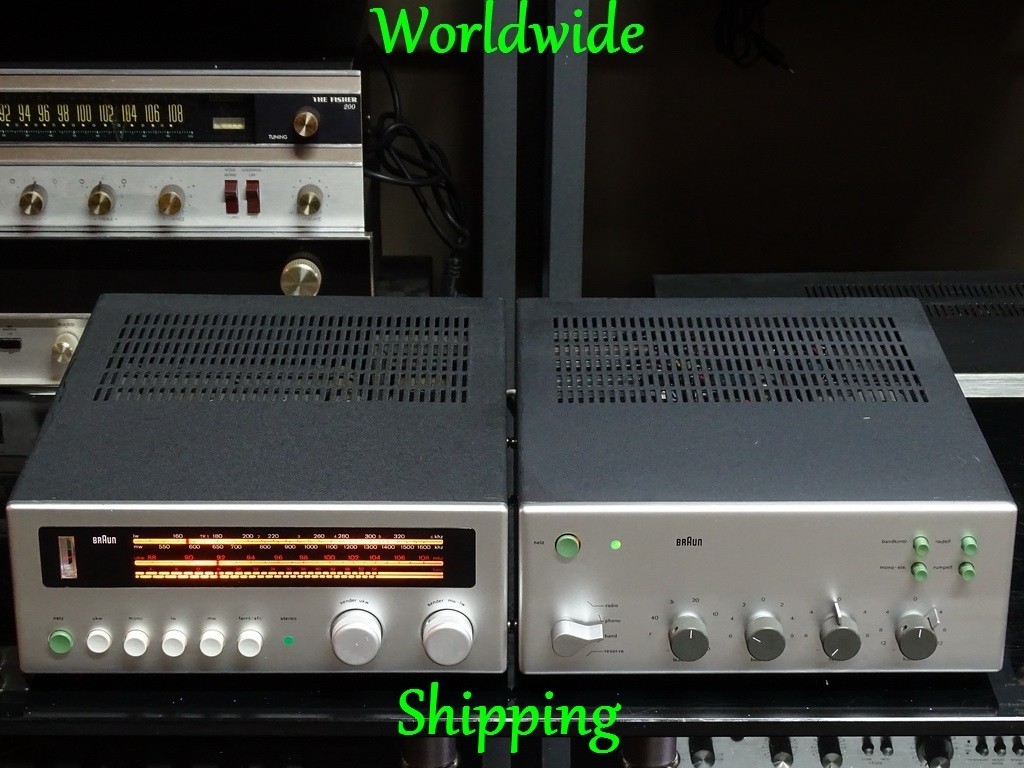
The unit’s construction is a hallmark of German engineering: a die-cast aluminum front panel, crisp white labeling, and precisely machined knobs with deliberate tactile feedback. The layout is ruthlessly logical—each control serves a single, clearly defined purpose, with no visual clutter. Even the typography, set in clean sans-serif lettering, aligns with the Bauhaus-influenced aesthetic that defined Braun’s identity.
Sound Characteristics and Performance
Because the AUDIO-250 contains no amplification circuitry, it does not color the sound in the traditional sense. Its role is signal management, and in this, it excels. By minimizing resistance and interference in the signal path, it preserves the integrity of the audio source. When paired with high-quality external components—particularly the LE1 amplifier and T1000 tuner—the system delivers a neutral, transparent, and balanced sound profile.
Users of restored Braun systems often praise the clarity and spatial accuracy of the setup, with a midrange that feels open and natural. The lack of built-in processing or tone controls (the AUDIO-250 offers only volume and balance) means the system rewards well-recorded music and high-fidelity sources. It’s not a unit for heavy bass boosting or dramatic sound shaping—it’s for listeners who value accuracy and restraint.
Notable Features and Design Innovations
The AUDIO-250’s most striking innovation is its modular integration system. Components were designed to be stacked and mechanically linked using a special rail system, allowing them to slide together seamlessly and form a unified horizontal array. This wasn’t just about looks—it ensured alignment, stability, and ease of use.
Other notable features include:
- Precision potentiometer for smooth, quiet volume control
- Slide switches for input selection, offering clear tactile feedback
- Minimalist labeling with high legibility
- Passive design—no internal power, reducing heat and component wear
- Interchangeable faceplates (in some variants), allowing for customization
The design of the AUDIO-250 reflects Dieter Rams’ Ten Principles of Good Design, particularly “Good design is unobtrusive” and “Good design is long-lasting.” Decades later, the unit still looks modern—so much so that it’s often mistaken for a contemporary design object.
Common Issues and Maintenance
Given its age and passive nature, the AUDIO-250 is mechanically robust, but not immune to time. Common issues include:
- Dusty or crackling potentiometers: The volume control can develop noise due to oxidation. Cleaning with contact cleaner (applied carefully) often resolves this.
- Worn slide switches: These can become intermittent. Replacement is difficult due to proprietary design, so gentle cleaning and lubrication are preferred.
- Faded labeling: Some units show wear on the white silkscreen, especially if exposed to sunlight.
- Mechanical rail wear: The stacking system may loosen over time; inspect rails and alignment pins during restoration.
Because the unit has no circuit boards or active electronics, repairs are usually limited to mechanical servicing. Enthusiasts recommend gentle cleaning with a microfiber cloth and avoiding harsh chemicals that could damage the anodized finish.
Current Market Value and Collectibility
The Braun AUDIO-250 is a highly collectible piece, especially when found as part of a complete system. While it rarely appears on the market, when it does, prices reflect its status as a design icon:
- Standalone AUDIO-250: $400–$700 (depending on condition)
- Complete system (AUDIO-250 + T1000 + LE1 + TG60 + speakers): $3,000–$6,000+
Its value is driven more by design significance than audio performance alone. The Braun audio system is frequently featured in design museums, including MoMA, and is a favorite among mid-century modern collectors. Original packaging, manuals, and accessories significantly increase desirability.
Conclusion: A Legacy of Design Excellence
The Braun AUDIO-250 is not merely a piece of vintage audio gear—it is a statement of design philosophy. In an era when electronics were becoming increasingly complex and visually noisy, Braun offered clarity, restraint, and purpose. The AUDIO-250 exemplifies Dieter Rams’ belief that technology should serve people quietly and efficiently, without fanfare.
Today, it stands as a bridge between industrial design and high-fidelity audio, admired by audiophiles, designers, and collectors alike. While it may not deliver the raw power of a vintage receiver or the convenience of modern streaming gear, it offers something rarer: timeless elegance and functional purity.
For those who appreciate the marriage of form and function, the Braun AUDIO-250 remains one of the most quietly revolutionary audio components ever made—a true icon of minimalist hi-fi.
eBay Listings


As an eBay Partner, we earn from qualifying purchases. This helps support our independent vintage technology research.
Service Manuals & Schematics
- Service Manual — archive.org
- Manual — archive.org
Related Models
- Braun L-810 (1965)
- Braun ATELIER-1-81 (1965)
- Braun ATELIER-1 (1965)
- Braun ATELIER-3 (1965)
- Braun AUDIO-1 (1965)
- Akai AM-2850 (1975)
- Akai AP-206 (1975)
- Nakamichi BX-1 (1985)
- Acoustic Research research-ar-17 (1978)
- Acoustic Research AR-19 (1994)