Braun AUDIO-2: The Marriage of Design and Sound
In the mid-1960s, as stereo audio technology began to mature and enter the homes of discerning listeners, one German company stood apart not for sheer power or technical complexity, but for its unwavering commitment to clarity, minimalism, and intelligent design: Braun. Among its most iconic contributions to the world of audio was the AUDIO-2, a modular high-fidelity system conceived under the visionary direction of Dieter Rams. Though not a conventional amplifier or receiver, the AUDIO-2 represents a pivotal moment in the history of audio equipment — where industrial design became inseparable from the listening experience.
A Design Philosophy in Action
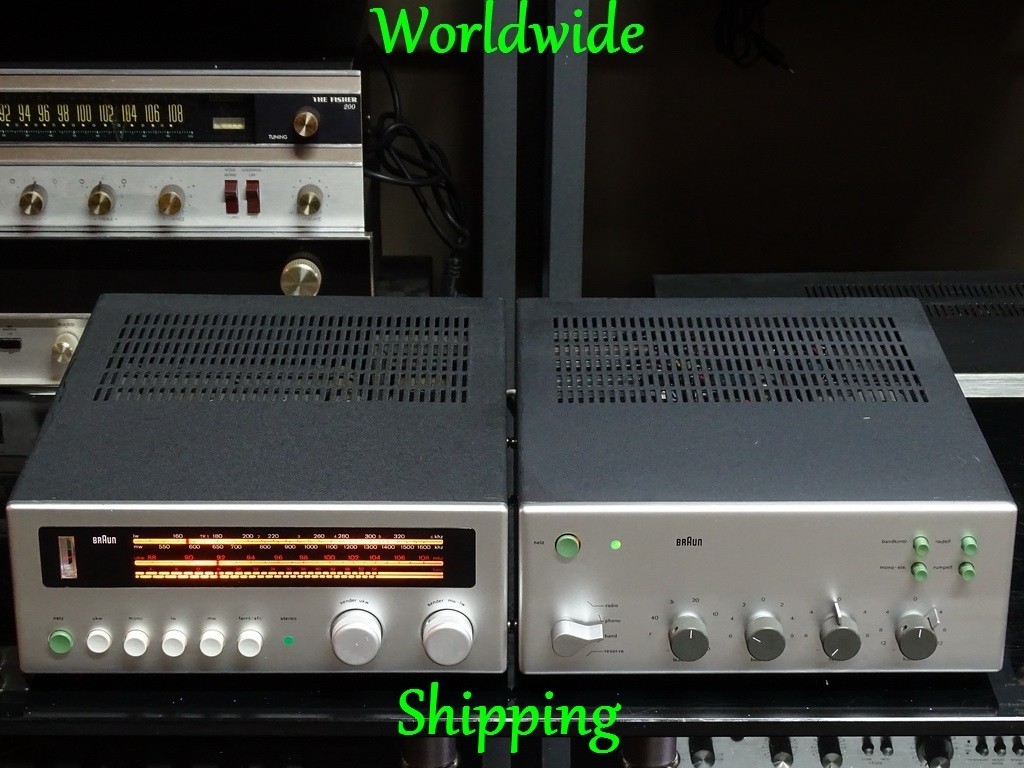
The Braun AUDIO-2 was not merely an audio product; it was a statement. Introduced in 1965, it emerged from Braun’s broader philosophy of "less, but better" — a mantra that would later define modernist design across disciplines. Unlike the ornate wood-cased receivers and tube-laden amplifiers of the era, the AUDIO-2 embraced a stark, functional aesthetic: clean white enamel, brushed aluminum accents, recessed controls, and a layout governed by precision and order.
The AUDIO-2 was part of Braun’s modular "System 2" audio family, which included components like the PS 500 turntable, TS 45 tuner-amplifier, and L 450 speakers. The AUDIO-2 itself functioned as a control and distribution unit, designed to integrate these components into a cohesive, wall-mountable system. It was less about amplification and more about organization, signal routing, and user interface — a concept far ahead of its time.
This was audio as architecture. Dieter Rams and his team treated the listening environment not as a collection of disparate boxes, but as a unified system where form followed function with surgical precision.
Technical Specifications
While the AUDIO-2 did not amplify sound itself, it played a critical role in the System 2 ecosystem. It housed selector switches, input/output jacks, and power distribution for connected components. Its design allowed for clean, centralized control and minimized cable clutter — a rare consideration in the 1960s.
| Specification | Detail |
| Model | AUDIO-2 |
| Manufacturer | Braun (Germany) |
| Year Introduced | 1965 |
| Category | Audio Control & Distribution Unit |
| Primary Function | System integration and signal routing |
| Power Output | Not applicable (non-amplifying unit) |
| Impedance | Not applicable |
| Inputs | Multiple (for turntable, tuner, tape) |
| Outputs | To amplifier and speakers |
| Construction | White phenolic resin, aluminum, steel |
| Dimensions | Approx. 45 x 12 x 8 cm (WxDxH) |
| Mounting | Wall-mountable or surface placement |
| Compatible Components | TS 45, PS 500, L 450, TG 60 |
The unit featured flush-mounted rotary selectors, clearly labeled in Helvetica or a similar sans-serif typeface, and was engineered for durability and ease of use. All connections were thoughtfully placed on the rear panel, promoting a clean front aesthetic — a hallmark of Rams’ design principles.
Sound Characteristics and Performance
Because the AUDIO-2 was not an active audio component, it did not color or amplify the sound. Its contribution to audio performance was indirect but profound. By enabling seamless integration between high-quality components like the TS 45 amplifier and PS 500 turntable, it ensured optimal signal transfer and minimized interference.
When paired with the full System 2 setup, the result was a listening experience characterized by clarity, neutrality, and precision — values mirrored in the design itself. There was no sonic embellishment, no artificial warmth or bass boost. Instead, the system delivered what was on the record, unaltered and honest.
The AUDIO-2’s role was to disappear — to make the technology recede so the music could take center stage. In this, it succeeded brilliantly.
Notable Features and Innovations
The Braun AUDIO-2 was revolutionary not for its circuitry, but for its systematic approach to audio. Key innovations included:
- Modular Integration: One of the first attempts to create a fully coordinated, multi-component audio system where every piece shared design language and connectivity standards.
- Wall-Mounted Design: Breaking from the tradition of floor-standing consoles, the AUDIO-2 could be mounted on the wall, saving space and elevating audio equipment to the level of interior design.
- User-Centered Interface: Minimal controls, logical layout, and intuitive operation reflected early human-centered design principles.
- Aesthetic Consistency: Every screw, label, and finish was standardized across the System 2 range, creating a unified visual language rarely seen in consumer electronics.
The AUDIO-2 also reflected Braun’s collaboration with art and architecture. Its design resonated with the ideals of the Bauhaus and Swiss graphic design, influencing later generations of product designers, including Apple’s Jony Ive, who cited Rams as a major influence.
Common Issues and Maintenance
Today, surviving AUDIO-2 units are rare and highly sought after. As with any 1960s electronics, several issues may arise:
- Oxidation of connectors: Internal jacks and switches may suffer from corrosion, especially if stored in humid environments.
- Fragile casing: The white phenolic resin can yellow or crack over time, particularly if exposed to UV light.
- Missing hardware: Wall-mount brackets and original screws are often lost.
- Compatibility: Modern audio sources (e.g., Bluetooth, digital players) are not natively supported, limiting practical use.
Restoration should prioritize preservation over modification. Purists recommend cleaning contacts with deoxit, carefully rewiring if necessary, and avoiding repaints or replacements that compromise originality. Given its status as a design artifact, even non-functional units retain significant value.
Current Market Value and Collectibility
The Braun AUDIO-2 is not a high-power amplifier or a turntable with moving parts — yet it commands attention in the collector’s market. As a design icon, it transcends typical audio equipment valuation.
- Condition: Fully functional units in original condition with matching System 2 components can fetch $1,500–$3,000 at auction.
- Rarity: Few AUDIO-2 units were produced, and even fewer survive complete.
- Provenance: Units with original packaging, manuals, or documentation from Braun’s design studio are exceptionally valuable.
- Museum Appeal: The AUDIO-2 is featured in permanent collections at the Museum of Modern Art (MoMA) in New York and the Vitra Design Museum in Germany.
Collectors often seek the AUDIO-2 not to use it daily, but to display it — as a sculpture of modernist ideals. Its value lies as much in its cultural significance as in its technical function.
Conclusion: A Legacy of Clarity
The Braun AUDIO-2 is more than a vintage audio component. It is a manifesto in metal and plastic, a declaration that technology should serve people quietly, efficiently, and beautifully. In an era of bloated feature sets and flashy interfaces, the AUDIO-2 reminds us that restraint can be revolutionary.
While it may not deliver 100 watts per channel or support the latest codecs, its influence echoes in every sleek, minimalist device we use today. From high-end audio brands like Bang & Olufsen to consumer electronics giants like Apple, the DNA of the AUDIO-2 lives on.
For the vintage audio enthusiast, the AUDIO-2 is not just a piece of equipment — it’s a cornerstone of design history. And in the world of analog sound, where warmth and nostalgia often dominate, the Braun AUDIO-2 stands apart: cool, calm, and eternally relevant.
eBay Listings


As an eBay Partner, we earn from qualifying purchases. This helps support our independent vintage technology research.
Service Manuals & Schematics
- Service Manual — archive.org
Related Models
- Braun L-810 (1965)
- Braun ATELIER-1-81 (1965)
- Braun ATELIER-1 (1965)
- Braun ATELIER-3 (1965)
- Braun AUDIO-1 (1965)
- Akai AM-2850 (1975)
- Akai AP-206 (1975)
- Nakamichi BX-1 (1985)
- Acoustic Research research-ar-17 (1978)
- Acoustic Research AR-19 (1994)