Bose 901 Series I: The Speaker That Challenged Conventional Wisdom
When the Bose 901 Series I was introduced in 1968, it didn’t just enter the high-fidelity market—it disrupted it. Designed by Dr. Amar G. Bose, the founder of Bose Corporation and an MIT professor, the 901 Series I was unlike any loudspeaker before it. Eschewing traditional direct-radiating designs, it embraced a radical philosophy: that most of the sound we hear in a concert hall is reflected off walls and ceilings, not delivered directly from the instruments. This insight led to a speaker that sent the majority of its sound toward the rear and side walls, relying on reflections to create a spacious, lifelike listening experience.
The 901 Series I was the first in a long-running line of Bose’s most iconic and controversial loudspeakers. Loved by some, criticized by others, it became a symbol of both innovation and polarizing audio philosophy. Still, few can deny its impact on the audio world. For over five decades, the 901 series remained in production (with updates through multiple generations), a testament to its enduring design and loyal following.
Technical Specifications
The Bose 901 Series I featured a unique configuration that set it apart from conventional speakers of its era. It utilized nine identical 4-inch full-range drivers—eight arranged to fire backward and to the sides, and one front-firing driver to provide a touch of direct sound. This configuration was central to its “direct/reflecting” concept, aiming to mimic the natural sound field of a live performance.
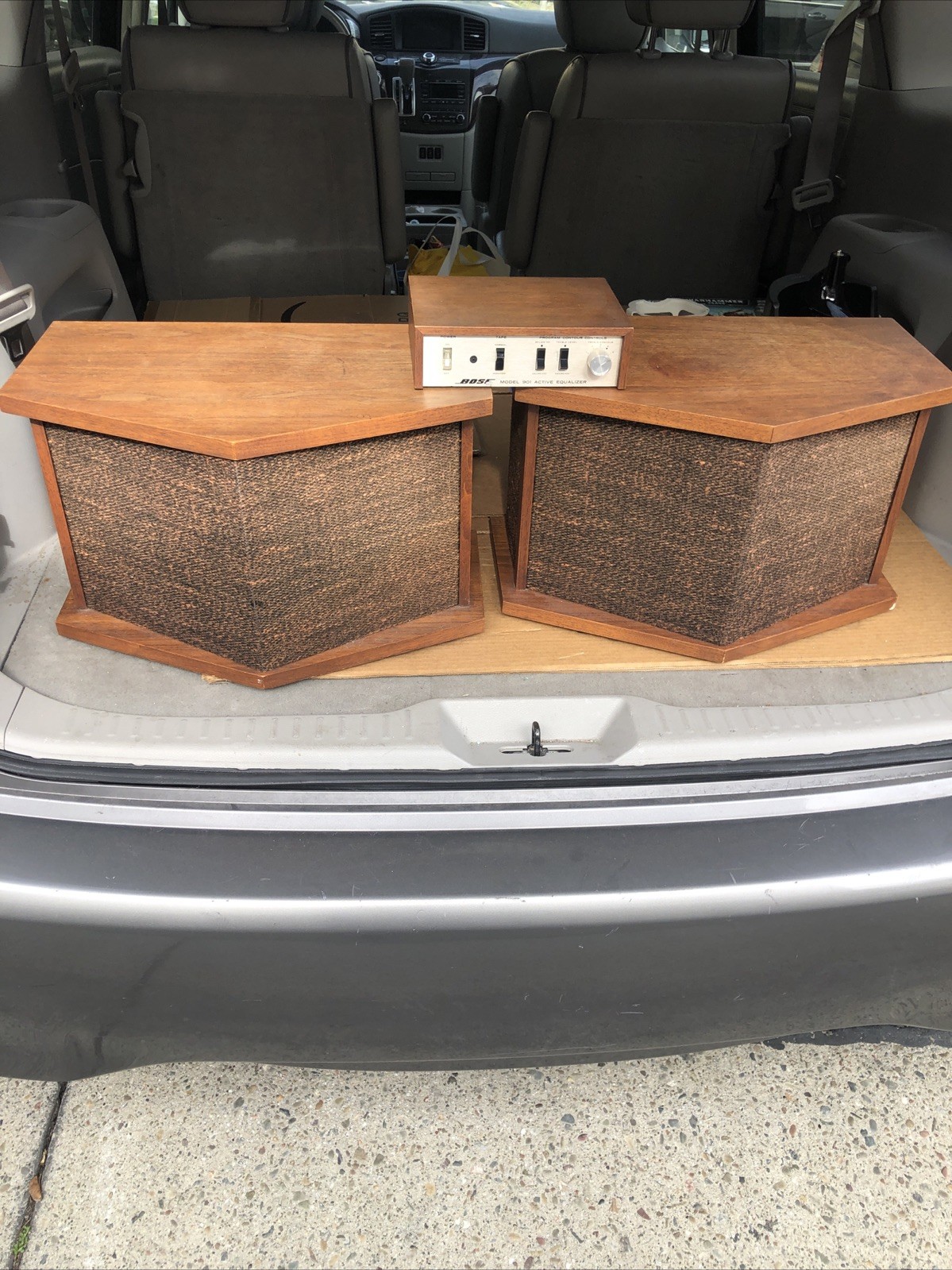
Because the speaker’s frequency response was inherently uneven—due to the emphasis on reflected sound—it required the use of a dedicated equalizer to achieve a balanced tonal output. This equalizer, typically built into a companion preamplifier or used as a separate unit, was not optional; it was essential for proper operation.
| Specification | Detail |
| Model | Bose 901 Series I |
| Year Introduced | 1968 |
| Driver Configuration | 9 x 4" full-range drivers (8 rear/side, 1 front) |
| Frequency Response | 40 Hz – 18 kHz (with equalizer) |
| Sensitivity | 92 dB (1W/1m) |
| Nominal Impedance | Not applicable (requires EQ) |
| Recommended Power | Not applicable (passive, but EQ-dependent) |
| Crossover | None (full-range drivers) |
| Enclosure Type | Acoustic suspension, non-resonant cabinet |
| Equalization Required | Yes (Bose proprietary EQ) |
| Dimensions (H×W×D) | 21" × 5.5" × 7" |
| Weight | 22 lbs per speaker |
Sound Characteristics and Performance
The sonic signature of the Bose 901 Series I was unlike anything else on the market. When properly set up—with the speakers placed away from walls and the equalizer engaged—the soundstage was remarkably wide and enveloping. Music seemed to fill the room in a diffuse, ambient manner, creating a sense of space that many listeners found captivating.
Critics of the 901 often pointed to its lack of precision imaging—individual instruments weren’t sharply localized, as they are with conventional speakers. But Bose argued this was by design. In a real concert hall, you don’t pinpoint the violin section to a single spot; you experience it as part of a larger acoustic field. The 901 aimed to replicate that experience in the home.
Bass response was surprisingly full for such modest drivers, thanks to the acoustic suspension design and the room reinforcement from reflected energy. However, deep bass extension was limited compared to larger floor-standing speakers or those with dedicated woofers. The reliance on room acoustics also meant performance varied significantly based on placement and room size.
Notable Features and Innovations
The 901 Series I introduced several groundbreaking ideas:
- Direct/Reflecting Technology: This was Bose’s core innovation—using reflected sound as a primary delivery method. It was a bold departure from the direct-radiating norm and formed the foundation of Bose’s speaker philosophy for decades.
- Mandatory Equalization: At a time when most speakers aimed for flat response out of the box, the 901 embraced the need for electronic correction. The included equalizer compensated for the speaker’s natural response curve, boosting bass and treble to achieve tonal balance. This integration of electronics and acoustics was ahead of its time.
- Uniform Driver Array: Using nine identical drivers simplified production and ensured consistent tonal character across the frequency range. While not a true full-range driver by modern standards, the 4-inch units were well-suited to the system’s diffuse sound field.
- Minimal Cabinet Resonance: The dense, non-resonant enclosure reduced coloration, allowing the drivers and room interactions to define the sound rather than the box itself.
Common Issues and Maintenance
Over time, the Bose 901 Series I can develop several age-related issues:
- Driver Foam Aging: Like many speakers of its era, the 901 used foam surrounds on its drivers. These degrade over time, leading to crumbling foam and distorted bass. Re-foaming or full driver reconing is a common restoration step.
- Equalizer Reliability: The proprietary equalizer units (such as those in the Bose EQ-1 or EQ-2) may suffer from aging capacitors, potentiometer wear, or connection issues. Keeping the EQ in working order is critical—without it, the 901 sounds thin and unbalanced.
- Cabinet Finish: The original wood veneer or walnut finish may show wear, scratches, or fading. While not affecting sound, cosmetic restoration is often pursued by collectors.
- Placement Sensitivity: The 901 demands careful placement—at least two feet from the front wall and ideally with reflective side walls. Poor setup leads to weak bass and a collapsed soundstage.
Owners are advised to service the drivers every 20–30 years and to store the speakers in a climate-controlled environment to prolong foam life.
Current Market Value and Collectibility
The Bose 901 Series I is a sought-after piece among vintage audio enthusiasts, particularly those interested in landmark designs. While not as rare as some boutique speakers, original pairs in good condition—with working drivers and matching EQ units—can command $400 to $800, depending on market demand and condition.
Later versions (Series II, III, etc.) are more common, so the Series I holds special appeal for collectors due to its historical significance. Original packaging, manuals, and the correct equalizer boost value. However, because the 901 was mass-produced and widely sold through retail channels, many units suffered rough handling or improper storage.
Restored pairs with re-foamed drivers and serviced electronics often sell at a premium. Audiophiles who appreciate the 901’s unique sound and legacy are willing to invest in proper restoration.
Conclusion and Legacy
The Bose 901 Series I was never just a speaker—it was a statement. It challenged the audiophile orthodoxy of the time, insisting that listening experience mattered more than technical specifications on paper. While purists criticized its lack of imaging precision and reliance on equalization, countless listeners found its sound more natural, immersive, and emotionally engaging than traditional speakers.
Its legacy is undeniable. The 901 series remained in production for over 50 years, evolving through multiple iterations but staying true to its original concept. It helped establish Bose as a major player in consumer audio and influenced the development of surround sound and ambient audio systems.
Today, the 901 Series I stands as a milestone in speaker design—a bold experiment that worked well enough to endure. Whether you love it or question its approach, you can’t ignore its impact. For vintage audio collectors and sonic adventurers, the Bose 901 Series I remains a fascinating and rewarding piece of audio history.
eBay Listings


As an eBay Partner, we earn from qualifying purchases. This helps support our independent vintage technology research.
Related Models
- Bose 4.2-SERIES-I (1984)
- Bose 101-MUSIC-MONITOR (1970)
- Bose 10.2-SERIES-I (1988)
- Bose 10.2-SERIES-II (1988)
- Bose 1800-SERIES-II (1979)
- Akai AM-2850 (1975)
- Akai AP-206 (1975)
- Nakamichi BX-1 (1985)
- Acoustic Research research-ar-17 (1978)
- Acoustic Research AR-19 (1994)