Bose 501-SERIES-II: The Sound of Scientific Innovation
In the mid-1970s, as audiophiles debated the merits of direct-radiating speakers and room acoustics, Bose introduced a radical departure from conventional loudspeaker design: the Bose 501-SERIES-II. Released in 1975 as an evolution of the original 501, this passive speaker system embodied Dr. Amar G. Bose’s groundbreaking research into how humans perceive sound in enclosed spaces. Rather than aiming for pinpoint stereo imaging, the 501-SERIES-II was engineered to create a spacious, enveloping soundfield—what Bose called a "diffuse field" reproduction. This approach, rooted in psychoacoustics and concert hall behavior, made the 501-SERIES-II one of the most distinctive and controversial speakers of its era.
A Speaker Born from Research
The philosophy behind the Bose 501-SERIES-II traces back to Dr. Bose’s experience at a 1966 concert in Boston’s Symphony Hall. Disappointed by how poorly most home speakers recreated the immersive sound of live music, he began exploring how human hearing interprets reflections, reverberation, and direct sound. His research at MIT led to the conclusion that early reflections—those arriving at the listener within 20 milliseconds of the direct sound—play a crucial role in perceived spaciousness and realism.
The 501-SERIES-II was designed around this principle. Instead of minimizing reflections, it harnessed them. By combining forward-firing drivers with rear- and side-firing elements, the speaker flooded the room with sound energy, creating a more natural and expansive listening experience—particularly in untreated domestic environments.
Technical Specifications
| Specification | Detail |
| Model | 501-SERIES-II |
| Manufacturer | Bose Corporation |
| Release Year | 1975 |
| Type | 3-way, passive, reflex-loaded speaker |
| Drivers | 1 x 12" woofer, 4 x midrange, 1 x dome tweeter |
| Frequency Response | 40 Hz – 18 kHz (±3 dB) |
| Crossover Frequencies | 500 Hz (woofer to midrange), 5 kHz (midrange to tweeter) |
| Sensitivity | 86 dB (2.83V/1m) |
| Nominal Impedance | 8 ohms (compatible with most receivers) |
| Enclosure Type | Bass reflex with multiple driver ports |
| Dimensions (H×W×D) | 24" × 12" × 12" (61 × 30.5 × 30.5 cm) |
| Weight | 45 lbs (20.4 kg) per speaker |
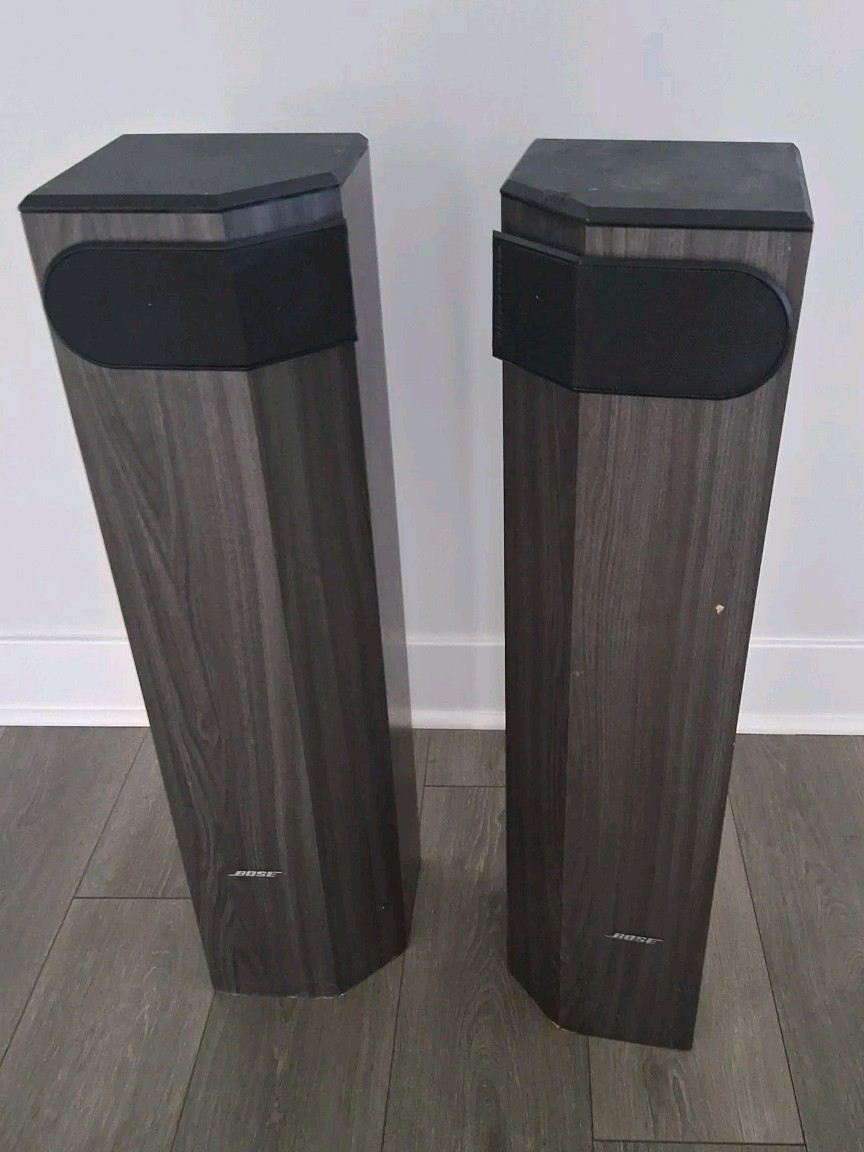
| Finish Options | Walnut veneer, black ash |
| Recommended Amp Power | 20–100 watts |
Sound Characteristics and Performance
The sonic signature of the 501-SERIES-II is unmistakable. It does not deliver the tight, focused stereo image prized by purists. Instead, it creates a wide, ambient soundstage that fills the room, mimicking the reflective characteristics of a concert hall. This diffuse field approach results in a forgiving sound that works well in less-than-ideal listening rooms and allows for a broader "sweet spot"—multiple listeners can enjoy a consistent experience without being seated in a precise location.
Bass response is solid for its time, thanks to the 12-inch woofer and bass reflex design, though it lacks the deep extension of modern subwoofers. The midrange is smooth and articulate, with multiple midrange drivers helping to disperse sound laterally. The high frequencies are handled by a single dome tweeter, which provides clarity without harshness.
Critics often noted that the 501-SERIES-II sacrificed detail and imaging precision for ambiance. However, many listeners found this trade-off worthwhile, especially when enjoying orchestral music, jazz, or vocals, where spatial realism is more important than pinpoint localization.
Notable Features and Innovations
The 501-SERIES-II introduced several design elements that were novel for consumer audio at the time:
- Multi-Directional Driver Array: The speaker features a unique configuration with drivers firing forward, to the sides, and slightly rearward. This dispersion pattern was engineered to excite room reflections in a controlled way, enhancing perceived spaciousness.
- Psychoacoustic Tuning: Unlike most speakers tuned by frequency response alone, the 501-SERIES-II was optimized based on human hearing models. Bose prioritized how the ear-brain system interprets sound over flat on-axis measurements.
- Acoustic Suspension and Porting: While not a sealed box design, the bass reflex system was carefully tuned to complement the diffuse field approach, avoiding the "one-note" boominess common in early ported cabinets.
- Modular Crossover Network: The internal crossover was designed for reliability and ease of service, a hallmark of Bose’s engineering philosophy.
Common Issues and Maintenance
As with any vintage speaker, the Bose 501-SERIES-II can suffer from age-related wear:
- Foam Surround Deterioration: The original foam surrounds on the woofer and midrange drivers are prone to disintegration after 30–40 years. Re-foaming or full driver reconing is often necessary for optimal performance.
- Crossover Component Aging: Electrolytic capacitors in the crossover network may dry out, leading to loss of high frequencies or distorted bass. Replacing these with modern equivalents can restore clarity.
- Grille Fabric and Binding Posts: The original fabric grilles may be torn or faded. Replacement grilles are occasionally available through specialty vendors. The binding posts, while sturdy, can corrode; cleaning or upgrading to modern terminals improves connectivity.
- Cabinet Integrity: The wood veneer is generally durable, but scratches and water rings can occur. Refinishing should be done carefully to preserve vintage value.
Owners are advised to have the speakers professionally serviced if they exhibit weak bass, rattling, or muffled sound.
Current Market Value and Collectibility
The Bose 501-SERIES-II is not a high-value collector’s item like certain Quad or Klipsch models, but it holds a niche appeal among vintage audio enthusiasts and Bose collectors. Pairs in good cosmetic and working condition typically sell for $200–$400, with fully restored units commanding higher prices.
Its value lies more in historical significance than resale potential. As one of the first consumer speakers to apply psychoacoustic research to design, the 501-SERIES-II represents a bold experiment in how we experience sound at home. It paved the way for later Bose innovations like the 901 series and modern spatial audio systems.
While not ideal for critical listening by today’s standards, the 501-SERIES-II remains a fascinating piece for those interested in the evolution of speaker design.
Conclusion and Legacy
The Bose 501-SERIES-II was never meant to win audiophile shootouts. It was designed to solve a different problem: how to make recorded music feel more like live performance in a typical living room. In that goal, it succeeded admirably.
Though often misunderstood and sometimes maligned for its unconventional sound, the 501-SERIES-II was a product of serious scientific inquiry. It challenged the orthodoxy of flat frequency response and direct radiation, offering instead a holistic approach to sound reproduction.
Today, the 501-SERIES-II stands as a testament to Bose’s willingness to innovate—even when it meant going against the grain. For the vintage audio enthusiast, it’s not just a speaker, but a piece of audio history: a bold statement that sometimes, the best sound isn’t the most accurate, but the most natural to human ears.
eBay Listings


As an eBay Partner, we earn from qualifying purchases. This helps support our independent vintage technology research.
Related Models
- Bose 4.2-SERIES-I (1984)
- Bose 101-MUSIC-MONITOR (1970)
- Bose 10.2-SERIES-I (1988)
- Bose 10.2-SERIES-II (1988)
- Bose 1800-SERIES-II (1979)
- Akai AM-2850 (1975)
- Akai AP-206 (1975)
- Nakamichi BX-1 (1985)
- Acoustic Research research-ar-17 (1978)
- Acoustic Research AR-19 (1994)